Uninvited visitors

Over the six years we’ve lived here we have become familiar with the sound of the local dogs. There’s the poor old border collie that lives tied up in a farmyard about a kilometre up the road who barks out of sheer boredom and frustration. And there’s Numa, the gentle, white Abruzzese sheepdog that lives up the lane opposite us who barks briefly and gruffly only in greeting. And there are a few more whose voices we regularly hear from somewhere down the valley but cannot identify. So on this particular Saturday morning as we were getting ready to do our weekly shop, I knew that it wasn’t any of the local dogs I could hear barking loudly and aggressively just up the hill behind the house. But having registered the barking – and the hooting of passing cars – I put it out of my mind and carried on writing my shopping list.

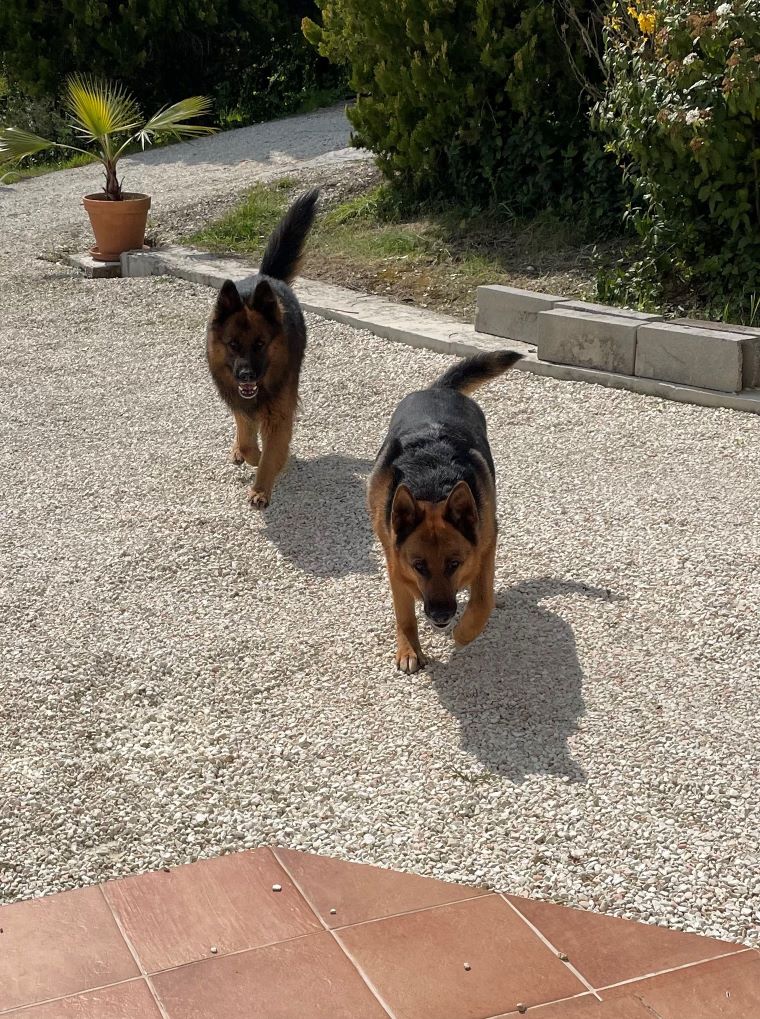
When I went back upstairs a few minutes later to get my handbag, though, I heard the same aggressive barking again. Only this time it seemed to come from in front of the house. It also seemed a lot closer. I looked out of the landing window, and there, loping menacingly around our gravel drive, were two enormous long-haired German shepherd dogs. They had presumably got into our garden (which, like many rural properties, is only fenced to the front) from the field around our property that adjoins the road. I inhaled sharply. Mr Blue-Shirt had just gone to put the shopping bags in the car and open the gate! I galloped down the stairs, across the kitchen and dining room and burst through the door into the hall – just as Mr Blue-Shirt, his eyes the size of saucers, charged in through the front door and flung it shut behind him in one rapid movement.

“Bloody hell!” he panted. “They’re huge! I tried to scare them off, but they just ran at me.”
I went over to the front door, peering through the window next to it.
“Don’t you go out there! They’re both heavier than you. If they take a run at you…”
“I’m just looking. I’m not going anywhere near them!” I said as Mr Blue-Shirt reached for the pick axe handle that lives in the umbrella stand ‘just in case’.
“You’re not going back out there, are you?”
“ We did some training with dogs in Northern Ireland. I’ll be fine.”
“That was forty years ago!” I reminded him, but it was too late. Mr Blue-Shirt had already slid back out through the door and was standing on the step, trying to scare the dogs away by swinging the sturdy length of wood towards the dogs like a golf club. The dogs weren’t for scaring, though: they charged straight at him again, scattering gravel over the step, their teeth bared and eyes blazing. Thankfully, Mr Blue-Shirt was a milli-second ahead of them and managed to leap safely back inside just as one of the dogs hurled himself at the door, his huge claws scraping frantically at the timber.
“Well, we won’t be going shopping for a while, then, will we?” I said as Mr Bue-Shirt drew a few deep breaths and let his heart rate slow.
“No. But how are we going to get rid of them?” he said.

We pondered this as we both climbed the stairs to the landing from where we had a better view of the driveway and the sliding gate onto the road – in front of which the Polizia Locale had just pulled up in their blue and white Panda, closely followed by a grubby Audi estate.
“I’ll go and see what’s going on,” said Mr Blue-Shirt heading back downstairs.
“How?!” I said, pointing at the two dogs still barking and pacing back and forth between the door and the gate.
“I’ll go out the back way and out onto the road from the field. I’ll be perfectly safe. And I’ll take the pick axe handle to keep them at bay if I need to.”
I didn’t have a chance to argue, and a couple of minutes later he appeared outside the gate, talking to the two police officers, one of whom was trying to calm the dogs and coax them over, presumably so they could capture them in some way.  You’re braver woman than me, I thought as the young female officer cooed and clicked at the obviously very defensive creatures and patted her thighs in the customary ‘Here, boy!’ manner.

When a small van drew up next to the police car and a man got out carrying what looked like some kind of tool box, I phoned Mr Blue-Shirt to ask what was going on. They weren’t going to do anything to the poor creatures, were they? No, he reassured me. The man was the on-call vet who the police had asked to come out with a chip reader. The idea was to get the dogs to come close enough for the vet to try and read any contact telephone number from any chip either of the dogs might have – their glossy coats and muscular form suggested that they were well looked after – and then get the owner to come and fetch them.

While more coaxing and coo-ing went on, I asked what the chap with the Audi was doing there. Apparently, it was him that had called the police – from inside his car where he had been trapped by the dogs for some twenty minutes, right outside his house a few hundred metres down the road from us. Even through the window on the landing I could see the deep scratches down the car door and the muddy streaks on window.
“Got to go,” said Mr Blue-Shirt suddenly. “They want my help with something.”

By now the dogs were a little calmer and had flopped down in front of the gates, just out of reach of the police officer and the vet with his chip reader. But a couple of minutes after Mr Blue-Shirt had rung off, his pick axe handle appeared through the bars of the gate with the chip-reader precariously attached to it with some kind of tape. It might have been makeshift, but it did the trick: the vet managed to get his reader close enough to the dogs’ necks to establish that they were indeed chipped, and to retrieve the owner’s contact details. For barely a quarter of an hour later, a mud-spattered 4X4 joined the other vehicles outside the gates and from it appeared a red-faced, round-bellied, balding man, at the sight of whom, the two dogs instantly jumped up, their tails wagging, in what could only be interpreted as relief. Mr Blue-Shirt slid the gate back just enough to let the dogs through, and with the smallest of gestures from their owner, they obediently hopped straight into the back of his SUV, ready to be taken home to Morrovalle, the village about 4km away from where they had escaped that morning.

There ensued a bit of argy-bargy between the owner, who, inexplicably, was already cross at having been called out in the first place, and the police officers who now wanted him to pay the vet’s call-out fee, to which he took even graver exception. He only calmed down, Mr Blue-Shirt recounted later, when the police officers pointed out that the vet would have had no choice but to destroy his dogs if they had been unable to contact him, so he should perhaps quit while he was ahead – and, while he was at it, pay for the repairs to the other chap’s Audi. Essentially, though, the drama was over, and within a few minutes everyone had gone their separate ways, which for us meant our trip to the supermarket. Now, where had I put that shopping list…?
The Beautiful South

“How do you fancy a trip to Matera while you’re with us?” I said.
We were on our regular Zoom call with Nick and Elaine a couple of months before their latest visit to what they have come to call their ‘Italian home from home’.
“Is that the city that features in the opening sequence of the new Bond movie?” asked Nick.
“The very one,” I said. “It’s right down in Italy’s instep, as it were.”
“So it’s quite a long drive,” continued Mr Blue-Shirt. “… but a really easy one as it’s straight down the motorway that runs along the coast.”
“Didn’t you manage to get snowed in there a few years ago? I remember you both raving about it all the same.”
“That’s right, a freak storm. It left us holed up in our hotel room for most of our stay. And as we didn’t get to see as much of it as we had planned, we always said we’d go back,” said Mr Blue-Shirt. “So what do you reckon?”
“Well, we’re up for it! Count us in,” said the ever-decisive Elaine.
“Excellent! Leave it with us.”
And with that, the conversation moved seamlessly on to their son’s forthcoming wedding and their elder granddaughter’s latest triumph on the football pitch.

A few weeks later, in warm spring sunshine, the four of us were whizzing down the near-empty autostrada with its unbroken views of the turquoise Adriatic Sea on our 500km journey south. This took us from verdant Le Marche through rugged Abruzzo, tiny Molise, newly trendy Puglia, and on to wild and mountainous Basilicata, in the far south of which lay our destination, the ancient city of Matera and its unique Sassi.

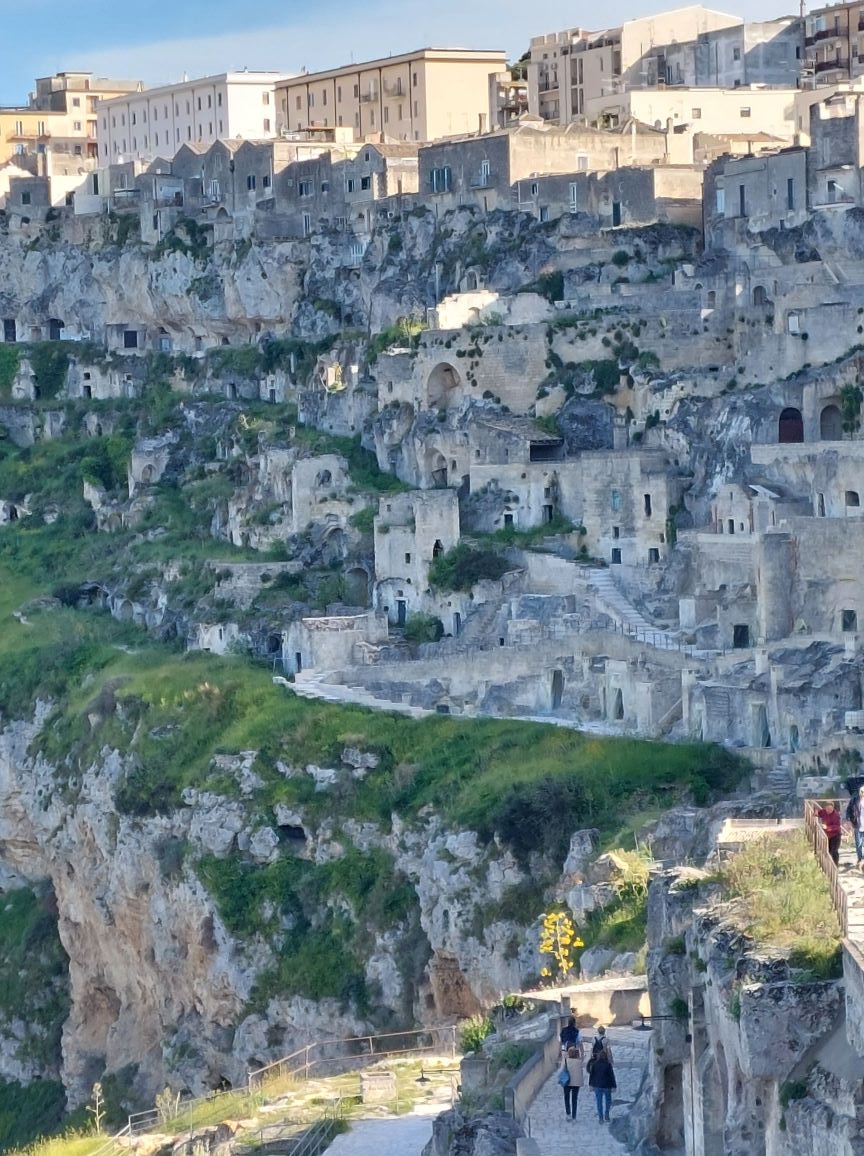
The word means ‘rocks’ or ‘stones’ and it is the name of the twin districts of the city famous for their cave dwellings, the first of which were burrowed into the sheer rock faces of the gorge that forms the city’s eastern edge getting on for ten thousand years ago, and which are still visible today. Over the succeeding millennia, ever more, ever bigger and ever more sophisticated caves and caverns were hewn from the butter-coloured limestone rock, eventually resulting in the sprawling, three-dimensional complex of houses, shops and even churches that exists today.

By the middle of the 20th century, though, the area had become characterised by extreme poverty, neglect and disease and in fact became known as La Vergogna d’Italia – the Shame of Italy. But since the 1980s, the Sassi have undergone extensive restoration, regeneration and redevelopment that have both brought the place back to life and turned it into a fascinating tourist destination featuring a mass of bars, restaurants, shops, hotels and apartments, as well as a good amount of private housing, which means the place still feels ‘real’.  Indeed, so great has the city’s renaissance been that in 1993 it became a UNESCO World Heritage Site, and in 2019 it was the European Capital of Culture.

Thanks to some intensive Googling one wet Sunday afternoon at the back end of winter, Mr Blue-Shirt had managed to find us somewhere to stay in the Sassi themselves. It is claimed that they comprise up to twelve layers of dwellings, and the apartment he had booked was located about half way down, and therefore, much like everywhere else in the Sassi, only accessible on foot. In fact, there is only one proper road that passes through the Sassi, and that is only for access, so all cars have to be left up in the modern part of the city in any event.

Fortunately, our host had told us where to park and where to enter the Sassi, and also sent us a location pin – without which it would have been almost impossible to find our accommodation, for the Sassi are such a mind-boggling tangle of serpentine alleys, steep stairways, narrow arches – as well as eye-level chimneys and floor-level rooves – that they defy any proper mapping. So with our phones in one hand and our bags in the other, we wound our way down a series of steep, cobbled lanes and staircases and finally arrived in front of a tall, narrow palazzo that appeared to be growing out of a neighbouring section of the same honey-coloured stone. And once we had mastered the hefty, complicated lock, we found ourselves in a delightful higgledy-piggledy apartment with arched, solid stone ceilings and narrow, carved stone staircase linking three different levels. Better still, the whole of the rest of the Sassi district was literally on our doorstep.

Those who like to move from one sight to another by the most efficient route possible will find the place utterly maddening, for in addition to the difficulty of mapping the Sassi, many of the alleys and lanes linking the main thoroughfares have no names either. So getting around the place is largely a matter of just following your nose and seeing where you arrive, wherever that may be, safe in the knowledge that it will still be fascinating, even if it isn’t quite the place you were aiming for, and that you will eventually find the place you were originally aiming for, even when you are no longer looking for it. That said, the key sights, such as the incredible rupestrian (cave) churches, museums and galleries are actually very well signposted. Even so, it is impossible to go very far without bumping into other visitors with similar ‘I wonder what’s round here’ expressions on their faces. Indeed, we found that much of the charm of the place was the sense of discovery it offered at every turn. But if the feeling of going round in ever decreasing circles becomes too much, there are plenty of opportunities to enjoy a cappuccino or a beer while you regain your bearings.

Well, there are in spring, when there enough visitors to give the place a buzz, but not so many it feels overrun; and when the temperatures are in that Goldilocks zone that makes sightseeing a pleasure not a sweaty ordeal. And, more importantly, means it is perfectly comfortable to sit outside for aperitivi and enjoy sight of this most remarkable of cities fade to coppery pink in the slanting rays of the setting sun…

Emanuela

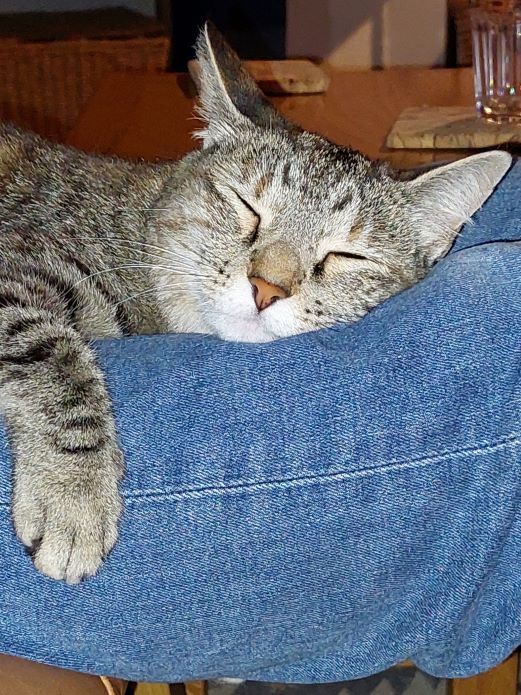
Our gentle, funny and sociable tabby cat Tilly is very possessive of her humans. They are hers and hers alone, as any other cat that we approach or that approaches us will immediately learn. Fixing the latest chancer with an unblinking, golden-eyed stare while pressing her small yet muscular form tight against one or other of us, her message is clear: “These are my humans. You can’t have them.” But Mr Blue-Shirt and I are not quite the only ones to have earned Favoured Human status with Tilly. No, there is one other person who has been awarded this title: her lovely ‘Zia (Auntie) Emanuela’ who takes care of her whenever we go away.

It took some finding her, though, as catteries are rare round here: when it comes to looking after cats, it seems people tend to rely on neighbours or relatives, neither of which we have nearby. So it was only after an extensive search conducted over several weekends and culminating in a referral to a friend of a friend of a kennel owner that we were finally directed to Emanuela, who lives on a modest smallholding tucked in the hills on the far side of the Potenza valley about 10km from our place. As soon as we drove through the sturdy metal gates and down onto the broad gravel courtyard, it was obvious that raising and caring for animals took precedence over growing fruit and vegetables. To the right of the gateway was a spacious hen coop with a large run around which pecked a selection of chickens, turkeys, geese and even a couple of guinea fowl. A row of half a dozen roomy, home-built kennels ran down the rest of the right-hand side, each with its own outside space, and each housing one or two dogs, the whole lot jumping and barking and tail-wagging as we crunched across the gravel and came to a halt in front of the squat, single-storey house. But it was only as we got out of the car that we noticed all the cats dotted about the place: on the window sill, in a wheelbarrow, under a kiddies’ trampoline, on the bonnet of a battered Fiat Panda and at least three more curled up in the shade of the hedge running along the bank to the left – all of them clean, bright-eyed and extremely well-fed.

While we were still playing spot-the-cat a small, stout figure with an enormous bosom and a rolling gait emerged through the sun-bleached curtain covering the front door, a work-hardened hand outstretched in greeting and a broad smile creasing her deeply tanned face that was framed with curly black hair flecked with silver.
Ciao, ragazzi! Benvenuti! Sono Emanuela.” – “Hi, guys! Welcome! I’m Emanuela.”
In between shushing the dogs and sending her skinny, stooped and almost toothless husband Gino off the fetch us some eggs, she pointed out the cats – “He’s Zorro – he’s nearly twelve. That little one’s Mikki. And that tabby one’s his mother, Nutella. My grandson named her, ” she explained with a throaty chuckle, her deep-set, pale blue eyes sparkling with humour. As she continued with her roll call, we knew we had struck gold: Tilly would be just fine here.

We were right. For Emanuela’s love for animals knows no bounds. In addition to the cats, dogs and poultry, all of which she rears herself, she also keeps a couple of horses and a handful of scruffy sheep as well as a transient population of waifs and strays. On one occasion this even included a pair of sleepy rescue tortoises that she excitedly insisted on showing me, grabbing me by the hand and heading off across the drive to the pen she’d erected in the field behind the kennels. Humans rate pretty highly, too, mind:  she also regularly cooks for her son and daughter-in-law who live in a matching bungalow at the rear of the plot, babysits for at least two grandchildren, and was primary carer for her mother until the latter’s dementia became too advanced even for the indefatigable Emanuela to cope with and she went into a care home, and finally also for Gino, whom Alzheimer’s reduced to a fragile shell within barely two years. The only time I have ever seen her less than fizzing with purpose and vigour was when poor Gino died quite suddenly of pneumonia earlier this year; the only time I’ve seen those sparkling blue eyes glassy with tears.

And amidst all of this, Emanuela has continued to shower Tilly with love and attention – and fill her to bursting with turkey biscuits – every time we’ve gone away. Indeed, the two of them have become such good pals that instead of putting her in one of the generous, purpose-built sheds behind the house, she has long given Tilly a room to herself inside the house and allowed her the run of the cosy bungalow in the evenings when all the other animals are shut away in their pens, eventually even letting her snuggle up on her bed at night. Oh, yes: Emanuela is definitely one of Tilly’s Favoured Humans.

I Blame The Shed

Looking back, I think I know what made me stop blogging for a while. It was clearing out the shed. Odd, I know. But let me explain…

Carrying out that most mundane, unappealing and tedious of homeowners’ jobs slightly over six years after Casa Girasole became ours (and Casa Girasole became Casa Girasole, in fact) seemed to shout ‘settled’ to me in a way that extended well beyond simply ‘time served’.  And well beyond so many other things that might be an emblem of ‘settled-ness’, like the waitress in our favourite café knowing our breakfast order by heart, the local carabinieri waving us on when performing roadside document checks, no longer needing to spell our surname in the bank, and mis-addressed post still reaching us; beyond the path Mr Blue-Shirt has worn to the woodstore, or our bedroom curtains now faded from the sun, or the myriad now well-established routines that have come to mark the passage of the year, from olive-pruning to chimney-sweeping.

No, there was something about the task that seemed to signal the end of a journey that had brought us from uncertain newcomers to established Monteluponesi; from making-do to making our house truly our home. For throughout that journey we had been adding. And as we improved, repaired, replaced and completed one element of the house or another and our forever home took shape, we steadily gathered and accumulated a huge amount of what can really only be described as ‘stuff’. And we just kept on cramming it into the large but saggy shed we inherited from the previous owners alongside all the gardening equipment it already housed.

As well as the materials the previous owners had left behind that we had thought ‘might come in useful’, there were sundry plumbing and electrical fittings from the house that we had kept for possible re-use; left over tiles, left over grout, off-cuts of timber and hundreds of recycled screws; half-finished pots of paint, a collection of paintbrushes, tubs of this and rolls of that, packets of… something, and jars of God-alone-knows-what-that-is. The result was that by early this spring I had to move a bike, a wheelbarrow and a bundle of timber (having first squeezed past the lawnmower and barked my shin – again! – on a cobweb covered rotavator) just to get at the bloody secateurs: we had clearly reached ‘peak stuff’.

There was no more we could add. The circle was complete. It was time to start throwing out. Our journey had ended. We were settled.

And with that, I suddenly felt I had nothing more to write about. All the novelty and discovery was over. The primary colours of adventure had mellowed into the pastel shades of routine, the jagged edges of alien rounded into normal.

Only over the intervening months I have realised that I was wrong. Not about all the crap in the shed, of course. That definitely had to go. Or the sense of being settled. But wrong about the adventure being over and there being nothing more to add. Maybe not much more that is tangible, but plenty more of what is intangible, like friendship, travel, people, knowledge and experiences. So that also means that there is – and always will be – plenty of bright colours and plenty for me to write about. Like visiting the cave-houses of Matera, and being held hostage by wild dogs. Or taking a ten-hour train trip through three countries, Tilly’s special friend Emanuela, and driving the Cinquino through the peaks of the Gran Sasso. And that’s just to be going on with…

Books and Covers

We see the sign every time we go down the hill to do our weekly ‘big shop’ in Trodica, an unremarkable and mainly commercial, small town just off the dual carriageway that runs down to the coast. “Caffé Pasticceria Gelateria Spreca,”it says, in large blue letters on a white background.  It sweeps across in front of us as we round the curve of the roundabout in the centre of the town and quickly disappears behind a low-rise block of flats as we take the exit that leads to the supermarket. It is almost impossible to catch even a glimpse of the café itself, though, as it is set back from the roundabout and is obscured by the cars filling the small, permanently busy car park in front of it. All that is properly visible are the flats above it on the three upper floors of the bland, 1970s building. Perhaps we’ve been spoilt, but compared to the cosy little Caffé del Teatro in Montelupone’s medieval main square with its stunning views of the Sibillini Mountains from its sun-drenched terrace, it seems distinctly uninviting and so, for a good three years, we just pass on by.

But then, in the wake of the post-Covid ‘ripartenza’ (re-start), we join a hiking group – which turns out to use this very unprepossessing-looking place as one of its regular pre-hike breakfast-cum-rendezvous points. So at about 7.30am on a bright Sunday morning in May, we finally cross the threshold, fully expecting its interior to be as unexciting as its exterior; a café that does what it says on the tin, no frills, no atmosphere, just decent coffee, passable pastries and probably a small ice-cream servery tucked in a corner. As we open the heavy, tinted glass door and step inside, though, we are greeted by the irresistible aromas of baking and freshly ground coffee, and even at this early hour, the place is bustling with life. Above the cheerful hum of conversation that fills the bright, airy space rise the vigorous hiss of the coffee machine and the constant clatter of cups on saucers – that between them just about mask the sound of our expectations shattering to pieces on the sparkly grey marble floor tiles. “Wow!” we say in unison and pause briefly to take in our surroundings.

A couple of waiters in smart black trousers and matching polo shirts move briskly among the small round tables, efficiently clearing the newly-vacated ones or elegantly delivering orders to the newly-occupied ones. We weave between them towards the illuminated glass cabinet that runs the length of the right-hand side and along the top of which are arranged tray upon tray of freshly baked pastries of every conceivable variety. Such is the concentration required to make a choice that it’s only once we have been served a maple and pecan plait (Mr Blue-Shirt) and an almond croissant (me) by the very patient woman behind the cabinet that we notice on display inside it the neat, multi-coloured rows of tiny, hand-crafted cakes, tartlets and macarons. Then beyond the patisserie and inside the furthest-most section of the cabinet, at least twenty generous stainless-steel tubs are lined up, each filled with a different flavour ice-cream, while on top, stands a pair of large glass vases containing teetering towers of homemade cones stacked inside one another. We move along to the black granite-topped counter to join the line of people waiting to order and pay and are still debating which flavours we would probably choose when our turn comes round.

Allora….” says the woman standing by the till and glances at the plates we are holding. “….due brioche….”  She taps in the code for our pastries. “E da bere…?” she asks with a smile – “And to drink?”
Un cappuccino e un caffé americano,” I reply while Mr Blue-Shirt fumbles for his wallet.
She taps in our order and hits ‘total’.
Cinque euro venticinque,” she says, handing us the receipt to give to one of the team of baristi further along the counter who are turning out coffee after coffee from the huge, state-of-the-art coffee machine with the usual practised ease combined with a good dash of flair.  
“Five Euros twenty-five!” says Mr Blue-Shirt.
“I know! That’s the same as in the village. I thought it’d be loads more,” I say. “I’ll take our pastries and bag a table while you wait for the coffees.”
I ease myself from the knot of customers enjoying their morning espresso at the counter and head on through to the far side of the café, passing a tall chiller cabinet full of gorgeous-looking made-to-order gateaux and celebration cakes on the way. I sit down at a table that looks out through patio doors onto a pretty, tree-shaded terrace that is invisible from the road, but from which I can still spot any other likely hikers from our group arriving at the counter – and from which I now see Mr Blue-Shirt approaching empty-handed.
“Someone will bring our coffees over,” says Mr Blue-Shirt, sitting down opposite me. “She insisted.”
We’re barely half-way through our still-warm pastries when a waitress appears and places our coffees before us with such a flourish, her “Prego!” could just as easily have been a ‘Ta-dah!’ then bustles off back to the bar, clearing a table and straightening some chairs on the way.
“This place is amazing,” says Mr Blue-Shirt through a mouthful of crumbs.
“I had no idea it’d be so good. I’m sure this croissant is homemade,” I say.
“It probably is. While I was still at the bar a couple of guys in chef’s toques came out from the back carrying huge trays of freshly baked bread and cakes. And I’m going to have to have another cappuccino. The coffee’s delicious.”
“Looks like it’ll have to be another time,” I say, nodding over Mr Blue-Shirt’s shoulder to where I have just spotted a tall, athletic-looking man holding a backpack and a clipboard and gesturing impatiently at gaggle of people in walking gear at the bar. We gulp down the remains of our pastries, wash them down with the last of our coffee, pick up our backpacks and hurry out through the patio doors and round to the car park. As we take our place in the convoy of cars heading off towards the distant mountains, we are still marvelling at our fantastic find and agree we’ll definitely be back soon.

And since then, we have been back – often. So often, in fact, that most of the staff now know our breakfast order by heart. And so often that we can confirm that its patisserie, gelato and aperitivi are all just as good as its coffee and pastries.  I just wish it hadn’t taken us so long to stop judging this delightful book by its unpromising cover.

La Befana

Tomorrow, Blue Monday, is the most miserable day of the year, it is said. Largely, to start with anyway, by travel companies seeking to sell us the promise of better things to come in the form of summer holidays. however, this notion since has been enthusiastically adopted by the media more generally, who would now have us all believe that finding January miserable has become not merely customary, but practically obligatory. You know the usual shtick: the Christmas decorations have been consigned to the loft for another year, the only Quality Street left rattling round at the bottom of the tin are the sickly soft centres, all you can find in the freezer is yet more leftover turkey and you’ve already made curry three times. The weather is ghastly, the credit card bills have landed, the poinsettia has turned to twigs, and as for the new year diet and ‘dry January’…

In Italy, though, we have an extra public holiday to help keep the festive vibe going for a little longer. If Christmas here traditionally starts on 8th December with the public holiday that marks feast of the Virgin of the Immaculate Conception, it equally traditionally ends on 6th January with the feast of Epiphany. This feast commemorates the visit of the Magi to the new born Holy Infant, and thus the revelation of god made flesh as Jesus Christ. That’s the official, Church position, at least. More popularly, however, this public holiday also celebrates the arrival on the Eve of Epiphany – aka Twelfth Night – of La Befana.

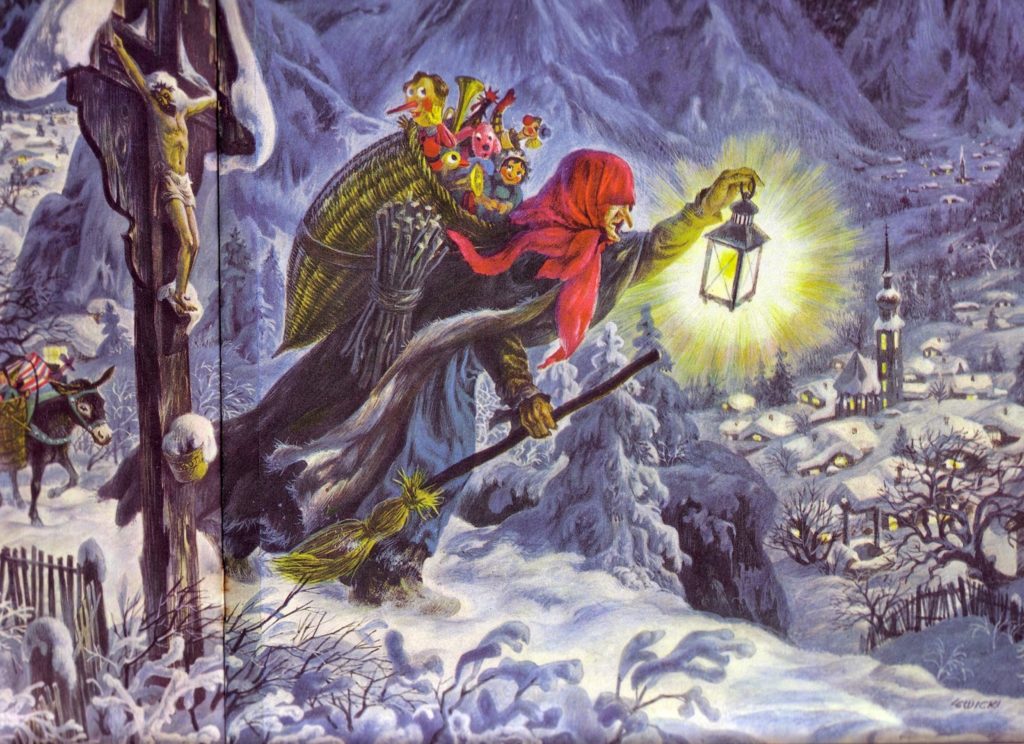
On the night before Epiphany this cheery-looking, hook-nosed hag, who in Italy is easily as popular among children as Babbo Natale (Santa Claus), rides on her broomstick from house to house, filling children’s stockings with toys, sweets and fruits – if they have been good; if the have been bad, they may receive just coal, onions or garlic. But since no child can be good all the time, every stocking nowadays normally also contains a chunk of coal in the form of black-coloured candy. Good or bad, though, if children try to catch a glimpse of La Befana when she arrives, she may give them a whack with her broomstick – although this may just be a parental ruse to try and keep over-excited children in bed.  La Befana is usually depicted wearing a black shawl and covered in soot since she enters children’s houses via the chimney. As a gesture of welcome and thanks, families usually leave her a glass of wine and a plate of tasty titbits or Christmas treats such as panettone to restore her for her onward journey. She is a well-mannered visitor and traditionally sweeps the floor with her broom before she leaves, which to some has come to symbolise sweeping away the problems of the old year.

While it was not until the twentieth century that the traditions of La Befana cameto be practised throughout Italy, her roots are thought to be in Roman festivities honouring both Strenia, the goddess of the new year, purification and wellbeing, and Janus, the god of beginnings, endings and transitions, who is usually pictured facing both backwards and forwards. These were held at the start of the year – ‘January’ is widely thought to derive from ‘Janus’ – and involved the exchange of gifts. Like many rites and customs of pagan worship, La Befana was subsequently adopted by the early Church and her origins woven into the Christian narrative relating to the birth of the Christ Child. The only thing is, the Church has never been able to settle on a single, definitive version of the legend. That said, most versions typically tell of the Magi asking La Befana for help in their search for the new born Son of God, and her regret that she does not accompany them on her journey because she has her housework to do. Which doesn’t do much for the claim that ‘cleanliness is next to godliness’. Anyway, wracked with guilt, La Befana later tries either to join the Magi in their search, or to find the baby Jesus herself, and according to one telling, takes food and gifts for the infant Christ with her, along with her trusty broom with which to help Mary keep the stable clean. Her good intentions go unrewarded, though, and so more than two thousand years later she still visits the home of every child in her continued search for the new born Messiah. In the absence of the Son of God himself, she leaves gifts for all good children, taking comfort from the belief that the Christ Child is present in all children. Another variation offers a more tragic spin and depicts La Befana as a grieving mother, who, on hearing of the birth of Jesus, sets out to find him, believing him to be her dead child. In this version, however, her search is successful and she is able to present the Christ Child with her gifts, and the gift he gives her in return is to be the mother of every child in Italy.

Although La Befana is an integral part of Epiphany celebrations everywhere, she is held in especially high regard in the post-unification regions that historically formed part of the Papal States, in particular Lazio, Umbria and Le Marche. Indeed, La Befana’s official home is in Urbania, a small town in Le Marche’s north-west corner, where the four-day Festa della Befana is held annually. These protracted festivities normally involve every conceivable variety of Befana-based activity, attracting over fifty thousand visitors every year and rising. Children can visit La Befana in her house (a permanent site within the town hall), listen to her stories, watch her knitting stockings and scarves, and leave her letters at the Befana Post Office expressing their good intentions for the forthcoming year. The town is lavishly decorated for the occasion with Befana-themed adornments including four thousand knitted stockings, and its winding, medieval streets are filled with stands offering craft demonstrations and traditional games, handmade toys and local food and drink. There are fire jugglers, street performers, dance and music as well as dressing-up competitions and gaggles of Befanas swooping among the bell towers.

And this year there was even more jollity than usual in Urbania as the traditional festivities finally returned in all their glory after a three-year, pandemic-induced absence. So we can hope that La Befana has lived up to her reputation as a super-efficient housekeeper and used an extra big broom to sweep away the problems of the Covid years to ensure that in 2023 we can again sing, dance, eat, drink and make merry together. Once the weather has improved, the turkey is finished, we’ve paid off our credit card bills and dry January is over, anyway.

Image: painting by James Lewicki from “The Golden Book of Christmas Tales”, 1956 https://italialiving.com/articles/lifestyle/the-feast-of-the-epiphany-and-celebration-of-la-befana/

Mood medicine

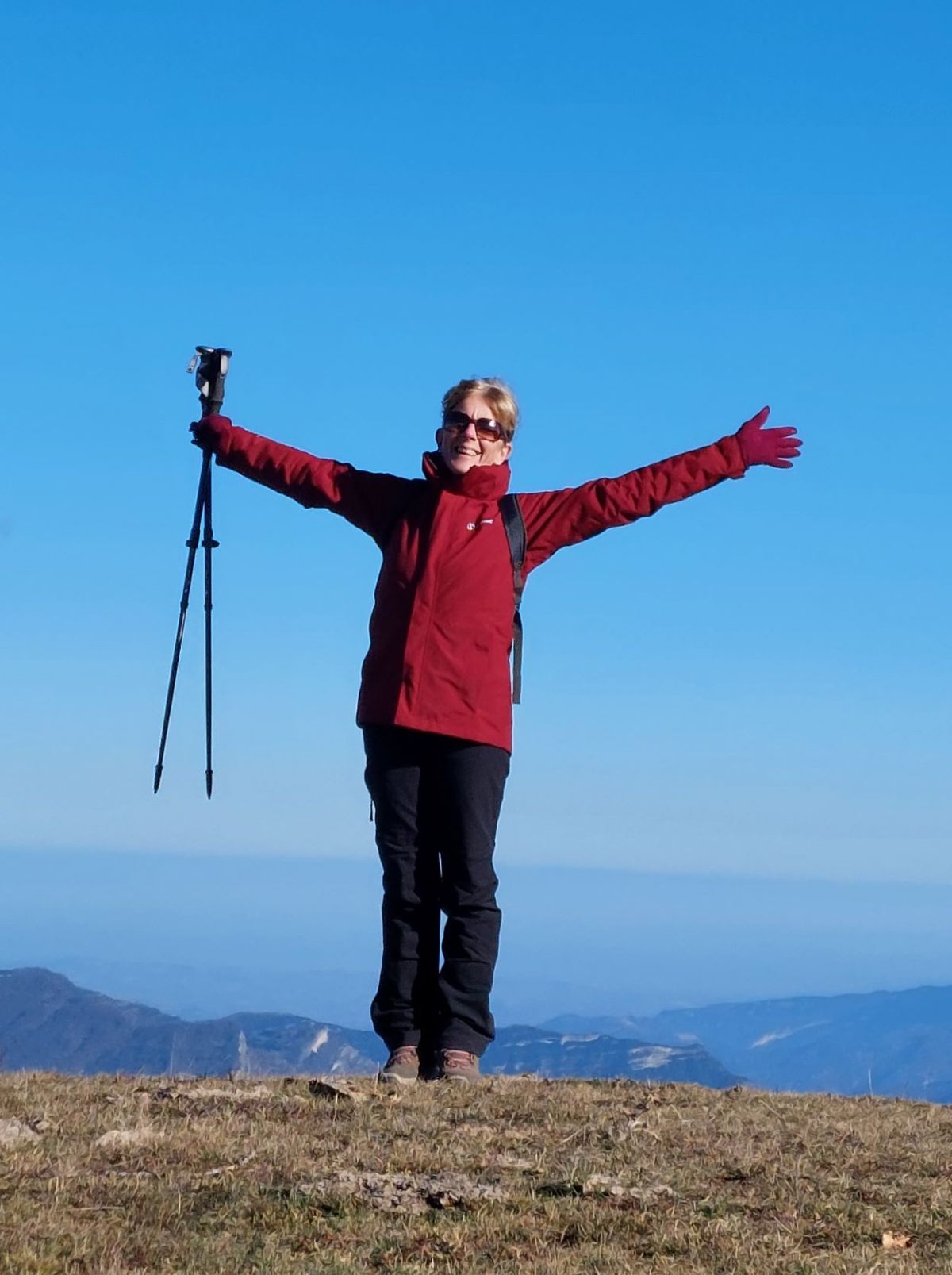
“Experiencing awe increases well-being” and “can help a person transcend themselves,” according to Psychology Today. And in that odd period between Christmas and New Year when Mr Blue-Shirt and I had yet to emerge from our turkey-and-telly-induced inertia and were feeling rather like a pair of half-deflated party balloons, we definitely felt in need of a bit of awe – all the more so since we had also spent days shrouded in persistent, joy-sapping fog. So on the one morning during the week that we woke to crystalline skies and dazzling sunshine, the choice was obvious. We would head up to Forca Canapine, the pass that lies in the heart of the Sibillini Mountains on the border between Le Marche and Umbria, for the ten-kilometre hike up to the summit of Monte Cavallo and back.  This walk, which is one of our favourites, was guaranteed both to help us work off a few of those pigs in blankets and give us a good dose of awe.

Even the drive up to the start of the walk gets the awe-meter rising. A short stretch inland along the dual carriageway swiftly carries us towards the jagged outline of the distant peaks, and as soon as we turn off and head due south, we leave the broad, fertile Val di Chienti and begin the steady climb in the mountains. Rows of dormant vines and neatly-ploughed fields that in summer are ablaze with sunflowers soon give way to emerald green pasture and swathes of oak forest, a few yellowed leaves still clinging to the trees’ winter-grey branches. Visso, at 600m above sea level, is the last settlement of any size that we pass through and although it is still known as ‘the pearl of the Sibillini’, it now evokes a different, more frightening type of awe, for this village of barely 1200 souls that nestles among steep, forest-clad hills was all-but destroyed in the powerful earthquakes that struck the area in 2016. Having navigated the makeshift one-way system around the village centre that remains entirely cordoned off, the climb continues, the road now zig-zagging up through forests of lofty conifers, their long curving branches fat with shiny green needles. Then as the conifers give way to just tussocky grass, stunted gorse bushes and thistles, our awe levels rise again as the Sibillini’s mightiest peaks finally come into view and, as usual, we let out an involuntary ‘Wow!’

We have reached Forca di Gualdo and before us lies what resembles an immense, prehistoric amphitheatre. The steep flanks of a huge ring of barren limestone peaks plunge down to the spectacular Piano Grande, the former glacial lake that is now a vast, table-flat marshy plain criss-crossed with ditches and dotted with white upland cattle. We follow the road which traverses the slopes above the plain’s western side to our regular coffee-and-loo stop in Castelluccio. This tiny, earthquake-ravaged settlement (at 1452m, it is the highest in the Sibillini) is perched above the plain on a rocky promontory and ekes a living from tourism – it bristles with walkers, bikers, pony-trekkers and paragliders for much of the year – and from the cultivation of what are, according to many, the best lentils in the world. These are grown in the fertile soils of the plain, which in summer is transformed into a magic carpet of vivid blues and purples liberally sprinkled with red poppies and yellow rape. Today, though, the entire landscape, scoured by wind and rain and snow, is a drab mix of washed-out greens, greys and browns, as currently it is only the summits of the Sibillini’s two highest peaks, Monte Vettore (2476m) and Cima del Redentore (2448m), that bear a meagre covering of snow.

From Castelluccio, we drop down onto the plain, where the road briefly becomes an arrow-straight ribbon of tarmac, before finally zig-zagging up to Forca Canapine and the start point of our walk. Even as we pull on our coats, hats and boots and shoulder our small backpacks, our awe-meter climbs again: admiring the grandeur of the stupendous landscape through the windows of a warm car engages only one sense, but being physically present in that grandeur, feeling the sun on your face, hearing the wind rushing across the plain, and tasting the toothpaste-freshness of the cold, clear air magnifies the experience several times over.

We stride out up the gravel track that meanders along a broad valley, its twists and turns at times sheltering us from the stiff breeze, at times exposing us to its chilly breath, but constantly revealing glorious new vistas. A dark, pine-filled ravine one way, a glimpse of the distant coastal lowlands the other, then rearing up before us, a precipitous ridge covered in tough grass the colour of grubby straw on which a handful of cattle graze – and all of it beneath the unseasonably benign gaze of the ever-present Monte Vettore. After about forty-five minutes, the valley opens out and on one side drops away to a broad shallow basin. We have arrived at the magical Pantani di Accumoli, a cluster of shallow, gin-clear glacial ponds that glitter like jewels in the midday sun. In summer, cattle and horses come down to drink from the cool waters, and the slightly incongruous croaking of hundreds of frogs floats on the warm breeze. Now, though, the only sound is the swish of our feet through the coarse grass as we descend to the water’s edge. But we keep our voices low and our movements gentle as even today there are a couple of horses drinking from the furthest pond and we don’t want to startle them. Our awe levels edge a little higher.

Having paused for a few minutes to watch the horses – a mare and her spring foal, we surmise – we weave between the ponds and head up the steep hill on the far side of the basin for the second half of our walk. Slightly surprisingly in view of the altitude, this takes us through a dense, windless wood populated with tall, naked beech trees, whose mossy roots look for all the world like dinosaur feet. The hush is disturbed only by the rustle of dry leaves beneath our feet and the occasional crack as one of us steps on a fallen branch. We are soon unzipping jackets and peeling off hats and gloves thanks to the long, steady ascent in the protective lee of the hillside. However, we hurriedly reverse the process as we are buffeted by the icy gusts swirling around the peaks the moment we eventually emerge from the shelter of the woods. We are now just a few hundred metres short of our destination. Onwards and upwards we plod, pushed and pulled this way and that by the blustery wind and squinting against the brilliant sunshine.

Finally we are there: 1650m up, on the summit of Monte Cavallo, beneath an infinite dome of radiant blue and with magnificent 360-degree views across the entire Sibillini range – and feeling almost literally on top of the world. As a dose of awe goes…

Celebrating Normal

No matter what you choose to watch, read or listen to at this time of year, it is all but impossible to avoid some form of ‘review of the year’. Whether it is politics (Don’t get me started!), foreign affairs (Ukraine, we weep for you), climate science (COP27 or cop-out?), sport (Football – again…) or popular culture (White Lotus or The Traitors?), there always seems to be an almost irresistible urge to look back and take stock. After the preceding two years, which both staggered to an exhausted, pandemic-scarred close, a year of turbulence-free normality was what I imagine most were hoping for in 2022. And while the very particular and frightening abnormalities that Covid placed upon us largely receded, I doubt that many would characterise 2022 as truly normal or lacking in turbulence.   However, despite all that has been going on around us, now semi-officially known as a ‘permacrisis’ (the word of 2022, by the way), Mr Blue-Shirt and I have had one hell of a year. So here, then, is a personal review of 2022…

In a nutshell, La Dolce Vita made a spectacular come-back. Well, it did once we had recovered from Covid which we both managed to catch in February. Fortunately, neither of us had it too badly, although it did take a while to get back to full strength. As soon as we were firing on all cylinders again, though, things really took off.

Definitely one of the highlights of the year was hosting no fewer than ten sets of visitors between March and October. It was a real delight to be able to share our home with so many of our friends and family once again and to introduce them to Le Marche’s many pleasures: its yummy food, its fascinating culture, its pretty towns and villages and its magnificent scenery. After all, welcoming visitors to our home had always been one of the things we had been most looking forward to in moving to Italy – and at last we were back in ‘this-is-what-we-joined-for’ mode.

In between visitors it was pretty full-on too. On the house front, Mr Blue-Shirt’s main project was the construction a proper carport, complete with tiled path down one side, newly rendered and painted retaining walls, and all topped off with a timber pergolato. But he was at last able to devote time to setting up his workshop too. After a couple of false dawns, he now has a fantastic space in the corner of a barn owned by a local framer we have become friends with. It’s only about 3km up the road and has uninterrupted views across to the Sibillini Mountains and should be fully operational in the next few weeks – there is just the small matter of a forge to build first…

With the last few Covid restrictions finally lapsing in June, all the village food festivals that are so much a feature of summer here were back in all their glory. So we took great pleasure in being able to attend Montelupone’s annual artichoke festival and its excellent Festa della Pizza, as well as a wine-tasting event and a street-food festival in neighbouring villages. On the cultural front, we finally managed to make it to the annual opera festival at the Sferisterio, Macerata’s amphitheatre-like outdoor arena, taking in not only a fabulous modern production of ‘Tosca’ while my nephew and his partner were here, but also a brilliantly bonkers production of ‘The Barber of Seville’ while some musical friends from the UK were with us. As for scenery, we enjoyed some stunning walks in the Sibillini Mountains, the most spectacular – and challenging – of which was the 10km/1000m ascent to (and corresponding descent from) the tiny and mysterious Lago di Pilato over which the Sibillini’s two highest peaks stand guard.

Something else that made 2022 a special year for us is that we both turned sixty. We marked Mr Blue-Shirt’s 60th in June with the purchase of a classic Fiat 500, a car for which we have both had a massive soft spot for years. Having had three or four very pleasant days going out for test drives, his heart was finally stolen by a gorgeous 1970 500L that he found in Bologna: teal-blue with tan interior and in terrific condition, but with just enough tinkering required to keep him happy. We transported it home in the back of the van: it fitted in (just), but Mr Blue-Shirt did have to climb out through the sunroof.  So he could play with his new toy, I organised a surprise overnight trip to a swanky B&B further down the coast near Porto San Giorgio where we also enjoyed dinner in a fancy restaurant.

In early September and halfway between our respective birthdays, we marked our joint milestone with a fantastic holiday comprising four days in Alghero on Sardinia’s north-west coast, which is stunning, and five days in Barcelona, which has long been on our ‘must see’ list and was absolutely jaw-droppingly amazing. The trip also allowed us to give our 100% electric Nissan Leaf its first long outing, as we took the overnight ferry from Rome (Civitavecchia) to Sardinia, and from Sardinia to Barcelona, and then drove all the way home via the Côte d’Azur and the Gulf of Genoa.

I have to say, though, that this trip was probably eclipsed – and I admit I am probably biased – by the incredible Magical Mystery Tour that Mr Blue-Shirt organised for my 60th in November. It involved a week in the UK and included, along with several other surprises and treats, a surprise lunch party in Exeter with every single member of my family followed by a corresponding dinner party at a cosy pub/hotel in the Cotswolds with most of our dearest friends. ‘Overwhelming’ barely does the experience justice.

After so much partying, we chose to bring the year to a close with a comfortingly normal Christmas à deux. Superficially, it may have looked very much like the preceding two, but it felt oh, so very different. Over our roast turkey and all the trimmings, we raised our glasses to toast our year together as usual, but this year, Mr Blue-Shirt and I didn’t have to grasp feverishly at the odd glint of positive within a swirling, frightening fog of negatives. For all the positives 2022 had brought us still shone brightly like jewels of joy in a glorious kaleidoscope of memories, that with just a simple shake and twist can be infinitely re-played…

A Brief Guide to Christmas in Italy

The first time we spent Christmas in Italy it came as quite a surprise to find – bearing in mind Italians’ reputation for flamboyance and passion – that it is celebrated in a relatively understated manner. Christmas remains first and foremost a religious festival, and while it is one of the church’s cheerier ones, it is still treated with a much greater degree of reverence than in UK. Consequently, it is not subject to anywhere near the same level of rampant and relentless consumerism.

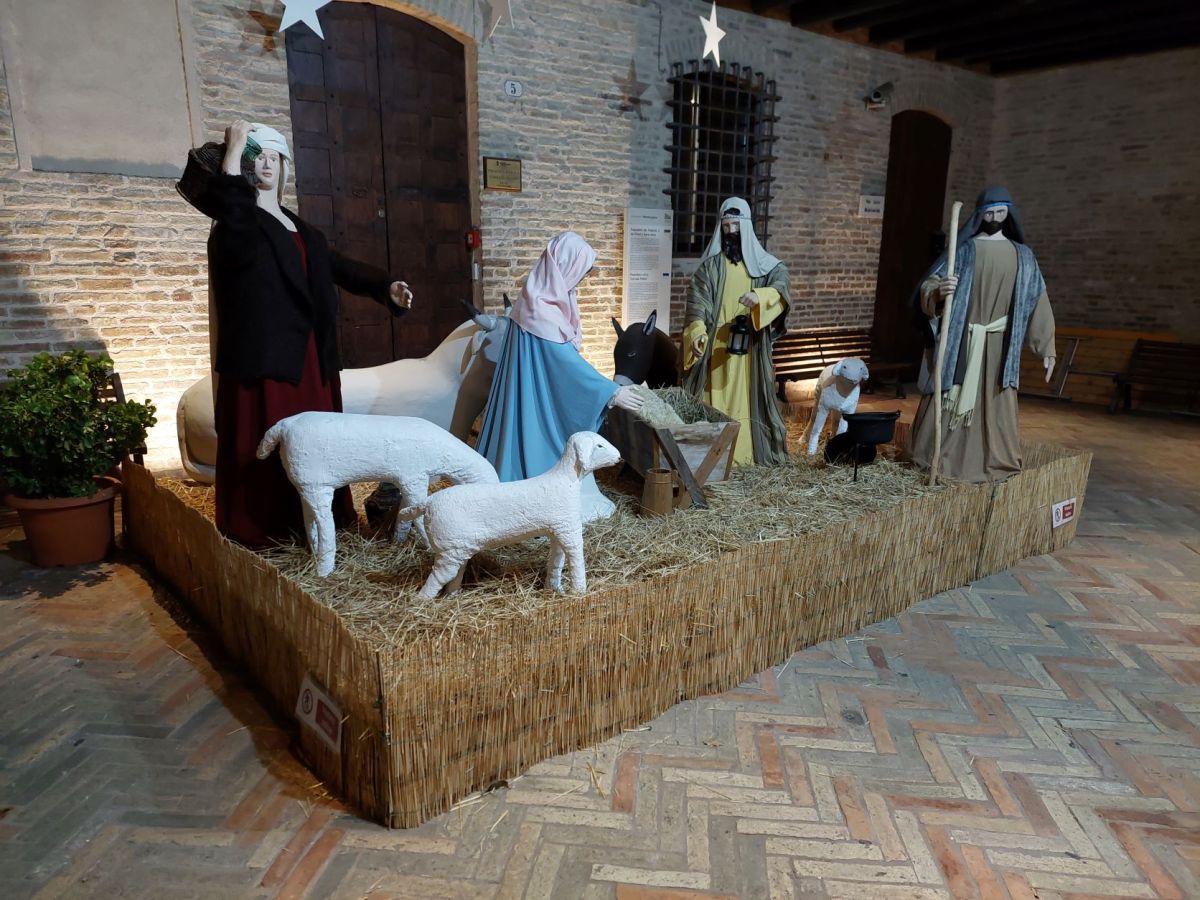
First of all, there is barely a hint of the approach of Christmas until the feast of the Immaculate Conception on 8th December, which is when most families put up their Christmas trees and decorations and when town centres formally turn on their Christmas lights . No giant inflatable snowmen and rooftop reindeer, though, nor any national-grid-dimming light displays that you can practically see from outer space. It is all very restrained and traditional with lots of pine garlands and strings of dainty fairy lights – and mostly plain, clear ones; coloured or flashing ones are still thought a little daring by some. As in the UK, Father Christmas – aka Babbo Natale – plays a leading role in festivities, but here the star of the show is very much the baby in a manger along with the rest of the cast of the nativity. Very many families will create their own nativity scene at home as part of their Christmas decorations, and most towns and villages will have a life-size one in a central piazza and starting from Santo Stefano (Boxing Day) many places put on a living nativity scene – presepe vivente – complete with ass if not ox.

This relative restraint is also apparent when it comes to Christmas shopping. People exchange gifts in Italy in much the same way as in the UK and so the shops do get much busier in December, but there is certainly no ‘shop ‘til you drop’ mentality. Shops themselves don’t seem to rely on sales over the Christmas period for their very survival, and there are almost no over-packaged, over-priced Christmas ‘gift packs’, novelty goods and jokey stocking fillers. Better still, shoppers are largely spared the dubious delights of Mariah Carey, Noddy Holder and Roy Wood played at full blast in practically every shop from November onwards – although I have heard ‘White Christmas’ and ‘Santa Baby’ rather too many times. Christmas cards are a rarity, as are advent calendars of any kind, and Christmas wrapping paper, gift tags and ribbon are still not as easy to find as in the UK, but since most shops will happily gift-wrap even the smallest purchase for you, this is seldom a problem.

This being Italy, however, what there is definitely always an abundance of is food. Attractive, cellophane-wrapped food hampers are extremely popular gifts and can even be found in most supermarkets as well as in specialist ‘foodie’ emporia. The most typical contents are lentils (a symbol of prosperity dating back to Roman times) and zampone (stuffed pig’s trotter, whose fattiness symbolises abundance), which are traditionally both served at New Year. Wine and cheese are also very popular, as are sweetmeats such as torrone, a nougat-like dessert spiked with nuts (or its Tuscan cousin, panforte) and, naturally, the omnipresent panettone. That said, pretty much anything goes, providing it feels a little bit festive and luxurious.

And then, of course, there is all the feasting, which begins in earnest on Christmas Eve (La Vigilia). The centrepiece of all meals served on the eve of religious festivals is fish as the idea is to have a giorno magro (a lean day) to prepare for the indulgence of the festival itself. That said, la cena della vigilia (Christmas Eve Dinner) is seldom that ‘lean’ as it often consists of several courses. There is, for instance, the seven-course festa dei sette pesci (feast of the seven fishes) which represent the seven sacraments. But it can also run to nine courses to represent the Trinity (squared for good measure) or twelve to represent the disciples, thirteen if you include Jesus.  There is no single, national dish, though, as Italian cuisine varies so much from region to region. In Naples, for example, salt cod fritters are very popular; in Rome, a soup of broccoli, pasta and arzilla (a type of skate) is traditional, while in Calabria, it’s spaghetti with anchovies and crispy breadcrumbs; and here in Le Marche it has to be stoccafisso all’anconetana, a hearty fish stew made with stockfish (dried cod), potatoes and tomatoes.  While Mr Blue-Shirt and I have not yet plucked up courage to attempt such an iconic dish ourselves, we do observe the fish tradition. But our hearts weren’t quite in it last year and the year before thanks to all the Covid restrictions, so we only managed fried sea bream fillets in shrimp butter. This year, though, we upped our game a bit and went for very thin spada (swordfish) steaks wrapped around a stuffing of olives, capers and anchovies and baked in a rich tomato sauce.

So after your (supposedly) lean day, it’s back to meat as the centrepiece of the Christmas Day feast.  But first, there will probably be a selection of cured meats and cheeses, and this will almost certainly be followed by at least one pasta course – and possibly several. Once again, there is no single, national dish, but pasta in brodo (pasta in broth) is a pretty ubiquitous in the north, while in the south, pasta al forno (baked in the oven) tends to prevail.  When it come to the main course, roast turkey is becoming increasingly popular, but just as common are goose, pheasant, partridge and duck, or, in Le Marche at least, a large joint of porchetta – roast pork. And again, it is quite normal to have more than one meat course.  Incomprehensible (if not heretical) though it may be to our Italian friends, we tend to give the pasta course a miss, and dive straight in with what has become our traditional main course,  an Anglo-Italian dish of our own creation that is a prosciutto-wrapped joint of turkey breast and leg rolled around a chestnut, pistacchio and sausagemeat stuffing, served with a sauce made from red wine, pancetta, olives and homegrown figs. This is accompanied by roast parsnips, which Mr Blue-Shirt smuggled back from the UK recently as they are practically unheard of here and a few Brussels sprouts for form’s sake.

As for dessert, although there is no equivalent of British-style Christmas pudding or mince pies here, dried fruit, nuts and spices in various combinations still feature strongly. Frustingo, for instance, is a Marchigian speciality made from a deliciously rich and squidgy mix of dried figs, almonds, pine nuts, raisins, chestnuts and candied peel flavoured with coffee, chocolate, rum and mosto cotto (a syrupy reduction of the leftovers of the wine-making process – and much tastier than it sounds). Probably the only truly national favourites – and two of the very few dishes that are invariably shop-bought rather than homemade – are panettone, the large, domed, brioche-like cake studded with sultanas and citrus peel, and pandoro, the slightly denser, star-shaped cake traditionally dusted with icing sugar, both of which are typically accompanied by sweet sparkling wine. We fall into the panettone camp, but tend to treat it as an alternative Christmas cake rather than as a dessert – and don’t tell our Italian friends, but we also like it toasted and spread with butter. Anyway, since neither of us is a big fan of English-style Christmas pudding either, our dessert consists of a variation on a chocolate fondant pudding laced with lots of Christmas spices and studded with chopped brandy-soaked prunes.

After two days of multi-course dining, you’d be forgiven for thinking that on Boxing Day (Santo Stefano) might be another giorno magro. Nope. As in the UK, leftovers tend to feature strongly, but in the form of completely re-worked dishes rather than just variations on cold meat. Leftover pasta, for example, is mixed with eggs and cheese to create a frittata di pasta (pasta omelette), and leftover meat is shredded and chopped and mixed into a rich tomato sauce to create a warming stew.  However, giving the chef a break and going out for lunch is just as popular on Boxing Day. When I go for a waistband-and-conscience-easing run along the seafront at Civitanova Marche as usual tomorrow, I am sure to find that most of the beachfront restaurants will have come out of hibernation especially for the festive period and that every single one of them will be crammed with groups of ten, twelve or more, all tucking in to steaming bowls of saffron-scented brodetto (fish stew), huge pans of silky pasta mixed with locally caught shellfish and platters piled high with crispy fritto misto (mixed fried fish). On Boxing Day, though, we tend to keep things strictly English so for us it will be cold turkey, pickles and, of course, lashings of yummy bubble and squeak…

Tanti auguri, buone feste – e buon appetito – a tutti!

The photo shows the life-size nativity scene in Montelupone. Note the empty crib: since the photo was taken a few days before Christmas, the Christ Child had not yet arrived.

Community Spirit

Montelupone is one of Italy’s loveliest villages. I know we’re a little biased on the matter, but this description happens to be official. Montelupone is one of 27 villages in Le Marche, and fewer than 300 nationally, that are members of the ‘Borghi più belli d’Italia’. This is the association that was founded in 2001 to promote the history, culture and individuality of small Italian towns, and whose names means ‘Italy’s Loveliest Villages’.  

To qualify for membership, historical buildings must not only predominate but also form a harmonious whole; and if a village also has a fortified castle or ramparts, then so much the better. Looks aren’t everything, though. Members must also have a strong cultural heritage and be living, breathing communities with an active village life that is celebrated with local events.

It is therefore not difficult to see why Montelupone qualified for membership. Contained within over a kilometre of defensive walls that ring the entire historical centre, access to which is gained through four imposing town gates, are four medieval churches, a small park and a war memorial around which winds a maze of cobbled streets lined with traditional, green-shuttered townhouses built in honey-coloured brick. These narrow walkways radiate out from the generous central square that is overlooked by the 14th century Palazzetto dei Priori with its distinctive castellated clock tower, and the elegant Palazzo Comunale (town hall) that also houses the exquisite little Teatro Nicola degli Angeli.

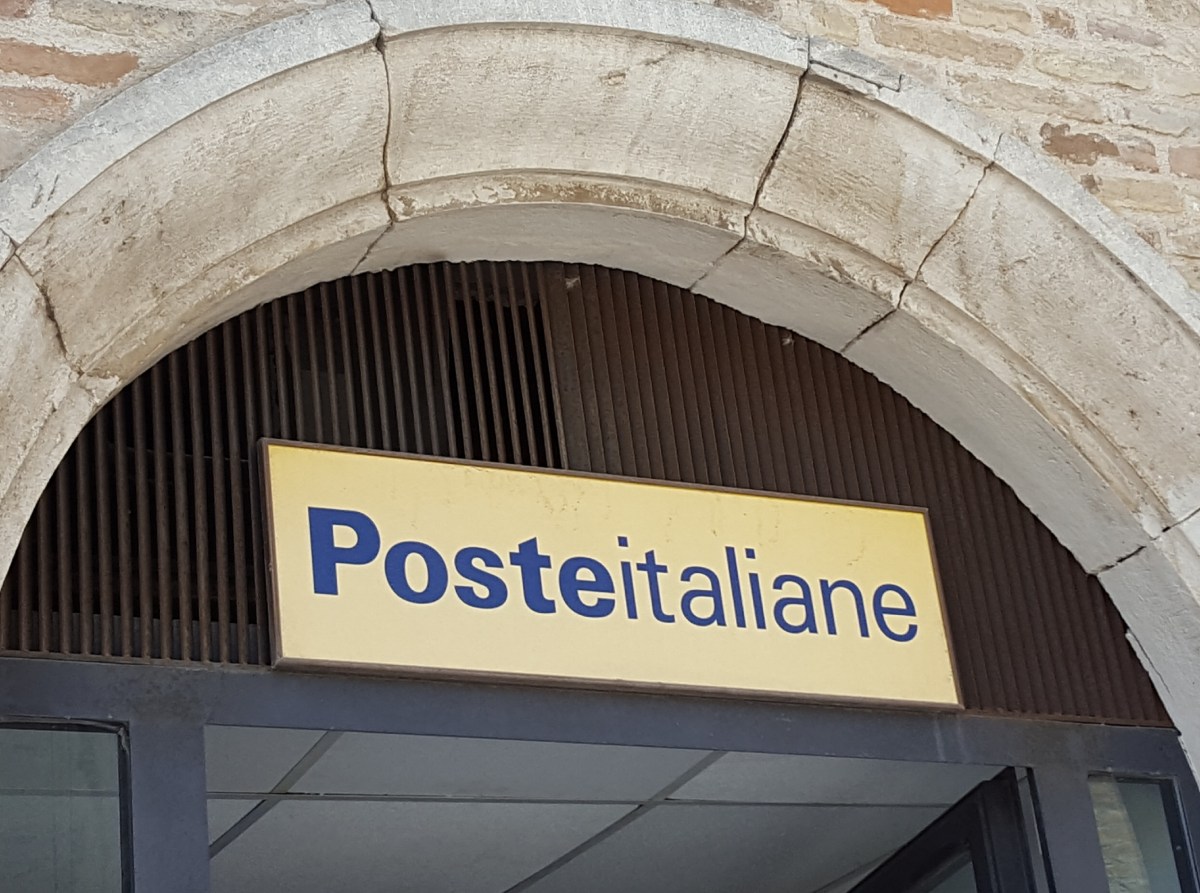
As for being a living, breathing community that celebrates it heritage, Montelupone’s annual fixtures include an artichoke festival, a pizza festival, an apiculture festival, a medieval weekend and a Christmas market, as well as a summer programme of smaller, family-orientated music, dance and sports events. And almost all of these events are organised and run by community volunteers from the not-for-profit association found in most small communities, the ‘Pro Loco’, whose purpose is the promotion of the town, its sights, history and identity. The village also offers its 3000 inhabitants a surprisingly comprehensive range of commercial and public services. These include a primary school, a doctor’s surgery and a pharmacy; a butcher, a baker, a greengrocer and a supermarket; a laundry, a newsagent, two hairdressers, two restaurants, a bar, a bank and a post office. And the last plays an unusually significant role in terms of bringing the community together – as everyone in the village seems completely united in finding the place utterly infuriating.

Located on the ground floor of a recently restored palazzo just off the main square, the modest space boasts three counters – although the middle one is completely redundant as in the five years we have been here I have never once seen it in use – largely because there are only two clerks. One is chubby and rosy with prematurely thinning dark hair while the other is skinny and sallow with curly hair and a threadbare beard. And both are expert in working glacially slowly, avoiding all eye-contact (or even smiling), and completely ignoring the growing gaggle of customers waiting to be served – with one or other of them often even carrying out non-customer-facing tasks while young parents are left trying to entertain fractious toddlers and stoical pensioners keep having to shift their weight from one stiff leg to the other.

Out of habit, we customers still dutifully tug a numbered ticket from the rickety dispenser in the foyer on arrival and still glance up at the LED display screen inside to see how far down the queue we are – only the staff haven’t bothered to turn the screen on for months (or, for that matter, replace the battery in the clock, which has stood at 21:43 for as long as I can remember). But as we then compare numbers to establish who’s ahead of who, at least we all have the chance to share in a collective moan, or maybe even ask someone to keep your place so you can pop to the café on the other side of the square for a quick cappuccino – and then offer to return the favour so someone else can go and grab an espresso. Or, now that winter is here, simply to announce that you can’t face waiting in the cold any longer. For even though all rules on capacity and social distancing have long since lapsed, our two ‘jobsworth’ postal clerks still won’t let people queue inside, so everyone is obliged to wait outside in what is probably one of the coldest streets in the village as it both faces the keen wind that blows in direct from the mountains and is in almost permanent shade.

This is exactly how things played out when I ‘nipped’ to the post office the other day, resulting in a 25-minute wait in damp, swirling fog to send a single letter to the UK: the half-dozen customers hunched against the cold, the shared grumbles, the comings and goings to the café, and the exasperated departure of a middle-aged man whose wife, judging by his responses, had obviously called to find out where the hell he’d got to as lunch was nearly ready. And rounded off, eventually, with a near-monosyllabic exchange with the chubby clerk with the thinning hair – his bearded co-worker was nowhere to be seen – whose disdain for the customers still waiting outside was all too apparent in the well-practised slowness with which he went through the (admittedly laborious) process of weighing and franking a single letter, taking my payment and giving me my change – all without once actually looking at me. I was met with rueful smiles and thankful glances as I left the fusty warmth of the interior, since my leaving meant that they were all a little bit closer to their turn. A couple of people even gave me a cheery “Ciao! Buona giornata! – Bye! Have a nice day!” as I disappeared into the fog.

Like I said, the post office has a way of bringing the community together – and consequently still helping make Montelupone One of Italy’s Loveliest Villages.