“How do you fancy a trip to Matera while you’re with us?” I said.
We were on our regular Zoom call with Nick and Elaine a couple of months before their latest visit to what they have come to call their ‘Italian home from home’.
“Is that the city that features in the opening sequence of the new Bond movie?” asked Nick.
“The very one,” I said. “It’s right down in Italy’s instep, as it were.”
“So it’s quite a long drive,” continued Mr Blue-Shirt. “… but a really easy one as it’s straight down the motorway that runs along the coast.”
“Didn’t you manage to get snowed in there a few years ago? I remember you both raving about it all the same.”
“That’s right, a freak storm. It left us holed up in our hotel room for most of our stay. And as we didn’t get to see as much of it as we had planned, we always said we’d go back,” said Mr Blue-Shirt. “So what do you reckon?”
“Well, we’re up for it! Count us in,” said the ever-decisive Elaine.
“Excellent! Leave it with us.”
And with that, the conversation moved seamlessly on to their son’s forthcoming wedding and their elder granddaughter’s latest triumph on the football pitch.
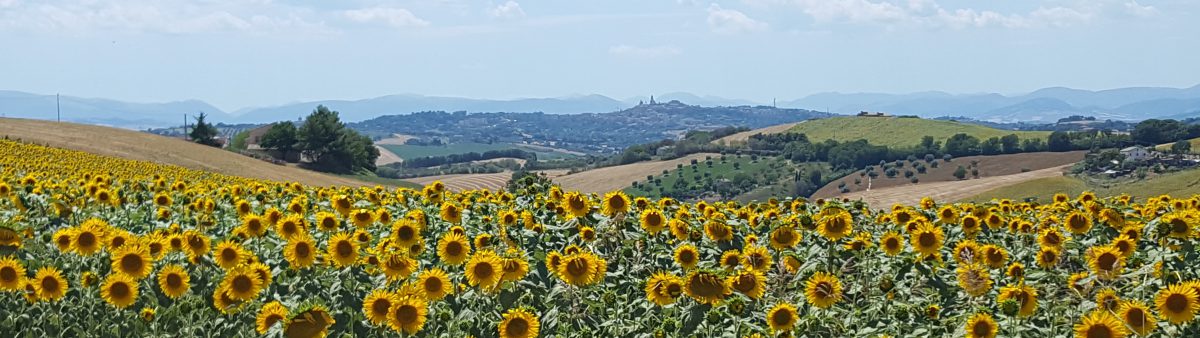
A few weeks later, in warm spring sunshine, the four of us were whizzing down the near-empty autostrada with its unbroken views of the turquoise Adriatic Sea on our 500km journey south. This took us from verdant Le Marche through rugged Abruzzo, tiny Molise, newly trendy Puglia, and on to wild and mountainous Basilicata, in the far south of which lay our destination, the ancient city of Matera and its unique Sassi.
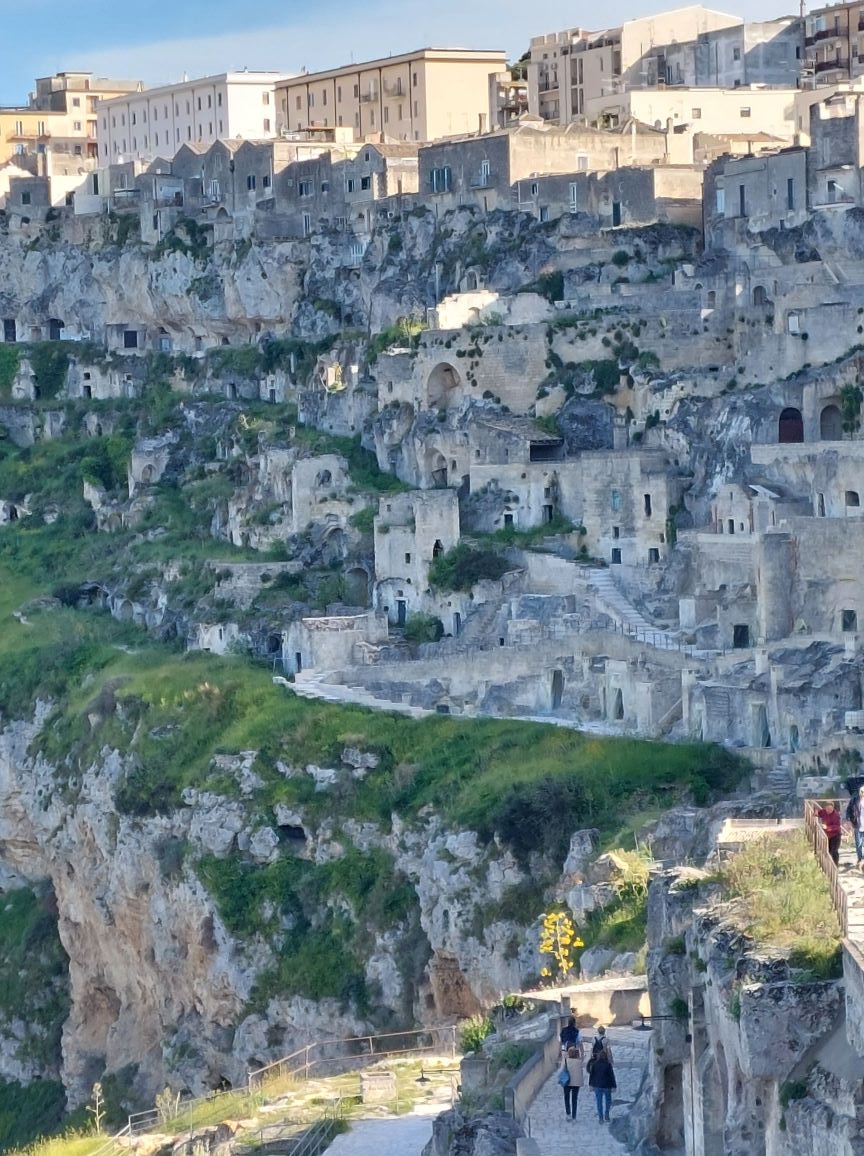
The word means ‘rocks’ or ‘stones’ and it is the name of the twin districts of the city famous for their cave dwellings, the first of which were burrowed into the sheer rock faces of the gorge that forms the city’s eastern edge getting on for ten thousand years ago, and which are still visible today. Over the succeeding millennia, ever more, ever bigger and ever more sophisticated caves and caverns were hewn from the butter-coloured limestone rock, eventually resulting in the sprawling, three-dimensional complex of houses, shops and even churches that exists today.
By the middle of the 20th century, though, the area had become characterised by extreme poverty, neglect and disease and in fact became known as La Vergogna d’Italia – the Shame of Italy. But since the 1980s, the Sassi have undergone extensive restoration, regeneration and redevelopment that have both brought the place back to life and turned it into a fascinating tourist destination featuring a mass of bars, restaurants, shops, hotels and apartments, as well as a good amount of private housing, which means the place still feels ‘real’. Indeed, so great has the city’s renaissance been that in 1993 it became a UNESCO World Heritage Site, and in 2019 it was the European Capital of Culture.
Thanks to some intensive Googling one wet Sunday afternoon at the back end of winter, Mr Blue-Shirt had managed to find us somewhere to stay in the Sassi themselves. It is claimed that they comprise up to twelve layers of dwellings, and the apartment he had booked was located about half way down, and therefore, much like everywhere else in the Sassi, only accessible on foot. In fact, there is only one proper road that passes through the Sassi, and that is only for access, so all cars have to be left up in the modern part of the city in any event.
Fortunately, our host had told us where to park and where to enter the Sassi, and also sent us a location pin – without which it would have been almost impossible to find our accommodation, for the Sassi are such a mind-boggling tangle of serpentine alleys, steep stairways, narrow arches – as well as eye-level chimneys and floor-level rooves – that they defy any proper mapping. So with our phones in one hand and our bags in the other, we wound our way down a series of steep, cobbled lanes and staircases and finally arrived in front of a tall, narrow palazzo that appeared to be growing out of a neighbouring section of the same honey-coloured stone. And once we had mastered the hefty, complicated lock, we found ourselves in a delightful higgledy-piggledy apartment with arched, solid stone ceilings and narrow, carved stone staircase linking three different levels. Better still, the whole of the rest of the Sassi district was literally on our doorstep.
Those who like to move from one sight to another by the most efficient route possible will find the place utterly maddening, for in addition to the difficulty of mapping the Sassi, many of the alleys and lanes linking the main thoroughfares have no names either. So getting around the place is largely a matter of just following your nose and seeing where you arrive, wherever that may be, safe in the knowledge that it will still be fascinating, even if it isn’t quite the place you were aiming for, and that you will eventually find the place you were originally aiming for, even when you are no longer looking for it. That said, the key sights, such as the incredible rupestrian (cave) churches, museums and galleries are actually very well signposted. Even so, it is impossible to go very far without bumping into other visitors with similar ‘I wonder what’s round here’ expressions on their faces. Indeed, we found that much of the charm of the place was the sense of discovery it offered at every turn. But if the feeling of going round in ever decreasing circles becomes too much, there are plenty of opportunities to enjoy a cappuccino or a beer while you regain your bearings.
Well, there are in spring, when there enough visitors to give the place a buzz, but not so many it feels overrun; and when the temperatures are in that Goldilocks zone that makes sightseeing a pleasure not a sweaty ordeal. And, more importantly, means it is perfectly comfortable to sit outside for aperitivi and enjoy sight of this most remarkable of cities fade to coppery pink in the slanting rays of the setting sun…
 Ms Marche