Colours, Curfews and Christmas shopping

There are three religious public holidays in Italy that do not exist in Protestant countries such as the UK. One is Epiphany on 6th January, another is the Feast of the Assumption on 15th August, and the third is the feast day of the Virgin of the Immaculate Conception on 8th December. Officially, the Immaculate Conception is one of Catholicism’s four Marian dogmas (ie it was divinely revealed) and states that Mary was born free of original sin by virtue of her role as the Mother of God.  Semi-officially, however, her feast day is also the day in Italy that signals the start of Christmas and so it is the day on which people traditionally dig out their Santa hats, untangle their fairy lights and put up their Christmas trees. And in a year when celebrations and festivities have been so very thin on the ground, the date seemed to have taken on an air of dogged hopefulness, with people defiantly filling their trolleys with extra-sparkly baubles, angels and stars, extra-abundant wreaths and garlands and supersize trees: we will enjoy some Christmas cheer somehow, however few people we can share it with, whatever the restrictions still in place.

For here in Italy, the second wave of Covid-19 infections has only just started to recede following the introduction in November of a national system of different coloured zones, each with its own set of restrictions, designed to slow, if not halt, the spread of the virus. Throughout the year, Le Marche has remained ‘mid-table’, with lower infection and fatality rates than many regions. And so it was with the second wave, meaning that we started off in the yellow zone, with few additional restrictions beyond those such as the night-time curfew and the closure of all entertainment and leisure facilities that are in place nationally. Within barely a fortnight, however, Le Marche was moved (up? down?) into the orange zone because, among other things, pressure the region’s intensive care capacity was considered to have reached a critical level. We had barely thirty-six hours’ grace before movement from one comune to another (except for proven work, study, health or other needs) was outlawed, the self-declaration document and corresponding checks were re-introduced, and all bars, restaurants and cafés were completely closed. So Mr Blue-Shirt and I were effectively back to little more than a single trip out per week to go to the supermarket – although I have to confess that we did always go the long way round just to see a bit more of the outside world and did also usually visit a couple of additional shops to make purchases of admittedly questionable necessity.

But with all the metrics beginning to go in the right direction, we were hopeful that the emergency decree due at the end of November would return us to the yellow zone. Quite apart from allowing us a degree of day-to-day normality once more, it would also be the only way we would be able to buy a tree, never mind do any Christmas shopping, for confined to our comune, we have access only to a small supermarket, a couple of bakers, a greengrocer and a pharmacy; to find any bigger shops we need to travel to Ancona, Civitanova Marche or Macerata. The regional press was full of predictions that we would indeed return to yellow, local social media pages were just as confident, and Simeone, the owner of the café in the village even started to wash down its outdoor tables in readiness for re-opening. But in the end, despite the promising numbers, the long-anticipated decree made no mention of zone changes from red to orange, nor from orange to yellow. No gesture of seasonal goodwill, no Christmas lights at the end of the tunnel. Just a complex set of further restrictions and regulations applicable to yellow as well as orange and red zones, and to cover the entire Christmas period. No movement at all from one region to another between 21st December and 6th January, no movement at all from one comune to another on Christmas Day, Boxing Day or New Year’s Day, no relaxation of the 10pm curfew – not even to allow for Midnight Mass or seeing in the New Year – but in fact an extension from 5am to 7am. Plus a long list of do’s and don’ts – but mainly don’ts – covering family get-togethers, visits to friends, overseas travel and skiing trips. It was looking as if we were set not for a white Christmas, but for an orange one.  And a fairly deep shade of orange at that.

Exactly a week later, however, all those locally whose confident predictions had seemingly turned to dust (orange dust) were finally vindicated. After several days’ heated haggling between central government and the regions, our regional president finally succeeded in securing zona gialla (yellow zone) status for Le Marche – but which he felt obliged to accompany with impassioned exhortations to be sensible, to remain vigilant, and …..well, not to put too fine a point on it, not to ‘kick the arse out of it’. The upshot of which is that we can now enjoy a coffee in the village (even though we may have to drink it outside), we can go out for Christmas drinks or even a meal (providing they are at lunchtime), we can go Christmas shopping (providing we avoid shopping centres at weekends), and since Umbria is among the handful of other regions that have also turned from orange back to yellow, we can even nip over to Spello if we want (up to 21st December, at least). Indeed, some are suggesting that it is the government’s hope (if not actual intention) that every region, even those currently in the red zone, will be in the yellow zone by mid-December.

And so it was that Mr Blue-Shirt and I were among those down in Civitanova Marche defiantly filling their trolleys with extra-sparkly baubles, angels and stars, extra-abundant wreaths and garlands and supersize trees, sharing their hopeful resolve to enjoy some Christmas cheer , and like everyone else, determined to focus on what we could do rather than what we couldn’t. We even managed to do it in time for the feast of the Immaculate Conception as tradition dictates.
When you’re in a hole….

We would count to three as we ushered first-time visitors across the hall. Then it would usually happen just before we opened the door into the main living area:
“Ooh! That looks interesting! What’s down there?”
What they had invariably noticed was the low-level brick arch at the base of a tall, narrow section of honey-coloured brick wall opposite the front door, with a flight of broad, deep stairs descending into the darkness below.
“It looks intriguing. Is it some kind of cellar?”
“Yes, kind of,” one of us would respond. “Let’s take your things up to your room, then we can show you around if you want.”

Some time later, nursing a mug of coffee or glass of wine (depending on their arrival time) our visitors would complete their brief tour of the house by following us back to the hall and down the steep brick-edged stairs into the musty gloom of the cellar. Or grotto. Or cantina. Or dungeon. For some reason, we’ve never decided what to call it this surprisingly generous, cruciform space that actually gives the impression of a tiny, subterranean chapel. I suspect we are unsure what to call it because we have never been able to use it properly, despite its modern, concrete floor and high, vaulted ceilings. For like all the best dungeons, I suppose, it leaks like a sieve, with moisture continually trickling and dripping from almost every mortar line and forming tiny glistening beads on the lattice of cobwebs that permanently garland the damp brickwork. And while all this might add to the distinctly gothic aesthetic, it renders the chilly space almost useless except for storing things made of plastic, glass or stainless steel. So it is really only a collection buckets and plant pots that lives down there along with our big olive oil flagon, a few beer crates and a couple of wine racks – although patches of grey-white mildew soon leave the labels unreadable if any bottles are left down there for longer than three or four weeks.

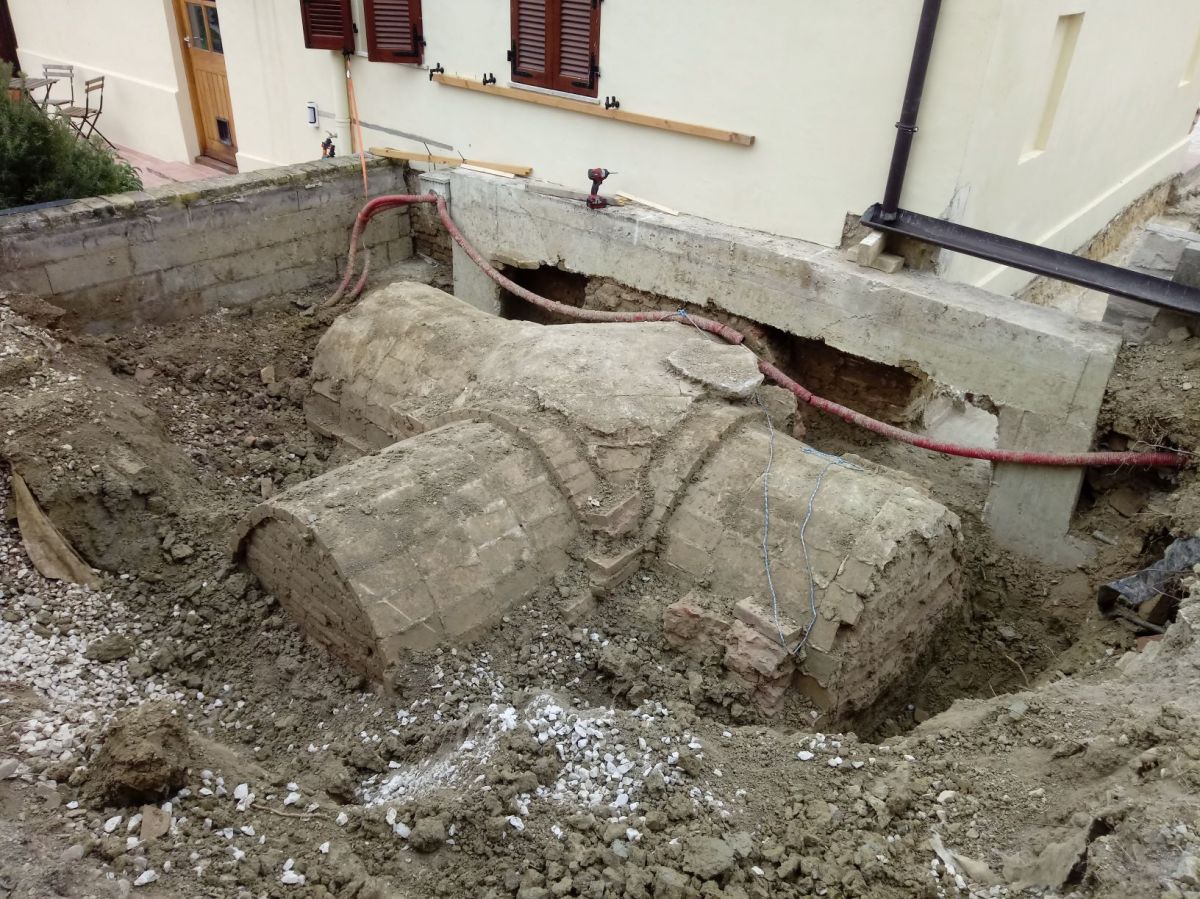
But all that is about to change. For Mr Blue-Shirt has recently got his next project, the restoration and repair (ie waterproofing) of the cellar, well underway. However, this has to be done from outside rather than inside because the whole structure extends north beyond the footprint of the house, and the moisture is in fact coming in through the tons of soil that are sitting on top of it. It has long puzzled us why anyone would have built a cellar in this way, since it seems obvious that, in the absence of modern tanking materials, it would be bound to leak. Giovanni, the chap who is handling our solar energy installation, solved the puzzle for us, though: since the house almost certainly dates from the late nineteenth century, the cellar will have been built not as a store, but as an ice house; it will have been filled with blocks of ice and used as a rudimentary refrigerator, with the thick layer of compacted soil on top of it helping keep the temperature down, and the almost inevitable moisture ingress a complete irrelevance. In the early twenty-first century, however, that moisture ingress is very definitely of relevance. Firstly, its effects deprive us of some much-needed storage space, and secondly, they are now spreading to the body of the house-proper.

To be fair, this cannot be blamed on the cellar itself, or even its original builders. No, the immediate source of the problem is the much more recent landscaping works carried out when the building was converted to a two-storey residential dwelling.  As far as we can gather from the drawings and plans we inherited when we bought the place, the land to the rear of the building must originally have sloped right down to the house. But as part of the conversion works, much of this was excavated down to the interior floor level in order to create the three-metre wide strip of flat space along the house’s north-eastern side that Mr Blue-Shirt has since turned into a proper terrace. The trouble was (and is), the cellar is not completely below ground: the four arms of its arched roof protrude some sixty centimetres above floor level at the north-western end of the building. So after the soil had been removed to allow for the impressively solid anti-seismic concrete bracing to be installed, the whole area was filled back in, covered with a further twenty centimetres of soil and topped with a layer of concrete to create an elevated flat area on top of the cellar. But crucially, no tanking works were carried out at all, meaning that a mass of heavy clay soil a metre deep was packed directly up against the outside wall of the house. And then to make matters worse, the poor-quality concrete surface on this elevated area was not that flat after all, but sloped towards the house. This all too efficiently funnelled ever more moisture into that compacted clay – and eventually through the sixty-centimetre-thick outside wall and into the house, leaving the inside surface permanently mottled with khaki-coloured mould.

So the upshot of all this is that the rough concrete outer surface has had to be scraped away and the tonnes of soggy soil dug out – but at least this has given Mr Blue-Shirt the opportunity to hire his beloved digger again. Clouds and silver linings, and all that. The only thing is, the complicated outline of the cellar and the depth to which it is necessary to dig have meant that he has had to do a depressing proportion of the work by hand, with pick axe, mattock, shovel, wheelbarrow – and a very great deal of sheer brute force. And thanks to the density and weight of what is actually more wet mud than soil, Mr Blue-Shirt has had to apply his trademark engineering ingenuity to rig up a makeshift mini-crane, electric winch and sling to lift the full barrows out of the alarmingly deep crater that has appeared around the hump-backed brick structure of the cellar. All of which gives the area more the look of an archaeological dig than a building site.

Of course, this is only phase one of the project. Once Mr Blue-Shirt has reached floor level of the cellar, he can then set about adding some foundations and cladding everything in a layer of reinforced concrete before wrapping it all in a waterproof membrane. And while he is doing all this, we can think about how best to re-landscape the whole area given that, while the cellar will need to be re-buried, we will want to minimise the amount of soil that will still need to be in contact with the outer wall of the house – even with the necessary tanking in place this time. And that will just leave re-pointing all the brickwork, waterproofing the floor and sorting out all the electrics and plumbing for the washing machine and a second freezer.

Well, it’s one way to get through lockdown.

The Greening of Casa Girasole

To leave the house via our front door we currently have to pick our way through a jumble of large, odd-shaped cardboard boxes that almost fill our otherwise spacious hall. While Christmas might be barely a month away, they have nothing to do with the fast-approaching festive season, however.  No, these are the key building blocks in Mr Blue-Shirt’s most transformative and technically ambitious project to date: the installation of a comprehensive renewable energy system that will enable us to generate enough of our own solar power to make us almost completely independent of the mains electricity supply.

The project has, in effect, come about as a direct consequence of Covid-19. During the summer the government launched a wide-ranging programme of initiatives aimed at kick-starting Italy’s lockdown-weakened economy, and as part of this it started offering fifty to sixty percent discounts on domestic renewable energy installations. Mr Blue-Shirt had always hoped we might be able to install a few solar hot water panels on our south-facing roof to supplement our traditional energy sources, but these aggressive discounts have suddenly brought something a lot more comprehensive within our reach. And working on the principle that, faced with the challenges of a changing climate, whatever we can do, we surely should do, he also feels that the investment represents a responsible use of his inheritance from his parents.  

As soon as the scheme was announced, he set about contacting three or four local suppliers for information and prices, but soon settled on a small, well-established business down in Trodica run by the slightly chaotic yet extremely knowledgeable Giovanni with whom he immediately hit it off. During the summer, he and Mr Blue-Shirt exchanged countless emails and drawings and Giovanni made so many visits to the house to measure this, inspect that or check the other that he soon gave up announcing his arrival at the front door with the customary “permesso?” but, while Mr Blue-Shirt trotted upstairs to scoop up all his own paperwork from his desk, simply gave me a wave and made his way round to the terrace where he spread out his paperwork on the table.

And there he and Mr Blue-Shirt would sit beneath the shade of a large parasol, poring over drawings, tables and catalogues before heading off to poke about in the boiler room and plod up and down stairs, discussing fixing points, fuse boxes, cable conduits and central heating manifolds in a surprisingly effective mixture of Giovanni’s very rusty, secondary school English and Mr Blue-Shirt’s vastly improved, evening class Italian. Over the weeks a specification evolved that both Giovanni and Mr Blue-Shirt were happy with and a detailed quotation soon followed. But before we had had a chance to go through the twenty-page document in any detail, Giovanni asked if he could pop round again as he wanted to make some changes to his proposal.

It turned out that the government had added further options to their incentive programme and, better still, had made it possible to claim the available discounts at the point of purchase rather than having to pay in full in the first instance and then claim the discounts through the tax system – a huge plus, given its famously labyrinthine and sclerotic workings. Giovanni had also decided to propose a different battery system that was even more efficient, but that was also a different shape and size from the one he had originally proposed. So this time he and Mr Blue-Shirt also spent ages in the hall deciding which would be the most practical yet least conspicuous place to mount the batteries – which turned out to be hidden in the large cupboard next to the front door – and working out all the corresponding cabling and ducting requirements.

A week later, Giovanni returned to go through his revised quotation including the updated discounts, to make one last tour of the house in order to finalise the location of each of the elements – and to announce that we now needed a new boiler too. Since our existing boiler was barely two years old, we both winced at this unanticipated addition to the specification. But Giovanni hastily reassured us that this would not affect the price at all as it was covered by the funding scheme, and also pointed out that it would ensure the boiler’s compatibility with other elements of the new system.  The boiler aside, however, we were at last there; he’d even been to the planning office in the village to obtain the relevant piece of paper, all signed and stamped, that formally gave the project the green light.

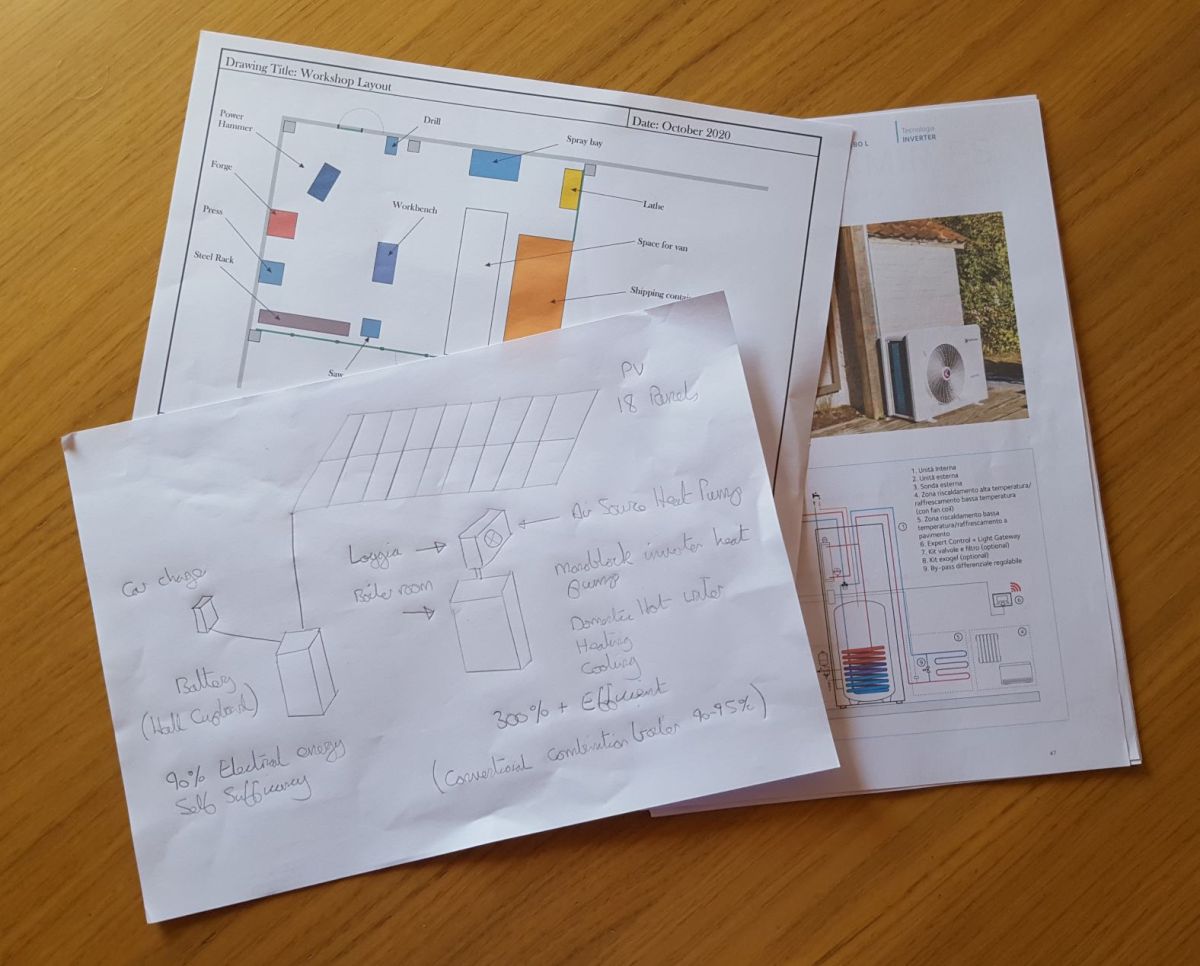
So at the heart of our all-singing, all-dancing solar energy installation is, naturally, a set of eighteen slimline photo-voltaic panels that will be mounted on the south elevation of the roof. These will charge the stack of lithium batteries housed in the cupboard in the hall that will be connected the power supply via the main fuse box. An air source heat pump installed in the upstairs porch will take heat from the outside air and feed it into the heating system by means of a mono-block inverter heat pump (No, I don’t know either; in fact, neither does Mr Blue-Shirt). This mysterious box of tricks will be installed in the boiler room together with the new boiler that will act as a back-up-cum-top-up, and is what will actually provide our hot water, heating, and also cooling thanks to three new cooling units, one installed in the guest room, one in our bedroom and one in the sitting room. Finally, there will be a bit of future-proofing in the form a car charging point in the carport, and the whole lot will be stitched together with several hundred metres of tubing, ducting, cables and conduits.

All we need now is Giovanni’s team of assorted fitters to come and install everything. But as if we needed any reminder of the catalyst for this project, one or two of them are still working on jobs delayed by the virus, and another couple are waiting for their quarantine periods to end. So much like everything else this year, we find ourselves once again in the lap of the Covid-19 gods…

It’s a small world

It is almost a cliché these days to say, thanks to our globalised economy, globalised communications, globalised logistics and globalised travel, that our world has shrunk. And now, thanks to a global pandemic, it has shrunk much more literally than most would have anticipated and anyone would have wished. Our world certainly shrunk a little further last week.

For barely a week, Le Marche had been one of the ten regions in the country in the newly created yellow zone, with few restrictions in addition to those put in place nationally at the start of the month as part of the latest regime of measures to combat the second, tsunami-like wave of Covid 19 infections spreading across the country. Although bars and restaurants had to close at 6pm, all leisure and entertainment venues were shut, secondary schools and universities had to go back online, and a night-time curfew had been introduced, life did otherwise seem to continue largely as normal – or what had been re-defined as normal since the first lockdown was lifted in early June. People still went to work, ran errands, did the shopping, took the kids to school (if they were primary school age, at least), went to Mass, went out for lunch and visited family. True, the daily number of new cases was much higher than during the first wave, but according to the other twenty criteria used by the government to decide which regions should be in which zone, Le Marche was still considered – within context – at low risk.

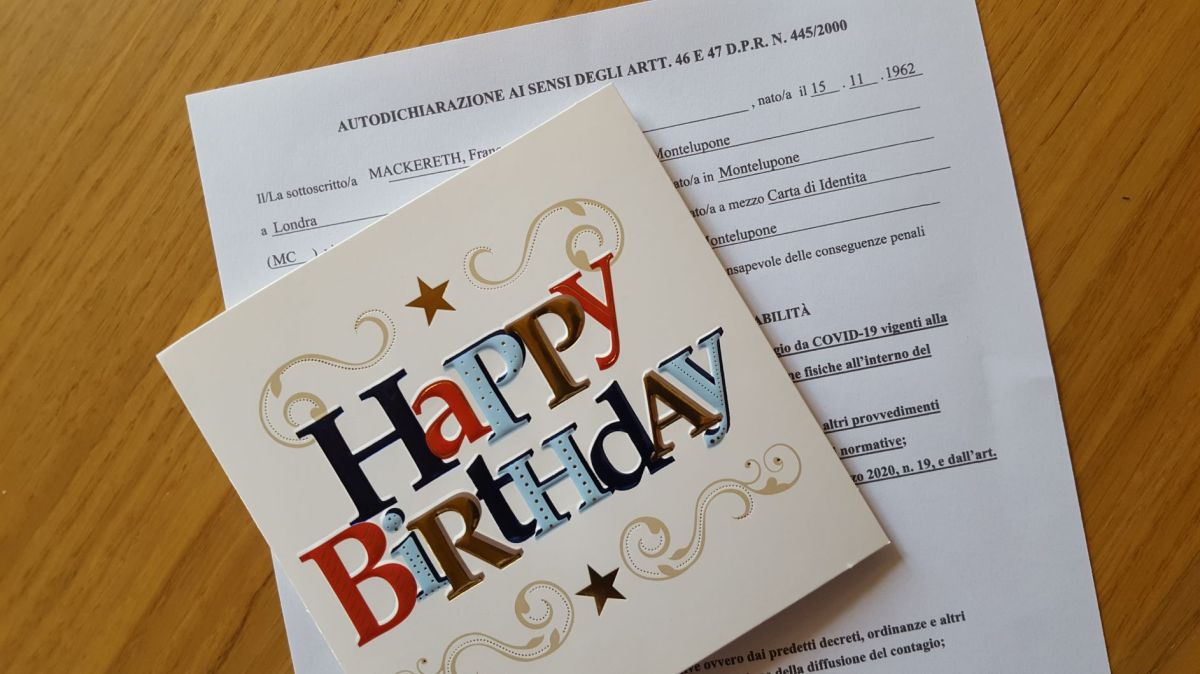
All that changed at the end of last week – on Friday 13th, in fact – when it was announced not only that Campania and Tuscany would move into the red zone, but that, along with neighbouring Emilia-Romagna and Friuli-Venezia Giulia in the far north-east, Le Marche would move into the orange zone. The catalyst for this was, in part, the relentless rise in new cases across our relatively sparsely populated and largely city-less region. These days, the virus feels much closer and more insidious, and there can be few people left who don’t know someone who has had to quarantine or who has tested positive. Alarming though that rise was becoming, however, it was the proportion of those new cases that were also symptomatic and the corresponding pressure that this risked putting on intensive care capacity that was of greater concern to the authorities. So for the Marchigiani this unwelcome ‘upgrade’ from yellow to orange would mean a total, 24/7, 7/7 closure of all bars and restaurants (takeaway and delivery services excepted) and a ban on movement not only from one region to another, but from one comune to another, except for proven work, study or health reasons and other needs. And of course, the word ‘proven’ means that the self-declaration document would be back (albeit a much more straightforward version of the form we were required to use for every outing the first time around) along with the accompanying document checks by the Carabinieri and increased fines for infractions.

The new restrictions came into force two days later, on a dank and chilly Sunday when, as if to underline the newly narrowed confines of our world, both the mountains and the sea were lost behind a thick curtain of drizzle-laden mist that left even the village hidden from view.  It also happened to be my birthday. Having seen the direction in which things were moving – and how fast – Mr Blue-Shirt had already cancelled the dinner, bed and breakfast birthday treat in Umbria he had arranged some weeks earlier. But now even the hastily substituted birthday breakfast in the village and a short trip up to the Cònero peninsular for a long walk along the beach and a slap-up fish lunch in Numana were off, so our own kitchen and dining room were swiftly pressed into service as the best restaurant in town. We used Saturday to dash around supermarkets in Trodica, Sambucheto and Civitanova Marche for ingredients for a birthday meal – all of which Mr Blue-Shirt naturally insisted on cooking – I dusted off the china and glassware we normally only use for Christmas and we agreed we would still dress up as if going out for dinner. Despite the busy-ness and bustle, however, it was hard not to feel slightly miserable and a little hard-done-by. But within the dense November gloom, I did my best to find some perspective and remember how many hundreds of thousands of other people will have spent their birthdays, anniversaries or engagements in lockdown too. And thanks to phone calls, video calls, messages and greetings from family and friends across two continents, I realised that our world had not shrunk quite so much after all. My birthday dinner was delicious too.

Liquid summer

As usual, we had been um-ing and ah-ing about when to start for a good couple of weeks, keeping an eye on what our neighbours were doing as a signal for when would be the right time. Over the preceding few days one of us would come in and report that “Maurizio and Flavia have started.” Or “There were stacks of crates outside the place with the goats.” Or “They’ve got their nets out next door to the bakery on the way to the village.”

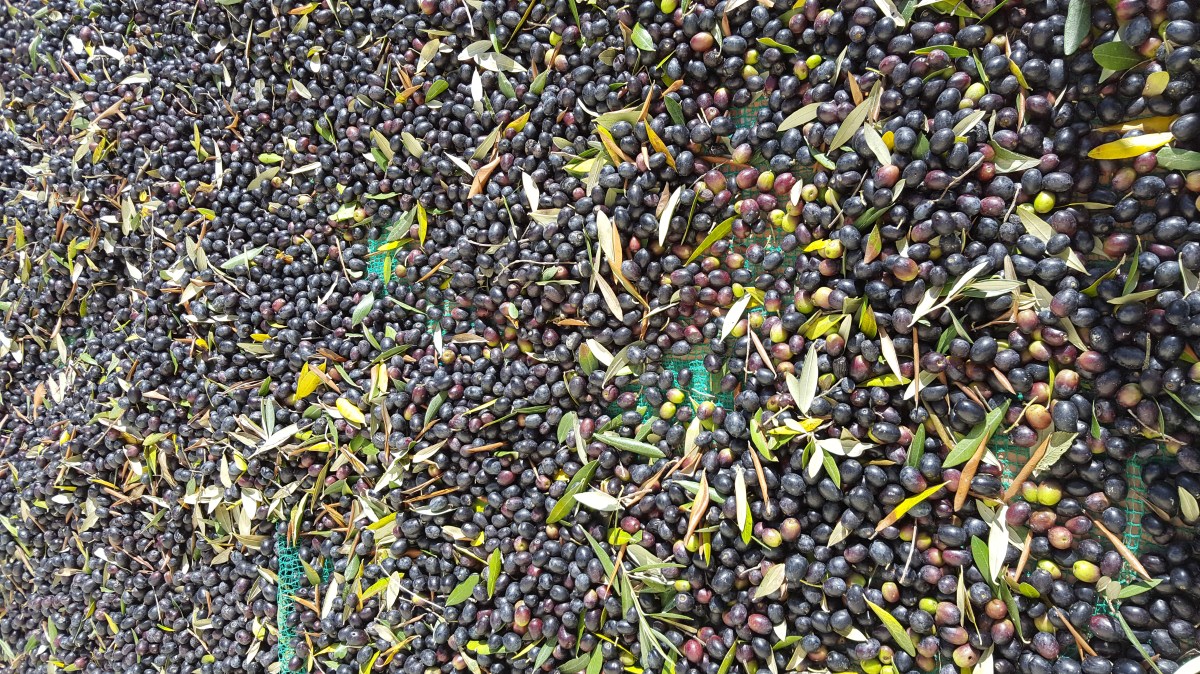
Our olive crop had been steadily ripening beneath the mellow sun of our long and langourous Indian summer as it slowly faded into autumn. The plump bright green fruit had gradually softened to a murky violet, then darkened to purple, and now to glossy black: thousands of little black beads shining in the sun like fairy lights made of jet. The trees that Mr Blue-Shirt had given a vigorous pruning back in January hadn’t fruited this year, of course, but there was so much fruit on the rest that from the house we could see it twinkling among the branches. So we were cautiously confident we’d have another good crop, especially as we hadn’t suffered any of the bad storms that typically mark the shift from summer to autumn and that can easily strip most of the fruit from the trees. But as ever, exactly when to harvest these little black jewels was a matter of judgement, and as ever, we had decided to take our lead from what other people were doing – hence the daily reports on what our neighbours were up to.

So it was the next available weekend that Mr Blue-Shirt retrieved the bright green nets, orange rakes and maroon crates from the shed  – and also (Mr Blue-Shirt being Mr Blue-Shirt) two chainsaws, the leaf-blower, the battery-powered secateurs, the pole shears, the bolt-croppers, the long-reach ladder, and the star of the show, his beloved abbacchiatoro elettrico. This car-battery-powered device consists of a telescopic pole on the end of which is a pair of lightly interlocking rakes that jiggle back and forth like a pair of rapidly clapping hands and tease the olives from the tree as you pass them along the branches. What these go-to gadgets lack in romance they more than make up for in efficiency, and the sound of their mechanical chatter drifting across the olive groves forms autumn’s background music.

Our confidence had been justified: at the end of three days’ non-stop raking, jiggling, snipping, sawing and gathering, five and a bit crates brimming with shiny black and purple fruit stood in neat rows on the floor of the van. Mr Blue-Shirt wiped his olive-stained hands on his muddy trousers and picked a few stray twigs from his fleece.
“Job’s a good-un,” he declared and stretched contentedly.
“It’s about twenty-five kilos per crate, isn’t?” I asked, rolling my work-stiffened neck and shoulders back and forth.
“Yep, so we must have a good hundred and twenty-five kilos there. Let’s get down to Rodolfo’s and weigh them in.”
We slammed the van doors shut, clambered into the cab and trundled off through the gathering dusk, down the hill to the oleificio we use to get our olives pressed. This is a small yet impressive set-up in the corner of a sprawling and immaculately kept olive farm down a lane on the way to Macerata. We had found it two years earlier by following the recommendation of our neighbour Enrico and the signs off the main road to Morrovalle, the next village from us.

“Spot on! A hundred and twenty-five point two kilos” confirmed Mr Blue-Shirt, reading the display on the industrial scales by the door to the pressing shed.
“We don’t know what the yield will be like, though,” I cautioned “At the end of the day, it’s all about how much oil we get. And after such a dry summer, we may not get such a good yield as last year”.
“Well, all will be revealed tomorrow: the chap who weighed our crop just said they’re really busy, so they won’t be able to press our fruit today. But let’s take a quick look in the shed. You didn’t get to see the whole pressing process last year, did you?”  

Ever the engineer, Mr Blue-Shirt has never lost his fascination for all things mechanical and is still drawn to practically any kind of machinery like a moth to a flame, so last year he had eagerly accepted Rodolfo’s invitation to go and watch the entire process from weighing the fruit in to picking up our flagon of oil.  As we stood in the doorway of the shed that was little larger than a domestic double garage, but that was teeming with activity, he talked me through the same process that a couple of leathery-faced old codgers had explained to him the year before.

“Right, so once it’s been weighed, the olives get tipped into that,” bellowed Mr Blue-Shirt above all the clanking and whirring, and pointed to the large steel hopper behind me. “They drop down through a stream of air that blows away all the twigs and leaves and so on.”
“We got rid of lots of leaves and twigs, though.”
“We picked out what we could, but there’s still loads of debris in there that you don’t want to end up in the oil.”
“So where do they go next then?” I asked, peering into the shed where three or four workers wheeled, shoved and carried different pieces of equipment back and forth.
“Well, they land in another hopper – See? Down there? –  which feeds them onto that belt.” He pointed towards a small conveyor belt that disappeared into the shed where it dropped the fruit into a large round tray.
“Look! This bit is great. They still use these huge rotating stone wheels to crush the whole olives into a sludgey paste. All this modern technology everywhere…” He gestured expansively around the shed … “…but it’s effectively the same technique they’ve used for centuries. I love it!”
“If it ain’t broke, don’t fix it, I suppose.”
“Exactly. And that bit’s just a modern take on ancient technology, too.” This time he indicated the large Archimedes screw that was feeding the black-ish goo up to the next machine. A precision-engineered, stainless steel one, admittedly, but an Archimedes screw all the same. Then, once the black paste had wound its way up through the screw, it was fed through the slot-shaped nozzle of the next machine which spread a generous layer of paste onto a circular mat made of stainless-steel mesh.

“OK, you can see that when the mat is fully covered, one of those blokes lifts it off, puts on a fresh one, and threads the full one over that pole mounted on a trolley.” I watched the fluid and practised movements of the young man who was obviously Rodolfo’s son. “They keep adding mats until they have a stack about 1.5 metres high.”
“I’m pretty sure the mats date back centuries too. Carol Drinkwater mentions them in her books about the history of olives. Only they were made of straw or something originally, I think. Anyway, what happens next?”
“Right, then they wheel the trolleys into the press on the left there, which slowly pushes down on top of the stack of mats.”
“I’m a bit disappointed it’s not one of those old things with a great big comedy wing-nut on top you sometimes see in farmyards”
“No, proper hi-tech this time: hydraulic. Four hundred kilos of pressure per centimetre squared,” he declared in full nerd-mode. I rolled my eyes.
“Only you would know something like that!”
“Last year one of the old codgers showed me the pressure gauge,” he grinned. “Apparently, it takes a good half hour to press all the oil out. It just trickles down the sides into that big steel tank down there in the floor.”
I peered down into what looked like a vat of used motor oil.
“Yuk! It looks revolting!”
“Yes, there are still quite a lot of crushed up solids in there– pulp, skin, bits of pip and so on. From that tank the oil is pumped into a centrifuge – that big cylinder there in the corner – to separate all the gunk from the oil. I think the chap said it spins at something like seven thousand revolutions per minute.”
“And so that’s the finished oil coming out of the centrifuge from that spout?” I asked, pointing at the glossy, yellow-green stream pouring into the flagon that had been positioned below the spout.
“Yup! And that’s it, done!”
“It must have been so satisfying to see our oil pouring into our flagon last year!”
“It was! I was dying to taste it, but you can see it’s still a bit cloudy, so it needs to settle for a couple of days.”

“So go on, tell me: how much have we got, then?” I asked as Mr Blue-Shirt heaved our freshly-filled flagon from the back of the car and down into the cantina.
“Twenty-five litres!” said Mr Blue-Shirt smiling broadly.
“Wow! That’s much more than I expected! I’m sure we had closer to two hundred kilos of fruit last year and only got a few more litres than that.”
“Yeah, thirty litres, I think. But I reckon we picked a week or so later this year, so the fruit was probably a bit riper. Rodolfo certainly thinks it’s a good yield. And he says the quality is high too: apparently, all those weeks of hot, dry sunny weather will give the oil a richer and more intense flavour. ”
 “So quality as well as quantity this year! Can we have a look?”

Down in the musty gloom of the cellar Mr Blue-Shirt unscrewed the lid of the flagon and shone a torch in through its wide neck. The beam illuminated the fragrant greeny-gold oil that nearly filled the flagon and I inhaled deeply, savouring the distinctive grassy, peppery aroma. I swear I could practically feel the sunshine and hear the crickets. It was not just oil; not just Casa Girasole oil. It was liquid summer…

As expected

Andrà tutto bene” – “All shall be well”. It was the national rallying cry that helped see the country through the earliest, darkest days of lockdown back in spring; those days when it was the unknown that everyone feared as much as the invisible viral enemy and its relentless march from one region to the next. It stiffened people’s resolve and lifted their spirits; it helped people pull together and reminded us all that this too shall pass. Invariably decorated with cheery rainbows, it was Scotch-taped to windows, pinned on doors and sprayed onto bedsheets that hung from balconies. Eight months on and the posters and bedsheets are still there, a little sagging and frayed and rather faded now, but still holding fast – just. And it is much the same with the Italian population as we enter Lockdown Version 2.

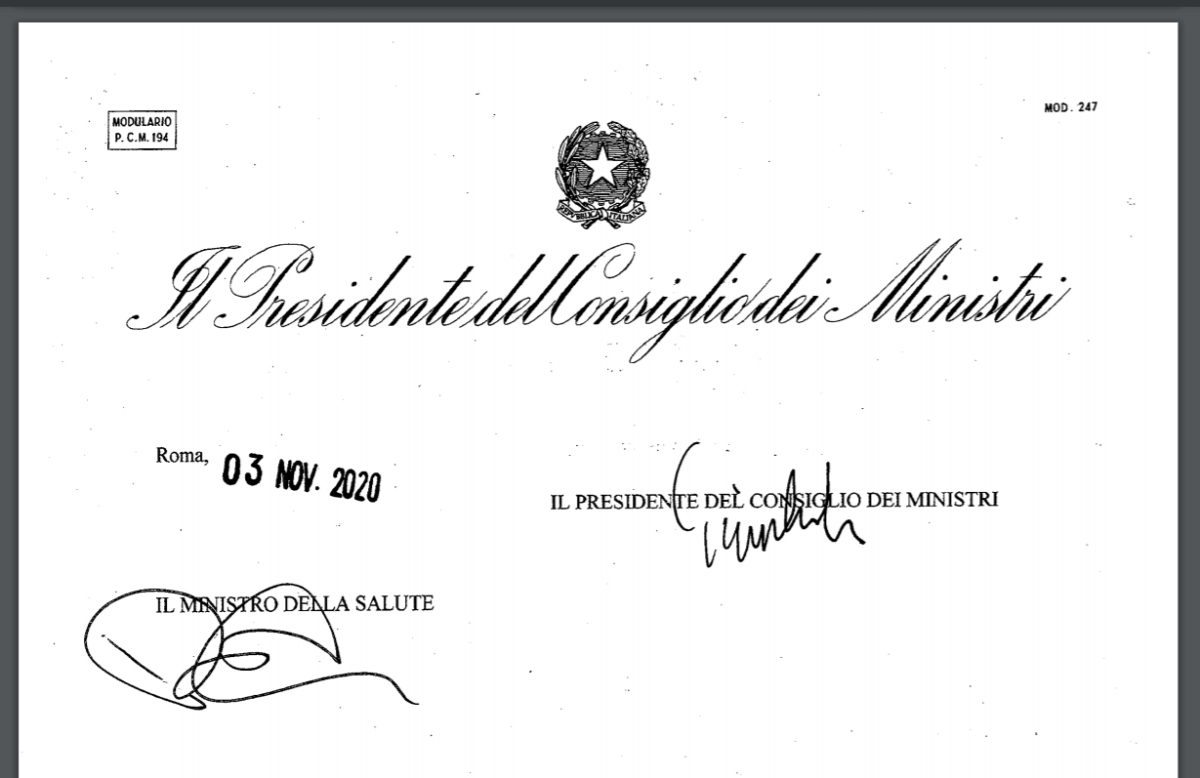
It came as no real surprise this week that following the continued almost exponential rise in new Covid infections, the regime of measures which was announced in late October that sought to balance economic, public health and social needs would swiftly be superseded by something much more robust. But Prime Minister Conte and his cabinet still shied away from imposing another total national lockdown like that in spring which confined everyone from the Alps to Etna in their home municipalities for almost three months. For this time round, with the people’s goodwill, resolve and savings long since exhausted, the mood of national solidarity and consensus is much more fragile. Added to which, the government has also been faced with twenty regional leaders who during the first lockdown were largely excluded from the decision-making process and left powerless to respond with local measures to local conditions and local needs. So this time it adopted a more consultative and collaborative approach, and after several days’ painstaking negotiations, the result is a much more nuanced response.

In addition to the measures announced the previous week that included the closure of all entertainment and leisure venues, the banning of amateur sports activities other than individual exercise, the closure of all restaurants, bars, cafés, patisseries and ice-cream parlours after 6.00pm, and a recommendation that at least seventy-five percent of secondary and tertiary teaching move back online, a month-long nationwide curfew from 10pm to 5am has also been put in place (other than for proven work, study or health reasons). Then a list of twenty-one criteria has been used to allocate each region to one of three zones: red, orange and yellow (green was abandoned at the last minute for fear of sending the wrong message). As well as the daily number of new infections, these criteria include the R-value, the percentage of intensive care beds occupied, the daily testing rate plus the percentage of positives, the time between symptoms and diagnosis, and the size and number of local ‘hot-spots’.

For the eleven regions in the yellow zone – of which Le Marche is one – the only further restrictions are online learning for one hundred percent of secondary and tertiary students, and the closure of all amusement arcades and betting facilities. For those in the orange zone (Puglia and Sicily) there is also a ban on movement (other than for proven work, study or health reasons) within and between regions and the complete closure of all bars and restaurants. Then for those in the red zone (Lombardy, Piemonte and Val d’Aosta in the far north and Calabria in the far south), there is a ban on movement (other than for proven work, study or health reasons) beyond one’s home municipality, all shops selling non-essential goods are closed, and another tier of schools has had to go online.  While these restrictions are undoubtedly severe, especially in the red zone, they are still not as severe as in the first lockdown, however, principally because in all three zones, factories and businesses can remain open, albeit with as much smart working from home as possible.

Then as for devolved powers, regional governments have been granted decision-making powers relating to their specific economic circumstances. Thus, inland regions can, for instance, issue rules relating to hunting licences, coastal regions can issue rules relating to fishing, and alpine regions can, presumably, issued rules relating to ski resorts. More importantly, however, regional governments have been given a voice in the corridors of power in Rome and so can more easily make their case for additional resources from central government to mitigate some of the economic impact of these new measures, and to help ensure that the civil unrest that is already a problem in some large cities can be avoided – and that the fragile yet vital national consensus can be preserved.  Time will tell whether Conte has got it right…

Carrots and Sticks

‘If we take these steps now, we will increase our chances of enjoying a peaceful Christmas together’. This was the way Prime Minister Conte chose at the start of this week to sell his government’s latest emergency decree to a weary and restive people, dismayed by the frighteningly rapid increase in the numbers of new Covid-19 cases. As recently as July and early August, numbers were in the low hundreds per day; only about sixty people were in intensive care nationally and daily fatalities were in the teens. Apart from the ubiquitous masks and hand sanitiser and the absence of hugs and handshakes, life felt almost normal. The sun shone, the sea was warm, the beaches full, restaurants busy, families and friends gathered. And as a nation, we lowered our guard.

The small but steady rise in numbers that first became apparent in mid-August was put down to people returning from trips to countries with higher infection rates than Italy and so measures such as compulsory testing within forty-eight hours of arrival were swiftly put in place [https://wordpress.com/post/lemarche.life/533]. It was just a summer blip, we all told ourselves: as soon as the holiday season was over, numbers would fall again. After all, the comprehensive contact-tracing and quarantine regime was working well. Added to which, everyone was desperate to take the final and possibly most precarious step in the return to normality and get students back to school and university after six months out of the classroom. It had been just as much of a political hot potato in Italy as it had been in the UK and elsewhere, but a reasonably workable set of safety measures and protocols was finally thrashed out. So at the start of term, fleets of yellow school buses could once again be seen trundling about the lanes, picking up and dropping off gaggles of apprehensive yet excited youngsters, all delighted to be back together with their classmates at last.

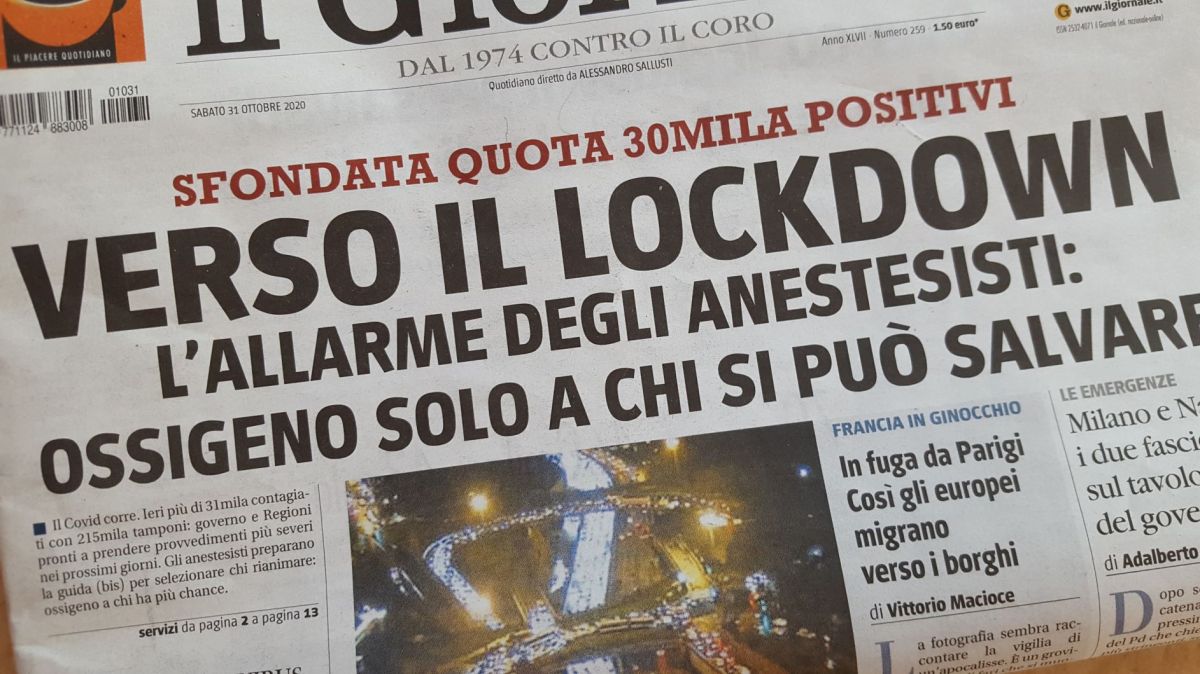
The thing is, it wasn’t a blip; the numbers didn’t fall. In fact, they continued to grow, and then to grow more quickly. Within the course of a month, numbers were back in the thousands and getting ever closer to where they had been when the country went into the first and strictest lockdown in Europe. Surely it couldn’t happen again? Not another lockdown; we couldn’t go through that again. That same thought circled round the mind of the nation; it was voiced in conversations muffled by masks, which did little, however, to hide that same fear etched in people’s faces. The government shared the sentiment and recognised the mood: a national lockdown was repeatedly ruled out. They knew that neither the fragile economy nor the people, whose goodwill, resolve and savings had been all but exhausted, would be able to bear it. And shaken by victories for far-right parties in a recent series of regional elections, they also knew that the political stakes had seldom been higher. But the government could not do nothing, so little by little, as if testing the water, restrictions started to be tweaked a little tighter. The wearing of masks outside as well as inside became obligatory, and in the regions with the most alarming infection rates such as Campania and in Lombardia (where the virus had first taken hold) a range of non-essential businesses could open only with restricted hours – and in some cases, not at all – and night-time curfews were announced. In major cities from Turin to Palermo, bitter frustration erupted into violent demonstrations, while in other towns up and down the country opposition to the new restrictions was more muted, but no less heartfelt. Still the numbers rose, though, almost doubling by the week and by now far higher than they had been back in spring, with the much slower rise in intensive care admissions and in fatalities providing scant, albeit welcome comfort.

So it was against this backdrop that Prime Minister Conte once more addressed a tense and fearful nation and announced a month-long closure of all entertainment and leisure venues, the banning of amateur sports activities other than individual exercise, the closure of all restaurants, bars, cafés, patisseries and ice-cream parlours after 6.00pm, and a recommendation that at least seventy-five percent of secondary and tertiary teaching move back online. And in light of data indicating that intra-family transmissions account for up to three-quarters of all new infections, he finished with an impassioned plea to show restraint and responsibility when it came to that most culturally and socially significant of Italian activities, the large, family get-together for Sunday lunch.

That was at the start of the week; by the end of the week, however, the infection rate seemed to be spiralling out of control, with numbers now exceeding even those featuring in policymakers’ worst-case scenarios. So the nation is now bracing itself for a much bigger stick and a much longer wait for that promised carrot.

The agony of choice

So after more than a year of ultimately fruitless exploring, browsing, asking and searching for a workshop to use as a forge, Mr Blue-Shirt suddenly has two apparently viable options to consider. While both of them would, on paper, give him practically everything he needs, neither, on paper, seem quite what Mr Blue-Shirt originally had in mind. But he is doing his best not to let the perfect be the enemy of the good while trying to work out which, if either, might turn out to be good enough.

Option one – chronologically anyway – is about twelve miles away (already a minus) in a former furniture factory that has been empty for about three years. The site, which is down at the coast just outside Porto Potenza Picena, has recently been taken over by Mr Blue-Shirt’s chum Antonio who runs the shipping company that transported Mr-Blue-Shirt’s container over from Lincolnshire and in whose goods yard it has stood since its arrival in April last year. Having inspected the entire site, which consists of three or four spacious sheds, an office building and several large areas of hardstanding, they have decided that the best area to set up a forge is a corner of the seven-hundred and fifty square metre warehouse in the far corner of the site. Once cleared of three years of detritus and pigeon droppings, this would offer Mr Blue-Shirt more than enough space for all his forging equipment while still leaving a huge area for an industrial tenant to use – always supposing any such potential tenant would be prepared to share the space with a blacksmith, of course. And since his space could at best only be screened off from the rest of warehouse, he would also have to make sure that his shinier tools weren’t at risk of going walkabout. That said, he could use his shipping container for lockable storage since the full height sliding double doors to his end of the warehouse would allow it to be craned into the space, which offers a flat concrete floor, mains power (although possibly only single phase), high ceilings and lots of natural light as well as a generous area of covered of hardstanding outside. Moreover, with a broad, deep ditch to the rear, two-metre high link fencing around the rest of the site and an imposing pair of gates providing access from the main coast road, Mr Blue-Shirt has few concerns regarding security – something that remains high on his list of priorities having had every single one of his tools stolen the first time we were burgled a couple of years ago.

Option two, meanwhile, is one of two unoccupied workshops at the premises of Giovanni, the chap who owns the firm doing our solar energy installation, and (a big plus) is only about six miles away in Trodica, a largely commercial suburb just off the dual carriageway that runs between Umbria and the Adriatic coast. The larger of the two spaces is at the rear of the site and has all the essentials, including the all-important three-phase power supply essential for running his power hammer, welder and hydraulic press. However, one wall of the simple, square building has a large and vigorous bush growing through it, the small extension containing a washroom seems to be parting company from the main building, and, strangely, has a suspended ceiling of the type found in large office buildings. It is also currently chock-full of what looks like several tonnes of redundant heating and air-conditioning equipment from Giovanni’s business. But then again, it is a good, square shape, is completely self-contained and easy to secure. The smaller of the two, on the other hand, is in much better condition, is already completely empty and also has all the necessary facilities (but minus the three-phase power supply). However, it is a rather strange L-shape and is located right next door to Giovanni’s showroom and directly beneath an apartment, so in Mr Blue-Shirt’s view noise could be a bit of a stumbling block, even though Giovanni has already dismissed these concerns. The site is surrounded one three sides by other commercial and residential premises and the heavy, sliding gate opens onto a well-lit, reasonably busy road, so Mr Blue-Shirt’s security concerns are minimal.

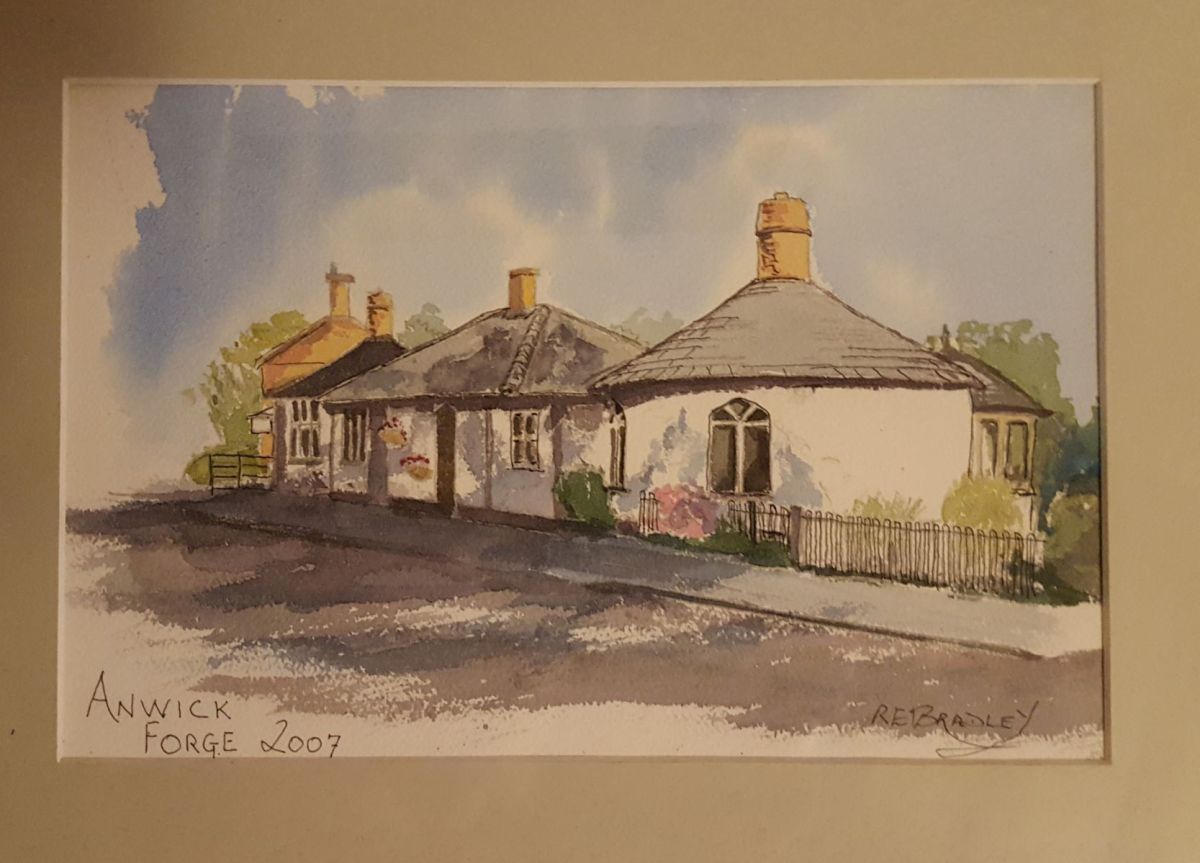
And yet…. Well, they just don’t make Mr Blue-Shirt’s blacksmithing heart sing. Our two-hundred-year old circular forge with its twin conical rooves was designed by John Nash and oozed charm and character from every smoke-stained brick; a hollow had been worn in the floor between the hearth and the anvil where successive smiths had worked hot metal, while their callused hands had worn shiny the handles of the tongs hanging on the racks that still lined the curved walls. Our office had spent the first century and a half of its life as an open-fronted shoeing shed, and Jim from next door would still lean over the stable door to reminisce about pumping the bellows when he was a lad and earning a penny or two from ‘Old Tom’. So I suspect he simply finds these brutally utilitarian spaces rather sterile and uninspiring. In his mind’s eye he had envisaged something cosier and much more bucolic; something, perhaps, with far-reaching views across the rolling Marchigian hills to the soaring Sibillini mountains that he could contemplate while waiting for his metal to come up to forging temperature; somewhere he could even offer tourists and visitors hands-on forging sessions. But although he has reluctantly concluded that such a place, should it exist at all, is either already occupied, not for sale, or for sale only at a price that exceeds his budget by at least a factor of five, he is not finding it easy to relinquish his vision. And after more than thirty years together, I know all too well that if Mr Blue-Shirt has set his heart on something, then…

Like waiting for a bus

We’ve had several meetings with Giovanni. On each occasion he and Mr Blue-Shirt have sat poring over drawings, tables and catalogues, spent ages poking about in the boiler room and repeatedly plodded up and down stairs, pondering fuse boxes, cable conduits and central heating manifolds. It’s all part of Mr Blue-Shirt’s latest project: to take advantage of the fifty to sixty percent discounts on green energy installations currently being offered by the government as part of their post-lockdown economic stimulus package. Mr Blue-Shirt had always hoped we might be able to install a few solar hot water panels on our south facing roof to supplement our traditional energy sources, but these aggressive discounts have suddenly brought something a lot more comprehensive within our reach.

Over the course of these meetings, which have involved Giovanni explaining how different permutations of the different systems available worked, and how the discount scheme applied to each, he became aware of Mr Blue-Shirt’s engineering knowledge, and having seen some of the work that Mr Blue-Shirt had done on the house, increasingly impressed by his practical capabilities.
“So what was your job in England?” he asked during an early meeting after Mr Blue-shirt had shown him some ‘before and after’ photos of the house. “Were you a builder?”
“No, I’m a blacksmith.”
“Ah, interesting. Not many of those left now… Anyway, these slimline PV panels each weigh about…” and the conversation returned to air-source heat pumps, inverters, batteries and cables.

The next time Giovanni came over it was to talk us through his quote, which once again involved wandering around the house, discussing where to put the various pieces of equipment. Keen to be involved as possible in the project, Mr Blue-Shirt would interject every now and then to point out that he would be able to drill the holes for this or that cable, box in a control unit or make support brackets for the battery, most of which Giovanni responded to with jokey comments about hitting things with a hammer, making everything from metal or covering it with metal grilles. All very well-meaning, but slightly wearisome nonetheless, so when they had returned to the table on the terrace to run through their findings, Mr Blue-Shirt took his phone from his pocket, tapped on his photo gallery and showed Giovanni images of some of the pieces of work he and our team had produced while we were running the forge. He scrolled through the pieces of funky public art, (‘Che bello!’) the stainless steel military memorials mounted on marble, (‘Wow!‘) the classical balustrades and staircases for posh London townhouses(‘Fantastico!’), the matching pairs of driveway gates with wildlife scenes for a former hunting lodge (‘Mamma mia!’) and the huge, angular planters and pergola for a gold-medal winning show garden at Chelsea Flower Show ‘(Incredibile!’). Whatever Giovanni had imagined Mr Blue-Shirt made, it clearly wasn’t this.

A couple of weeks later, Giovanni asked if he could pop round again as he wanted to make some changes to his proposal. It turned out that the government had added further options to their incentive programme and had made it easier to access the discount scheme which seemed most suited to our type of house (old and not terribly well insulated). He had also decided to propose a different battery system which was more efficient, but which was a different shape and size from the one he had originally proposed. So this time he and Mr-Bule-Shirt spent ages in the hall, assessing which would be the best place to mount the battery and investigating different cabling and ducting options. Having final decided on the most practical yet least conspicuous position (hidden in the cupboard next to the front door), we were just agreeing a time for him to come back with his revised quote when he casually asked if Mr Blue-Shirt was planning to continue his blacksmithing here.
“Yes, definitely. But for the last eighteen months I’ve had all my forging equipment in a container in Porto Potenza Picena: I’m still looking for a workshop – although I’ve got the offer of one near where the container is stored which I’m still thinking about.”
Giovanni just cocked an eyebrow and nodded. “Ciao, ciao,” he said, bumping elbows with each of us. “Ci vediamo la settimana prossima.”

And the following week, Giovanni duly returned to go through his revised quotation and all the discounts, and to make one last tour of the house in order to finalise the location of all the necessary components.  After all the weeks of to-ing and fro-ing it seemed that we were at last there: the number and type of panels (18, PV), all the tubing and cabling, the inverter (in the boiler room), air source heat pump (in the upstairs porch), battery (in the cupboard in the hall), two cooling/heating units (in the guest room and our bedroom), and car charging point (in the carport). And he’d even got the green light for the project from the planning office in the village. The only thing left was to see some of these pieces of equipment – the more visible ones in particular – in the flesh. So Giovanni invited us to visit his showroom that weekend, and – sensing that the deal was by now all but done – invited us out to lunch at his favourite fish restaurant on the seafront in Civitanova Marche.
“OK, I’ll book a table at ‘Il Gabbiano’ then, and we can go on there once we’ve finished at the showroom. And while we’re there, I could show you a couple of empty workshops I’ve got that you could use for your forge – if you’re interested, that is….”

So after more than a year of ultimately fruitless exploring, browsing, asking and searching, Mr Blue-Shirt suddenly had two apparently viable options to consider. While both of them would (on paper) give him practically everything he needs, neither (on paper) seem quite what Mr Blue-Shirt originally had in mind. So for the second time in barely a month, Mr Blue-Shirt is doing his best not to let the perfect be the enemy of the good…

Wanted: one forge

“I’m a blacksmith.” It’s still Mr Blue-Shirt’s answer to the ‘what do you do?” question he gets asked a lot. He spends his waking hours in steel toe-capped boots, a paint-daubed T-shirt and multi-pocketed canvas work trousers, hangs out at the trade counters of various building supplies shops and drives around in a large white van, so people tend to assume he is a jobbing tradesman of some kind. Which he is, in many respects, although we – the house and I – are his sole customers. And it is only a sabbatical; doing all the work to get the house exactly as we want has only ever been an interim phase. He remains at heart a blacksmith. Even though it is three years since he last struck hot metal over an anvil, setting up his own forge remains his ultimate objective. Admittedly, we have ended up needing to do and wanting to do far more work than we had originally envisaged, and lockdown naturally slowed progress further, but one day, other than routine maintenance, it will all be finished. And as Mr Blue-Shirt often points out, “I’m not going to spend the rest of my life chopping wood and cutting the grass.” No, making things in metal is a deep-seated, life-long passion that precedes even his passion for things mechanical, which was the fuel that fired his military career. In fact, not long after we got married, I remember asking him what he would have done had he not joined the army as an automotive engineer in the REME (Royal Electrical and Mechanical Engineers) and without a second’s hesitation he answered “I’d have been a blacksmith”. And more than thirty years later, he still needs to scratch that particular creative itch.

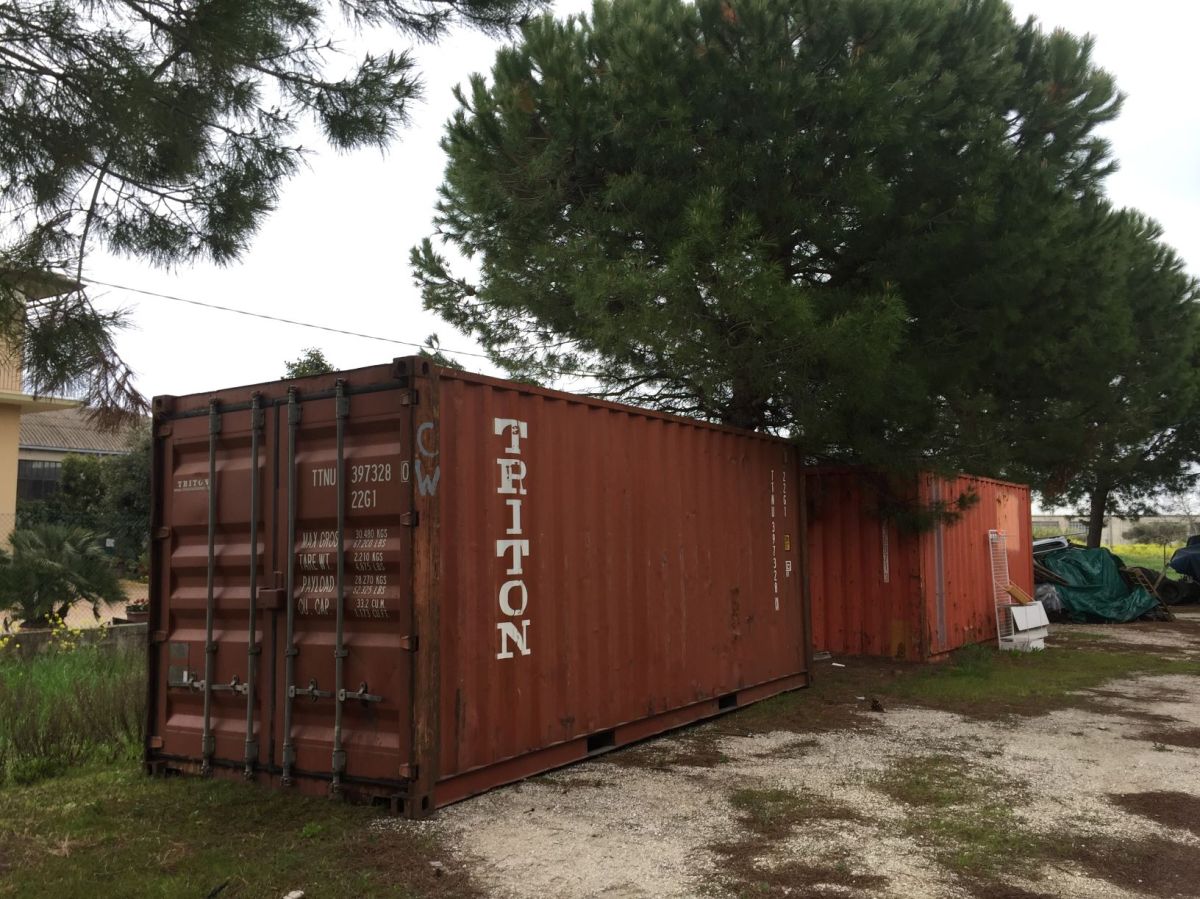
So for the time being he still has a forge in a box. Well, in a twenty-foot shipping container in a goods yard down at Porto Potenza Picena to be precise: twelve tonnes of tightly packed forging equipment patiently waiting for the right workshop to come along so it can be re-commissioned and teased back into service. And there’s the rub: finding a workshop. His search for a forge has been a variation on our early property searches here when holidays were spent bouncing down white gravel roads and clambering over ivy-choked ruins. On practically every trip to the builders’ merchants over in Villa Potenza, or to the quarry down in San Firmano, to the vet in Piediripa, or even to the supermarket in Trodica – and certainly while out on his Sunday cycles down to the coast – he will detour off along this, that or another track in search of a potential forge. Even I join in, keeping my eyes peeled for ‘Vendesi’ (for sale) signs on the way to or from teaching jobs in Recanati or Castelfidardo, in Filottrano or Appignano.

He’s not asking for much: sixty to eighty square metres of space, running water, mains power and a bit of outside space; a place where he can hang up his collection of blacksmith’s hand tools, set up his anvil, hearth and power hammer, and install a work bench, welder and spray bay. But just as with our initial property search, Mr Blue-Shirt’s hopes have been repeatedly raised and then swiftly dashed when a place that looks ideal from the outside or on paper turns out to be a non-starter as soon as he sets foot inside. Too big or too small; too far down a white road or too close to housing; too much land or no outside space at all; too much restoration work or too much conversion work.

He even considered a small plot of land on which he could erect a small pre-fabricated workshop and went to the local planning office to find out whether this might be a feasible option: it wasn’t. The piece of land Mr Blue-Shirt had earmarked as a potential location for a forge was designated as agricultural land and so could not be built on. But from the helpful and chatty planning officer, Mr Blue-Shirt learnt that until recently Montelupone had in fact had two working forges, and although their hearths had long since grown cold, their premises were still there. So clasping the map on which the planning officer had marked two red crosses Mr Blue-Shirt had set off to investigate.

The first was on the southern side of the village: an anonymous cube-shaped building with roll-down shutters and a shallow pitched roof. And decorated with a web of alarming cracks running up the buff-coloured walls, a victim of the earthquakes that shook the region in 2016. So he crossed that one off the list without even looking inside. The bureaucracy, time and money involved in repairing any earthquake-damaged property made it a complete non-starter.

The second forge was on the hill heading towards our place. We had both driven, walked, cycled and run past it on countless occasions but would never have imagined that behind the folding zinc doors there might be a forge. It looked very promising; it fulfilled all his criteria and even included the remains of a hearth. But it was simply way too big and consequently way too expensive. So that was that one reluctantly crossed off too.

Since then he’s ferreted out several other possibilities, and during lockdown a few more came up on the trading sites Mr Blue-Shirt subscribes to, but on closer inspection they have all turned out to be too…. something. He’s even enlisted the help of the people at the builders’ yard, the chap at the quarry, the owner of the agricultural supplies place, and the mechanic who services our car, asking them all to let him know if they hear of anyone wanting to sell a small workshop. He asked his chum Antonio too. Antonio runs the shipping company that transported Mr-Blue-Shirt’s container over from Lincolnshire and owns the good yard in which it has stood since its arrival in April last year. He’s an amiable and helpful fellow who loves to do deals – especially those that don’t involve the exchange of hard cash. So although he was originally going to charge a nominal rent for storing the container, as soon as he saw Mr Blue-Shirt’s sit-on mower, the rent was swiftly commuted to mowing the weed-strewn, two-football-pitch sized goods yard every few weeks.

These mowing sessions invariably include a coffee and a natter with Antonio, and during one such natter, it transpired that the lease on the goods yard was about to expire. Mr Blue-Shirt’s dismay soon turned to curiosity, however, as Antonio went on to explain that the new place he’d already got lined up, just a stone’s throw from his existing premises, included a warehouse with more than enough space for Mr Blue-Shirt to set up his workshop, and he was sure they could come to some arrangement…

A few weeks later, Antonio took possession of the site, a former furniture factory that had been empty for about three years, and immediately enlisted Blue-Shirt’s help in craning all the containers (including his own) from the old yard to the new one. Since then he and Mr Blue-Shirt have been like a pair of overgrown schoolboys planning their den, deciding what each bit of space could be used for, which pieces of abandoned equipment could be coaxed back into life, what repair work would be needed – and which would be the best area to set up a forge. This turns out to be a corner of a seven-hundred and fifty square metre warehouse which, in theory, would give him practically everything he needs and more: space, power, natural light, high ceilings, a concrete floor, and sliding double doors giving access to plenty of hard standing. But it’s not quite what Mr Blue-Shirt originally had in mind and is not without its drawbacks. And Antonio has yet to set out the precise nature of the ‘arrangement’ he has in mind. So in the meantime, Mr Blue-Shirt is doing his best not to let the perfect be the enemy of the good…