From amber to red in forty-eight hours

My phone started to go crazy just before 10pm yesterday evening. It was my colleagues on our WhatsApp teachers’ group letting everyone know that Prime Minister Conte was about to speak to the nation. Even before we’d turned on the TV, though, we knew it was not going to be good news. And sure enough, dark-suited, grey-faced and drawn, the Prime Minister announced in sombre tones that with the continued, relentless rise in fatalities and new cases of the virus, there was only one option left: close everything that is not essential for daily existence. But in an effort to put a more positive spin on the new restrictions, he stressed that the country was not becoming a red zone, but a ‘zona prottetta’ – a protected zone. Cruel to be kind. Tough love. For our own good.  And I think he’s probably right.

So for the next fortnight, it’s no bars, cafes or restaurants; no shops or markets, no pools or gyms or spas. No schools or universities, no museums, galleries, theatres or cinemas; no weddings, no funerals, no baptisms. No public gatherings, no sport, no gigs, no parties, no passegiate. Only travel beyond your comune if absolutely necessary – which effectively means just for work or medical reasons – and carry documentary proof of that need. Then remain far apart, touch no one and nothing. But best of all, stay at home, stay at home, stay at home. Essential services are guaranteed, though, and shopping for food and other necessities is permitted – although only one person per household, and always as close to home as possible. Supermarkets, pharmacies, newsagents and tobacconists can remain open, as can banks, petrol stations and garages. Firms and factories can still function, but with strict measures to protect their workforce in place.

It all feels slightly surreal. It is difficult to imagine that, especially on a glorious day like today, with blossom filling the hedgerows, trees bursting into leaf and the sound of birdsong filling the warm spring air and all looks well with the world, I would risk a fine or even arrest if I went out without good reason, or if I failed to provide acceptable auto-certification should I be stopped by the police, or if I was travelling with more than one person, or failed to maintain a safe distance from other people while I was out.

It will sink in soon, though, and it won’t be much fun. But Conte is right, I believe. He had no other choice. And it is only for two weeks (well, let’s hope it is). And if it works, it will be worth it: no pain, no gain. Conte put it better, though “Rimaniamo distanti oggi per abbracciarci tutti poi.” – Let’s remain at a distance today so that we can all embrace again later.

Life in the Amber Zone – Day 1

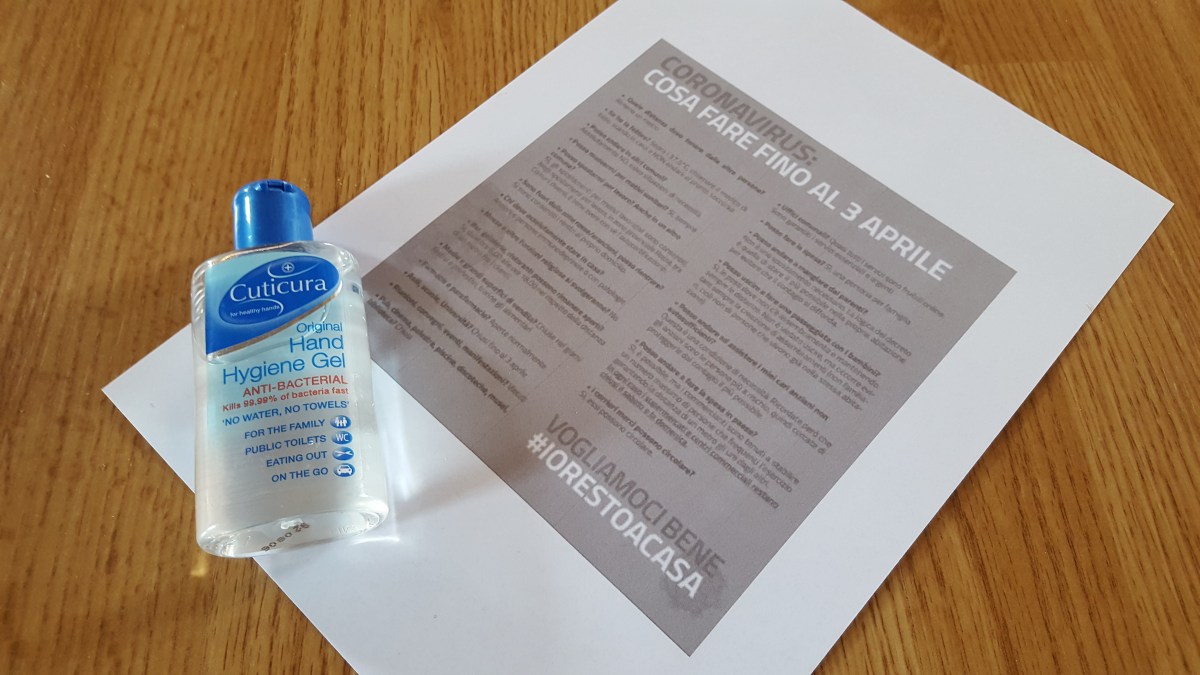
It came as no great surprise. In fact, there was almost an air of inevitability about it when the latest government decree was issued late on Monday evening. In an effort to halt the spread of coronavirus, the whole of Italy, from the Alps to Etna, is – to coin the media’s favourite term – under lockdown until 3rd April.

Here in Le Marche the first warning signs came at the end of February when all schools across the region were closed for a week. This affected me straight away as the language school I work for runs its own courses for adults and children, delivers course in companies, and does a lot of work in state schools. Consequently, just under half my timetable was cancelled at about 12 hours’ notice, although I was at least still able to deliver my company courses and individual lessons. Since there were no recorded cases at all in the region at the time, the immediate response to what looked suspiciously like a knee-jerk reaction was one mainly of dismay, especially since the region’s residents were given hardly notice of the closures. Indeed, there was similar dismay in Rome, but there it was because the national government reportedly felt that our regional government had exceeded its powers in issuing its decree unilaterally and some behind-closed-doors political argy-bargy ensued.

Whatever the finer constitutional points of the matter, the upshot was that the decree was lifted early and schools re-opened three days sooner than originally stated – only to be closed again three days later for a further five days, accompanied by general, common sense (if not blindingly obvious) advice about covering your mouth and nose when coughing or sneezing, and keeping away from anyone infected. This apparent indecision only added to people’s growing concern and provided little reassurance that the regional government actually knew what it was doing. Meanwhile, the number of cases in the north continued to grow.

Before Le Marche’s second five-day closure finished, however, the national government in Rome asserted its authority and on 4th March, with confirmed cases in all 20 regions, it decided to close every school, college and university across the whole country until 15th March. At the same time, it tightened restrictions further in the very worst hit areas in the north of the country – the ‘red zones’ – and added a longer, stricter list of do’s and don’ts for everyone. By this stage, there were a couple of dozen cases in Le Marche and one or two fatalities, all of them in the northernmost province of the region – ie that bordering Emilia-Romagna, one of the areas badly hit by the virus. It was getting closer. In practice, even at this point, though, things had changed very little for us personally.

As he effectively works from home anyway, Mr Blue-Shirt still carried on exactly as normal with his lengthy programme of work on the house. And while all lessons in state schools and group lessons in our own school premises were cancelled, I still carried on with my stripped-back timetable of a fortnight earlier. Only by now, the staff in the toll booths on the motorways were wearing latex gloves, as were increasing numbers of checkout staff in supermarkets. No masks in evidence, though, and no empty shelves, no panic buying. And the only reason queues seemed slightly longer was that people were just starting to stand a little further apart from one another.

Then over the weekend came the big spike both in confirmed cases and fatalities within the red zones, and increased numbers of cases across the rest of the country. The existing containment measures clearly weren’t working, and few people harboured much hope of things returning to normal on 15th March. And so, late yesterday evening, people’s worst expectations were confirmed. With a single flourish of his pen (and a very heavy heart, I suspect), Prime Minister Conte put the whole of the rest of the country – now officially the ‘amber zone’ – into quarantine, complete with a catchy hashtag to capture the essence of the stringent measures that have been put in place: ‘#iorestoacasa – I’m staying at home’.

So here I obediently sit. Instead of preparing lessons for ‘real’ classes, I have spent much of the day getting to grips with my school’s online platform for delivering virtual lessons wherever possible, emailing homework to students, and drawing comfort in this challenging teaching environment from the lovely bunch of people I work with. Beyond the confines of my virtual community, things are quiet; very quiet – even by the standards of the country road we live on. But life is continuing reasonably normally. Mr Blue-Shirt can report that as of today, there are good stocks of loo paper and pasta (and everything else) at the supermarket where Perspex screens have now been added the cash desks to protect checkout staff, and business almost as usual (and certainly as slow as usual) at the post office where people now have to queue outside. Our fridge, freezer and cupboards are full, we have wood for the fire, family and friends at our fingertips, and we are both feeling as fit and healthy as ever.

So day 1 in the amber zone? Strange, and slightly unnerving – but no real hardship as yet.

Another piece of the jigsaw

“That flat area outside the sitting room is just crying out to be turned into a terrace,” said Mr Blue-Shirt. “It’s the obvious place to have a table and chairs. It must get loads of sun – and just look at that incredible view!” Even in the murky grey of a November afternoon, the view was sensational: a broad, olive tree and vine filled valley, framed by two hill-top villages, that sloped down to a tantalising triangle of slate-blue sea in the distance. “Mmm,” I answered absently, as images ran through my mind of long, languid lunches enjoyed beneath a rose covered pergola on a sunny terrace edged with terracotta pots from which tumbled a mass of vivid red geraniums and crimson petunias.

“Come on. Let’s look round the back,” said Mr Blue-Shirt. “I’m getting cold.” My mind snapped back to reality and I trudged off in pursuit of Mr Blue-Shirt as he disappeared into the gloom. We had just finished viewing the inside of the house that just a couple of months later was to become our forever-home. Within minutes of stepping into the spacious, recently converted farmhouse we were smitten, and almost instantly could see the rooms filled with our furniture, see how we would use each of the airy rooms, see ourselves living there and fulfilling our long-cherished dream of la dolce vita. In an effort to apply the brakes to our enthusiasm and get our heads back in control of our hearts, however, we were now poking around the outside of the property to get a truer measure of the level of work required to turn this undeniably ugly duckling into the elegant swan we had been dreaming of for so long.

Although the ‘heavy lifting’ of the conversion from traditional marchigian farmhouse to modern, open-plan, four-bed, two-bath home had been completed – and in a way that chimed precisely with our needs and our taste – the outside of the property had barely been touched. Back then the area immediately surrounding the house still bore the heavy scars of all the building work that had been undertaken. The driveway consisted of little more than flattened builders’ rubble, and weeds were now growing from the piles of unused hardcore and gravel around its edge. The unfinished terrace to the northern side at that time was a sorry jumble of rough concrete, crooked breeze blocks, downpipes and drain covers, although the two shrink-wrapped pallets of terracotta tiles standing in front of the house like tired sentries hinted at grander ambitions now abandoned. To the southern side, the lake of weed-strewn rubble still lapped right up to the house, and on the eastern side, the doors from the sitting room opened straight onto a reasonably flat area of coarse and clumpy grass. The evenly-spaced patches of bare clay soil from which the grass had been worn away suggested that the then owners had at least seen the same potential as we had in this spot, which had surely been the most likely destination for those unused tiles.

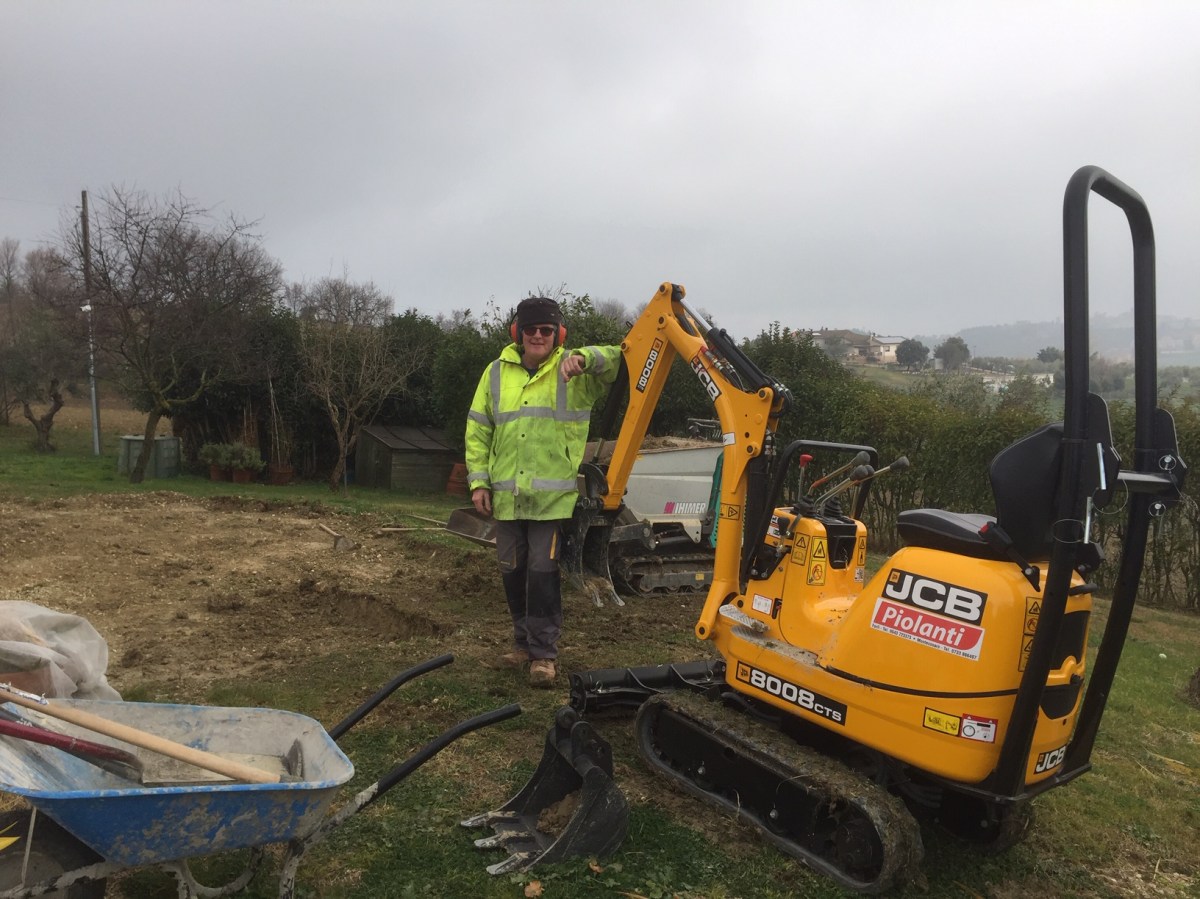
I recalled that murky November afternoon as I stood on the very same spot on a curiously similar February afternoon a couple of weeks ago; the spot where we and our friends and family had by then spent three summers eating, drinking, talking, laughing and lounging – and repeatedly re-positioning the table to try and stop it wobbling back and forth and spilling our drinks, and constantly tripping on the thick knots of grass or twisting our ankles in the numerous dips and cracks that peppered our proposed site for a proper terrace. Now, though, I was watching Mr Blue-Shirt finally starting to turn our fantasy of some forty months earlier into reality.

It had taken us months to decide on the shape and the size of the terrace: we wanted it to be generous – we weren’t short of space, after all, but proportional – not just big for the sake of it; and we didn’t want just a stark, rectangular slab. So after several rounds of drawing, measuring, pacing, pegging and stringing, we eventually settled on a broadly rectangular shape that linked the northern and southern stretches together, but with the edges steeply stepped in at various points to create a more interesting and less severe shape. This, along with a single step down onto the grass where the ground fell away more sharply along its longest side, would help lead the eye down the garden towards that marvellous view.

We had complete faith in our design, but even with his famously ‘can-do’ spirit, Mr Blue-Shirt was slightly daunted by the amount of work it would involve – which, of course, would be compounded by his ‘never knowingly under-engineered’ approach to all such undertakings. But he also loves a challenge, so with the grout between the tiles on the north terrace barely dry, he launched straight into the first of what would turn out to be no fewer than fourteen separate phases in creating will surely become his thirty-eight square metre magnum opus. And so here he was, once more aboard his favourite rented digger, happily clawing away at the tatty grass and carefully digging out the heavy clay soil to form the narrow trench for the concrete foundations of the low brick wall that would support the whole structure.

Standing in the chilly mist, that image from three years earlier flashed back into my mind.  But now I could also almost smell the wood smoke rising from our first barbecue and hear the clink of glasses and the sound of laughter drifting down the valley on the gentle breeze. Not long now…

Out on the tiles

Spring is in the air and Mr Blue-Shirt has got his mojo back.

Following the sudden deaths of both his parents within just seven weeks of each other, all work on the house and garden came to an abrupt halt last autumn. First there were the four gruelling trips to the UK that put paid to his schedule of works for the winter. Then there was the bone-aching exhaustion and sleeplessness that accompanies grief to deal with, as well as the matter of actually processing the enormity of the loss he had suffered.

December became a time to be and not to do; a time to mourn, to rest, and slowly to begin the healing. With the new year came faint stirrings of renewed vigour along with a growing need for activity and forward motion. So January saw Mr Blue-Shirt doggedly working his way through the heart-wrenching task of clearing his mother’s flat of every last teaspoon and biro to prepare it for sale, then sorting out his parents’ estates, cancelling subscriptions and closing bank accounts. Step by step he found himself erasing the minutiae of their worldly existence until all that was left of them in any material form were the two matching urns of ashes that sit on his sister’s window sill.

As I know from my own experience, finding ‘closure’ is a necessary part of the grieving process. But to make progress in that direction, there is much that must be dismantled, deleted, disposed of and destroyed and Mr Blue-Shirt soon began to long for something more positive; for growth, rebirth and renewal, which for him invariably means planning, doing and making,  So to satisfy his need to leave the shadows behind and focus once more on creating something new and whole and good, he set about tiling the remaining section of the terrace he built last summer.

It was in the lazy days at the end of summer after the pigsty had gone that he tiled the first section of the newly built terrace on the north side of the house. The final section, the part immediately outside the back door that became an impromptu breakfast terrace the instant the concrete had set, had been number one on autumn’s abandoned job list. It was unfinished business, and consequently the obvious start-point for Mr Blue-Shirt’s return to the building fray.

Before he could make a start on the tiling, though, he needed to render and paint the sections of low breeze block wall that enclose the western end of the terrace. Mr Blue-Shirt has tried his hand at most practical trades over the years, but rendering was a first even for him. Never one to be put off by anything so trivial as a lack of experience, however, he dived straight in with his customary battle cry of “How difficult can it be?” And of course, for probably the most practical person I have ever met, it was not remotely difficult. Within just a couple of days, the layers of tatty, dismal grey had disappeared behind a smooth, crisp layer of render, finished with a coat of vanilla-coloured paint to match the house. Mr Blue-Shirt was back on form.

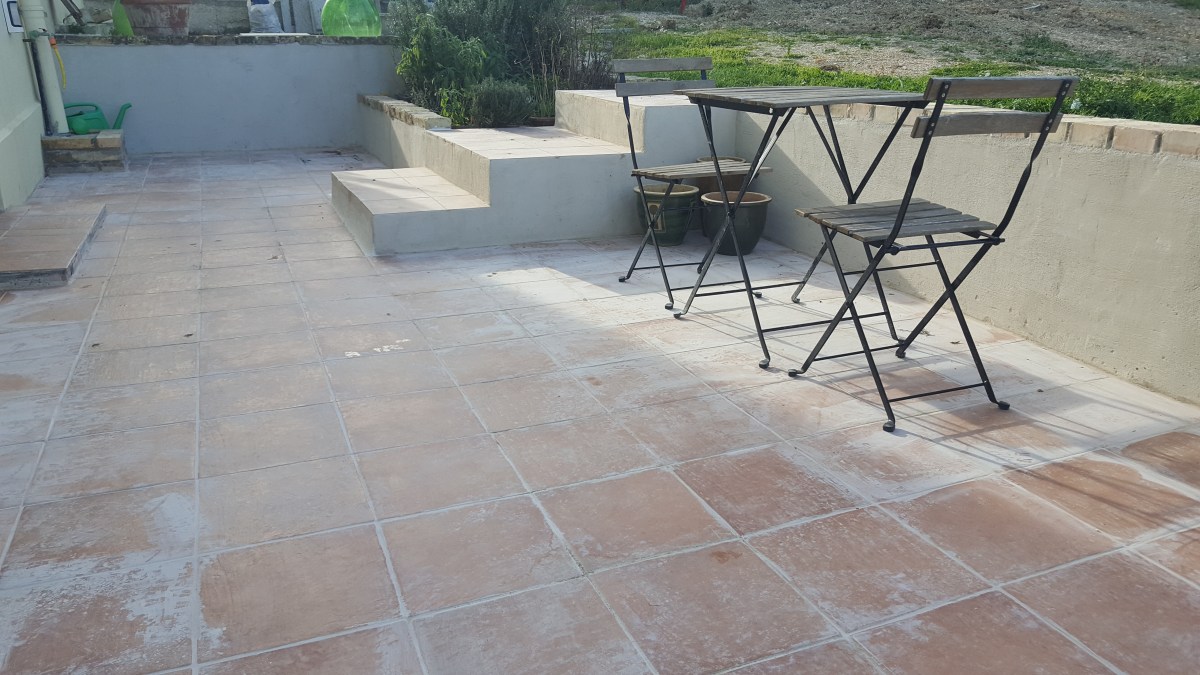
So with the warm-up job complete, it was on to the main event. And little by little, the irregular rectangle of pale grey concrete behind the house turned to terracotta as, row by laborious row, Mr Blue-Shirt meticulously measured, cut, cemented and laid one tile after another. He spent day after day hunkered down on his hands and knees in the howling winds that lashed the area for the first half of February. While his freshly rendered walls provided him with some shelter, he still had to keep leaping to his feet to chase after a succession buckets, drawings and tools that the wind repeatedly whipped up and flung down the garden.

What Mr Blue-Shirt found far more frustrating than the weather, however, was the house’s almost total absence of anything that is straight, symmetrical or perpendicular. The northern side of the modern extension to the eastern end of the house that forms our sitting room and bedroom is at a slight angle to the original house, so the terrace has a matching kink in it; the walls along the western edge are not parallel to the house; the steps that lead up to the knoll where the pigsty used to stand are not in line with the back step, which isn’t in line with the back door; and the drain covers that dot the terrace are not in line with anything at all. Oh, and the whole thing also sloped in towards the house until the concrete was laid. All of which not only offended Mr Blue-Shirt’s laser-like eye for accuracy, but also meant much more time spent measuring, cutting and checking, and, of course, resulted in an annoyingly high number of wedge-shaped sections of tile rather than the expanse of perfect squares that Mr Blue-Shirt had dreamt of. “Rustic charm!” I would chirrup whenever he lost patience with another fiddly bit of the jigsaw, or “We always wanted quirky, though,” when he measured a five-metre run of tiles and with anguish in his voice proclaimed “But it’s 2.2mm out!”

Now that it’s finished, of course, none of the quirks or kinks is apparent – or even of concern – to any normal mortal. For normal mortals (ie anyone other than a former army engineer), it is now simply a lovely cool and shady space to enjoy breakfast in the height of summer, to sip a cup of tea in the mellow, late afternoon sun, and all year round to drink in the far-reaching views from a slightly different angle.

So with the terraces to the north side and the south side now complete, that only leaves Mr Blue-Shirt with the main terrace to the east to build. How difficult can it be?

Out on the tiles

Spring is in the air and Mr Blue-Shirt has got his mojo back.

Following the sudden deaths of both his parents within just seven weeks of each other, all work on the house and garden came to an abrupt halt last autumn. First there were the four gruelling trips to the UK that put paid to his schedule of works for the winter. Then there was the bone-aching exhaustion and sleeplessness that accompanies grief to deal with, as well as the matter of actually processing the enormity of the loss he had suffered.

December became a time to be and not to do; a time to mourn, to rest, and slowly to begin the healing. With the new year came faint stirrings of renewed vigour along with a growing need for activity and forward motion. So January saw Mr Blue-Shirt doggedly working his way through the heart-wrenching task of clearing his mother’s flat of every last teaspoon and biro to prepare it for sale, then sorting out his parents’ estates, cancelling subscriptions and closing bank accounts. Step by step he found himself erasing the minutiae of their worldly existence until all that was left of them in any material form were the two matching urns of ashes that sit on his sister’s window sill.

As I know from my own experience, finding ‘closure’ is a necessary part of the grieving process. But to make progress in that direction, there is much that must be dismantled, deleted, disposed of and destroyed and Mr Blue-Shirt soon began to long for something more positive; for growth, rebirth and renewal, which for him invariably means planning, doing and making,  So to satisfy his need to leave the shadows behind and focus once more on creating something new and whole and good, he set about tiling the remaining section of the terrace he built last summer.

It was in the lazy days at the end of summer after the pigsty had gone that he tiled the first section of the newly built terrace on the north side of the house. The final section, the part immediately outside the back door that became an impromptu breakfast terrace the instant the concrete had set, had been number one on autumn’s abandoned job list. It was unfinished business, and consequently the obvious start-point for Mr Blue-Shirt’s return to the building fray.

Before he could make a start on the tiling, though, he needed to render and paint the sections of low breeze block wall that enclose the western end of the terrace. Mr Blue-Shirt has tried his hand at most practical trades over the years, but rendering was a first even for him. Never one to be put off by anything so trivial as a lack of experience, however, he dived straight in with his customary battle cry of “How difficult can it be?” And of course, for probably the most practical person I have ever met, it was not remotely difficult. Within just a couple of days, the layers of tatty, dismal grey had disappeared behind a smooth, crisp layer of render, finished with a coat of vanilla-coloured paint to match the house. Mr Blue-Shirt was back on form.

So with the warm-up job complete, it was on to the main event. And little by little, the irregular rectangle of pale grey concrete behind the house turned to terracotta as, row by laborious row, Mr Blue-Shirt meticulously measured, cut, cemented and laid one tile after another. He spent day after day hunkered down on his hands and knees in the howling winds that lashed the area for the first half of February. While his freshly rendered walls provided him with some shelter, he still had to keep leaping to his feet to chase after a succession buckets, drawings and tools that the wind repeatedly whipped up and flung down the garden.

What Mr Blue-Shirt found far more frustrating than the weather, however, was the house’s almost total absence of anything that is straight, symmetrical or perpendicular. The northern side of the modern extension to the eastern end of the house that forms our sitting room and bedroom is at a slight angle to the original house, so the terrace has a matching kink in it; the walls along the western edge are not parallel to the house; the steps that lead up to the knoll where the pigsty used to stand are not in line with the back step, which isn’t in line with the back door; and the drain covers that dot the terrace are not in line with anything at all. Oh, and the whole thing also sloped in towards the house until the concrete was laid. All of which not only offended Mr Blue-Shirt’s laser-like eye for accuracy, but also meant much more time spent measuring, cutting and checking, and, of course, resulted in an annoyingly high number of wedge-shaped sections of tile rather than the expanse of perfect squares that Mr Blue-Shirt had dreamt of. “Rustic charm!” I would chirrup whenever he lost patience with another fiddly bit of the jigsaw, or “We always wanted quirky, though,” when he measured a five-metre run of tiles and with anguish in his voice proclaimed “But it’s 2.2mm out!”

Now that it’s finished, of course, none of the quirks or kinks is apparent – or even of concern – to any normal mortal. For normal mortals (ie anyone other than a former army engineer), it is now simply a lovely cool and shady space to enjoy breakfast in the height of summer, to sip a cup of tea in the mellow, late afternoon sun, and all year round to drink in the far-reaching views from a slightly different angle.

So with the terraces to the north side and the south side now complete, that only leaves Mr Blue-Shirt with the main terrace to the east to build. How difficult can it be?

Sardines, Senators, Spats and Salvini

All right, UK.  It’s not all about you. There is at least one other country in Europe where the business of government has also been reduced to political soap opera; an ongoing drama full of division, deception, disloyalty and discord. Take Italy, for example.

When we left the story back last autumn (Number 65, your time is up), the unlikely coalition between the Five Star Movement (aka M5S) and The League (La Lega) had collapsed. Well, Matteo Salvini, the then Interior Minister and, de facto Prime Minister and leader of The League deliberately brought it down in a tactical gamble. With his party riding high in the polls and support for M5S plummeting, he quit the coalition – which was in its death throes anyway – in the hope that the President of the Republic, Sergio Mattarella, would call a general election. In theory, this would have allowed Salvini to storm to victory and form a ‘pure’ right-wing government, if not on his own, then in coalition with other parties of the right including the arch-nationalist Fratelli d’Italia, and the centre-right Forza Italia (where that veteran charlatan Berlusconi still pulls the strings). Only the President refused to play along with Salvini’s grand plan and instead – as the constitution actually requires – invited the two largest parties in parliament, M5S and the left-leaning Partito Democratico (PD), to try and form a new coalition. In the end, it didn’t take as much coaxing and cajoling as might have been expected of these two sworn enemies: despite or perhaps because of their woeful poll ratings, M5S were desperate to cling onto power, and the PD were just as desperate to get into government in order to oust Salvini and to halt the advance of La Lega.

But while the idea that ‘my enemy’s enemy is my friend’ might have been enough to bring them together, it was never going to be enough to keep them together in the longer term. Indeed, within weeks, cracks began to show in the fragile coalition. Right from the very start of this marriage of convenience there has been a steady exodus of MS5 deputies: some have been sacked, some have become just too disillusioned to continue, and some – bizarrely – have even defected to La Lega. Meanwhile, the anti-establishment party’s lack of political nous has led to it being effectively side-lined by the much more experienced PD who have ridden roughshod over many of M5S’s key policies. Indeed, its leader, Luigi Di Maio resigned in disgust in January and by February was even calling for people to protest against the very government he still sits in.

All of which discord and chaos has, of course, played straight into Salvini’s hands, for while he might have been out of a job, this media-savvy firebrand most certainly hasn’t been out of the limelight or the action; far from it. Buoyed by victories in half a dozen regional elections in 2018 and 2019, he and his allies went on to take Umbria in October 2019 and then Calabria in January 2020, with each victory putting the precarious coalition under ever greater pressure.  The election on 20th January in Emilia-Romagna, a stronghold of the left since World War II, was the big one, though. If Salvini and his right-wing cohorts won here, so commentators opined, then it really would be game over for the left-leaning coalition.

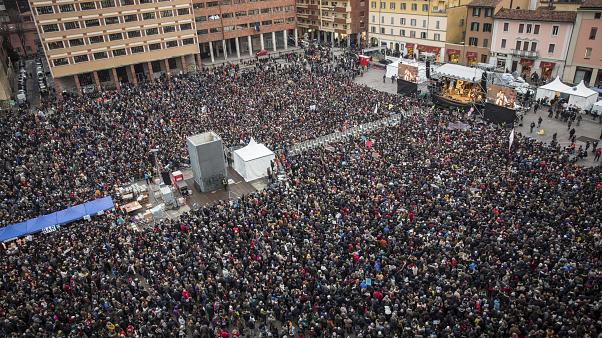
The campaign was bitterly-fought and saw the emergence of the ‘6000 Sardines against Salvini’, a flash mob (of 15,000 protesters in the end) that crammed itself into Bologna’s historical Piazza Maggiore in peaceful protest against Salvini’s political rhetoric and the right-wing surge it had unleashed across the country. The movement soon spread, with Sardine protests taking place throughout winter in Milan, Florence, Turin, Naples, Palermo and Rome where, according to the organisers, 100,000 protesters took part in the rally. After smaller rallies in Paris, Berlin and Brussels the movement returned to Bologna at the climax of the campaign with 40,000 people attending a huge rally and six-hour long concert in Piazza VIII Agosto featuring some of Italy’s top artists from the fields of pop, rock, punk, rap and folk as well as film and theatre. Exactly a week later, the centre-left PD candidate won an absolute majority in the polls, beating the Lega candidate by almost eight clear percentage points. And the coalition government in Rome heaved a sigh of relief that could have been felt from the Alps to Etna.

Victory in Emilia-Romagna has only partially steadied the coalition’s leaky ship, mind. In the last week, former premier and coalition partner Matteo Renzi has threatened to resign from the government over controversial judicial reforms, prompting Prime Minister Conte to reassure the President that he would still be able to command majority support within parliament even if Renzi’s small party withdrew support. Despite Conte’s reassurances, however, there is little confidence that the coalition could in fact maintain its parliamentary majority under such circumstances, so Renzi is under massive pressure not to resign and effectively clear the way for the right to gain power.

And of course, with the right currently holding thirteen of the country’s twenty regions as well as the two autonomous provinces in the far north, Salvini continues to rock the boat with as much vigour as ever. Even the Senate’s decision to remove his immunity from criminal prosecution for the alleged kidnapping of 131 migrants whom he prevented from disembarking on Italian shores in August 2018 doesn’t seem to have dented his confidence – or his popularity – at all. Indeed, many fear that the decision may play straight into Salvini’s hands and turn him into some kind of populist martyr, thereby boosting his poll numbers even further.  After all, seven more regions – including currently left-leaning Le Marche – go to the polls this year, so some might say he still has everything to play for.

Image: http://www.euronews.com

Enough to make my hair curl

Sono al posto giusto?” I asked apprehensively, raising my voice over the breathy howl of a trio of hairdryers. “Cerco Karina – I’m looking for Karina.” I was standing in an achingly trendy hair salon one street back from the sea front in the centre of Civitanova Marche and felt a long way outside my comfort zone. I was unsure whether this was actually the place Rachel had recommended to me, and so to check that I was in the right salon, I had asked if they used to have an English client by that name who had just moved away. It was from Rachel that we had bought the house and she had kindly left us a long list of useful names and numbers for the plumber, the electrician, the builder, the water company, the gas man, the council – and, very perceptively, I thought – her hairdresser. But rather than leaving the name of the salon, she had just given a first name – Karina – and a phone number. I had googled the number, which had come up as that for the salon I was now standing in, which made sense as Rachel and her partner had lived in Civitanova for several years before moving out to Montelupone, so I was fairly confident I was on the right track.   “Si! Si! Rachele! Sta bene? – How is she?” asked the petite woman with long, artfully tousled locks and almost comically huge horn-rimmed glasses.  “Io sono Karina. Come posso aiutarLa? – I’m Karina. How can I help you?”

I felt a tingle of relief: I’d overcome the first hurdle. “Si, sta bene. Senti… Yes, she’s fine. Anyway…” I took a deep breath and launched into my little pre-prepared explanation of my presence and my wishes. On reflection, I suppose it was really quite ridiculous to feel this nervous about going to the hairdresser after all the much more important and complex administrative labyrinths we had been attempting to negotiate over the preceding weeks. But this was going to be quite a leap for me. Not only was it my first trip to an Italian hairdresser, which would involve another raft of ‘newness’ to get used to as well as a whole new chapter in my expanding Italian vocabulary, it was the first time I had changed salon at all in getting on for fifteen years.

The salon in the UK that I had gone to for all those years was tucked down a side street on the edge of the small and sleepy market town about three miles from our forge in deepest Lincolnshire, and as such was the very antithesis of trendy. Run by two very blokey Yorkshiremen, the décor was as plain and functional as the service, which ran to a stack of dog-eared gardening and motoring magazines to read over a giant mug of builder’s tea, or instant coffee if they were feeling adventurous. And there was none of the usual sing-songy “going anywhere nice on your holidays?” chat either – I’m pleased to say. The one who did my hair for the first few years would talk to me at length about his son’s autism, and his difficulties in getting proper support for him. With the one I went to for the next few years, it was cars: we would chat at similar length about the aged soft-top MG sports cars that we each owned, comparing notes on their respective rattles, squeaks and judders, and exchanging recommendations for paintshops and mechanics. And they were both extremely efficient ‘does-what-it-says-on-the-tin’ hairdressers too: colour, wash, trim and blow-dry all done and dusted in just over an hour. From standing in Karina’s salon for just a few minutes, it was clear that it was going to be a rather different experience here.

First there was the décor: bang on-trend shades of beige, grey and off-white, with distressed, shabby-chic furniture, glitzy show-girl lights around the generous mirrors in front of which stood a row of smart chrome-trimmed chairs, and a chi-chi little table in the middle that was covered in a selection of pretty glass jars and dishes filled with dainty pastries, biscuits and chocolates. Then there were the staff: a couple improbably slim young women both dressed in matching black T-shirts and super-skinny jeans bustled around the place, folding fluffy black towels and scooping up glossy magazines while three more identically dressed and equally slim young women dried, brushed, teased and snipped the hair of the three black-gowned customers sitting in front of them. Karina kept breaking off from our conversation to issue instructions to her crew: “Irene, could you rinse Emanuela’s colour off, please. Veronica, can you start off Chiara’s blow-dry, please. Keti, Maria is ready to pay….” It was another world, and one which I found faintly intimidating.

So it really did take some getting used to. For a start, there was the language issue to deal with, then there were the differences in hairdressing techniques and products – the combined effect of which resulted in one or two minor disasters early on.  And then there was also what Mr Blue-Shirt and I, in our all too Anglo-Saxon way, refer to as ‘faffing’. This is when any job appears to be accompanied by quite a bit of (to us) unnecessary to-ing and fro-ing, a fair amount of apparently idle chit-chat, and a general absence of any sense of urgency which together seem to make so many things take so much longer than they need to, and which saw the time required for my very standard colour, wash, trim and blow-dry nearly double to just shy of two hours.

At first, all this would make trips to the hairdresser really quite nerve-wracking, but once I had got to grips with the vocabulary and could accurately explain exactly what I wanted, I relaxed, learnt to stop being so Anglo-Saxon, and to go with the flow. Indeed, I now positively embrace this slower pace – which is not ‘faffing’, as it turns out, but just better customer service. And as well as enjoying a couple of hours of what now feels like proper pampering, chatting with Irene, Veronica, Keti and Karina also allows me a solid couple of hours of Italian practice. Oh, and best of all, it’s cheaper than going to my two blokey Yorkshiremen.


Photo credit: Karina Love Hair, Viale Vittoria Veneto, 25, Civitanova Marche.
In vino veritas

Of course, there’s not much to see at this time of year. In the vineyards currently stand row upon row of what look like muscular brown forearms thrusting up from the winter soil. Each is topped with a gnarled, chunky fist that still holds last year’s long, thin branches in its grasp. Now leafless and lifeless, they cling to the rows of horizontal wires among which they wove last season; like musical notation on a stave from which the notes have been plucked, the song of summer now just an echo.

Something is stirring, though. With this unusually mild winter already on the wane, preparations for the coming season are getting underway. Scattered across the vineyards, groups of hunched figures slowly work their way up and down the rows, laboriously snipping away the dead branches that bore last year’s crop. They let each fist hold onto just one, maybe two strong slim branches, the torchbearers for this season’s growth. For in just a few weeks, a delicate frill of zingy green will sprout from those slim branches, the fragile young leaves shivering in the chill of early spring. Within a few more weeks, whole new branches will burst forth and race along the wires, and the tender frills will thicken into bright green jagged-edged bunting fluttering in the breeze. And as spring progresses, that bunting will grow into extravagant garlands that loop in and out among the now invisible supporting wires, creating palisades of rich green within which will nestle the flower clusters that will later develop into fruit.

Even though practically any and every view of the region’s undulating patchwork of fields will include at least one large vine-striped oblong, Le Marche is not one of Italy’s primary wine-growing regions. That honour goes to the likes of Tuscany (and its world-famous Chianti), Piedmont (and its aristocratic Barolo) and Veneto (with its all-conquering Prosecco). But like the other seventeen ‘also-rans,’ Le Marche nonetheless has its own vigorous wine industry made up of myriad small-scale wine co-operatives and family-run vineyards that between them produce a range of wines that are unique to the region and that reflect the local terroir, climate and cuisine, with only a small proportion of their output destined for sale beyond the region, and an even smaller proportion destined for export. That is not to say, mind you, that the wines from these lesser-known regions are automatically of poorer quality. After all, Italy has been producing wine since pre-Roman times and in 2018 was the world’s largest wine producer (beating both France and Spain by a considerable margin) so it seems safe to conclude that they have got the hang of it.

So while you are unlikely to find Le Marche wines on the shelves at Tesco or on restaurant wine lists, the region, which the New York Times has coined ‘the new Tuscany’, still has plenty to offer the more curious wine-lover. The three best-known are Rosso Piceno, Rosso Conero, and Verdicchio. The first is made predominantly from the Sangiovese grape that is cultivated on the slopes around Ascoli Piceno in the south of the region. The second is made predominantly with the Montepulciano grape which is cultivated on the westward facing slopes of the Conero promontory near Ancona. And the third, a pale and citrussy white (and a personal favourite) is produced in two principal areas around Jesi and Matelica, and is the region’s rising star and trailblazer: it is this now prize-winning wine from the centre of the region that you are most likely to come across in the UK.

Just as popular locally, though, are the ancient Passerina, and Pecorino (my preferred accompaniment to fritto misto and a simple green salad eaten at a beachfront restaurant), which has enjoyed a huge resurgence in popularity in recent years. When it comes to reds, other local favourites include Lacrima di Morro d’Alba and Vernaccia Nera, which is also the grape used in the ancient and idiosyncratic sparkling red wine, Vernaccia di Serrapetrona, which features in Dante’s epic ‘Divine Comedy’. Another regional oddity is vino cotto, which literally translates as ‘cooked wine’. This intense, ruby-coloured, port-like sweet wine dates back to the pre-Christian era and is made from boiled down and fermented grape must.  For many years it was regarded as a clandestine local hooch, but is now officially recognised – and celebrated – as a traditional Italian local food product. Indeed, the present-day centre of production is Loro Piceno (the village near Macerata where we once thought we might live, incidentally) which holds an annual Sagra del Vino Cotto.

So, in fact there is much to see at this time of year. For those muscular forearms with their chunky fists poised ready for the start of spring are the continuation of the same cycle of cultivation that has been repeated for generations and that has sustained local culture and community for more than two thousand years.

Salute!

The winner takes it all?

Loss. It is something I have had reason to write about far too often recently. All the many bereavements, the two burglaries, even the loss of two cherished pets. And now the enormous sense of loss Mr Blue-Shirt and I both felt at midnight on 31st January, which, although very different, felt just as momentous and just as life-changing. We feel utterly bereft, bewildered and betrayed.

We are bereft at the withdrawal of our almost life-long EU citizenship and the myriad rights and benefits it bestows – sorry, bestowed – upon us, our families and our friends. We feel utterly bewildered by the reckless abandonment of half a century’s solidarity and brotherhood in favour of isolation and petty nationalism; we feel equally bewildered by the wilful self-infliction of economic, social, political and cultural impoverishment on the country of our birth and its consequences for future generations.

And we feel betrayed by a hubristic and disdainful government that, in their own interests rather than the nation’s, sought to stoke division and discord, and turned the whole sorry affair into a winner-takes-all, zero-sum game in which those who, for perfectly legitimate reasons, held fast to the worthy principles of European unity and cooperation were not just ignored but mocked, taunted and vilified and ordered to ‘get over it.’

I refuse to succumb to bitterness, though. Because when I went to bed on Friday night, I was European, and when I woke on Saturday morning, I was European. I was still European this morning, and will be tomorrow, the day after that, and the day after that. For being European is as much part of me as being left-handed and long-sighted. It is what I am and who I am, and no one – least of all the power-hungry, self-serving chancers currently in Westminster – can take that from me.

I could continue my despairing rant ad nauseum, but I have had my fill of reflecting on loss and no longer wish to participate in the crude, divisive discourse of ‘we won, you lost’, as we are surely all losers now.

Instead, I will keep this short and give the last word to that icon of British patriotism, William Shakespeare. For across the centuries his peerless poetry seems – both inevitably and ironically – to hit the mark precisely:

England, bound in with the triumphant sea,
Whose rocky shore beats back the envious siege
Of watery Neptune, is now bound in with shame,
With inky blots, and rotten parchment bonds:
That England, that was wont to conquer others,
Hath made a shameful conquest of itself.

— Richard II (II.i)

With thanks to Shreya Sen Handley (https://shreyasenhandley.com) for the quotation.

January Blues

God, I loathe January. Yes, I know it’s a bit of a cliché; the media would have us believe that loathing January has effectively become compulsory these days. You know the shtick: the sparkle and euphoria of Christmas have faded, the only Quality Street left in the tub are the sickly soft centres, and all you can find in the freezer is yet more leftover turkey. The credit card bills have landed, the poinsettia is shedding more leaves by the day, and the new year’s resolutions have long since been exposed as a work of fiction – again.

For me, though, January is not just a collection of media tropes and the blindingly obvious. For me, it is truly the season of sorrows. It is the month in which we repeatedly pounded up and down the slush-slicked motorways between our home in Lincolnshire and my family’s in Devon, initially sick with dread and later numb with grief. It is the month in which barely forty-eight hours into the new year, I buried my father. It is the month in which, just two years later, I spent endless, agonising days at the side of my sister’s bed in the hospice, watching cancer steal her life from her. And exactly two years after that in the hospital right next door, it was the month in which I spent almost identical endless, agonising days at the side of my mother’s almost identical hospital bed, watching cancer steal her life too.

January is the month in which I became an only child. January is the month in which I became an orphan.

In the UK, the crushing weight of that immense sorrow was almost unbearable. For then it was accompanied and intensified by January’s ceaseless, dank and frigid gloom. Although technically the days were lengthening, the increase in daylight was imperceptible. Darkness reigned: we went to work in the dark; we came home in the dark; the lights were always on. It was a world drained of life; a world drained of colour, with black, naked trees and lifeless, sepia-coloured fields over which hung leaden skies that the watery winter sun was seldom able to penetrate. Then there was the exhausting misery of the damp, bone-chilling cold that seeped into the very core of my being and that turned every day into an unwinnable battle to keep its effects at bay. Without fail, my mood would darken, and without fail, in a matter of days I would find myself tumbling into a gaping chasm of wretchedness from which I could only manage to haul myself when spring at last beckoned.

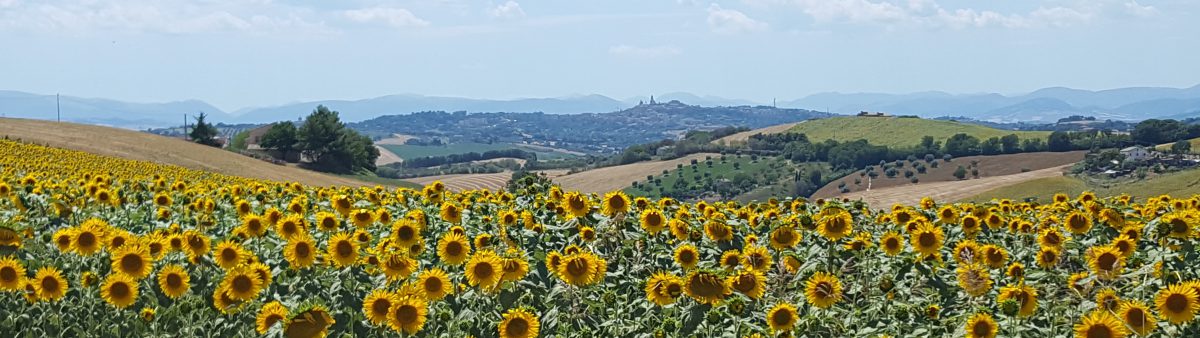
But here in Le Marche, a thousand miles to the south, the contrast could hardly be greater – this January at least. Since well before Christmas we have been blessed with benign temperatures, often in double figures. For weeks on end a honeyed sun has shone from a baby-blue sky. And on the days when its gentle rays have been filtered through a veil of fine mist, the land has been bathed in a soft golden light that has given everything an ethereal, dreamlike quality. It is a world full of colour, with hilltop villages flushed pink in the soft-focus sunlight and spring crops already carpeting the fields in vivid green. Tiny white and blue flowers now dot the hedgerows, while splashes of brilliant yellow mimosa blossom are starting to appear, and many of the trees – including all the olives, of course – always remain as green as they were in full summer. On occasion, the breeze even carries the soft murmur of birdsong.

Despite the renewal and growth and life that are evident everywhere, January remains the season of sorrows, mind – as I suspect it always will do; the multiples layers of loss simply run too deep. But the warmth and colour of a Mediterranean winter at least make the weight of that lasting sorrow bearable, and the brightness of a southern sky helps dim the shadows it continues to cast over me. They lift and sustain me and their reassuring embrace keeps me from falling into that annual chasm of wretchedness. They have, in part at least, redefined the January Blues.