The Unfinished Symphony

More than thirty thousand coronavirus deaths in Italy now. The same again and more in the UK. In excess of a quarter of a million around the globe. We mourn their loss and our hearts go out to their grieving families.

But this weekend our focus has entirely been inward facing and entirely personal. For yesterday was – would have been – was (we still find ourselves caught in limbo between the nearly-was and always-will-be) the twenty-third birthday of our stillborn only son, William.

The shadows remain; the pain persists. The love endures.

The unfinished symphony
The sculpture
Knocked from the pedestal
Just before
The final touch.

Though sleeping comes to birth,
Never living,
Never dies.
But continues its creation
In the hearts
Of its creators.

And so the symphony,
The masterpiece,
The stillborn child
Forever plays his melody
In his parents’ loving hearts,
In the hearts of his creators.

We read this unattributed poem at William’s funeral in a tiny country church in Wiltshire and in whose pretty graveyard he remains at rest…

Pochi passi

It’s one of Mr Blue-Shirt’s favourite Italian phrases and means ‘a few steps’. And nearly nine weeks since the whole of Italy went into almost total lockdown to try and halt the relentless advance of coronavirus, the country is about to take ‘pochi passi’ towards lifting some of the restrictions that have kept us all confined to our homes since early March.

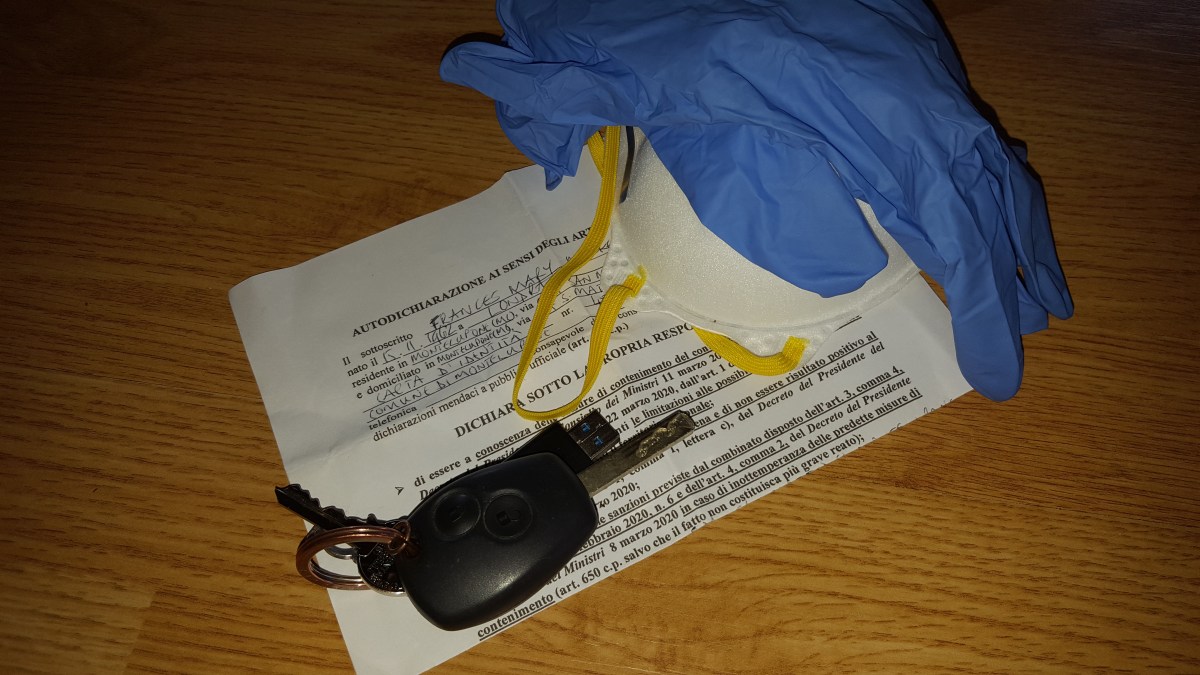
Only once all the daily data on testing rates, infection rates, fatalities and hospital discharges had steadily been moving in the right direction for a good couple of weeks did the government feel ready to announce on 26th April a comprehensive timetable for a very cautious, phased re-opening of the country over the course of the coming month – and all still subject to there being no significant spike in new cases. Now that the infection rate is consistently falling by over five hundred a day, the recovery rate has risen to around three thousand a day, and fatalities have fallen from over nine hundred a day at the start of the lockdown to well below three hundred a day, we will, as of tomorrow, be able to travel beyond the confines of our commune (while still remaining within the region, however) for reasons other than work, health or an emergency. Social distancing rules will still apply, of course, masks must be worn on public transport and wherever social distancing is not feasible, and everyone will still need to carry with them a document stating the reason for their outing, unless they are going to work or for a walk.

Public parks will re-open and – big ‘hurrah!’ from both of us – individuals will be permitted to go more than just a couple of hundred metres from home to take outdoor exercise – indeed, Le Marche’s regional government has issued an ordinance that specifically permits people to visit the beach for this purpose, although stopping for a chat with anyone or congregating with others is expressly prohibited. People will be able to visit members of their immediate family – although large family gatherings will remain forbidden, as will meeting up with friends. A range of industrial sectors will be able to re-start production – providing stringent health protection measures are in place – building sites can re-open, and the lottery will be back in action.

But while people will be permitted to travel beyond the comune from tomorrow, members of the same household will apparently still not be allowed to leave the house together (so it is unclear how this works with the newly permitted family visits), and there will still be very little to do if one or other of us does venture out. We will, for instance, have to wait a further week before shops other than supermarkets, pharmacies and those selling a strictly defined and limited range of ‘necessities’ can re-open – with a strict one-in-one-out policy in operation and all shop assistants required to wear masks and gloves.  It will be another week or two before shopping centres, covered markets, museums and galleries can re-open – undoubtedly with a strict mask-and-gloves rule in place – and travel between regions will be permitted.

Finally, providing the data during this period do not give undue cause for concern – and the government can retain the goodwill of the people whose patience is finally beginning to fray – hairdressers and barbers, beauty salons, bars and restaurants should be able to re-open by the end of May – all with strict social distancing and infection prevention measures in place, though. And state schools will remain closed until September.

So tomorrow one of us – we have yet to decide who – will be travelling the six whole miles to shop at our usual supermarket in the neighbouring comune for the first time in two months. And with the unambiguous simplicity of total lockdown having become so unexpectedly normalised, we are both slightly taken aback by the apprehension we both feel at having a whole new set of do’s and mainly don’ts we will have to negotiate, and how huge such ‘pochi passi’ feel…

Irony and Inspiration

Yesterday was Liberation Day in Italy. And seventy-five years after its liberation from the forces of fascism, Italy is once again fighting to free itself from the deadly grip of an occupying enemy, this time in the form of coronavirus. Seven weeks into lockdown and another ten days or so to go before there is any meaningful easing of quarantine restrictions, the poignant irony of this anniversary has not been lost on the Italian people. Their celebrations this year, while laden with extra symbolism, were minimal and makeshift. But were as full of defiance and hope as the partisans of earlier generations.

It was on 25th April 1945 that the pivotal cities of Milan and Turin were liberated from Nazi occupation, just six days after the partisan Comitato di Liberazione Nationale (Committee of National Liberation) proclaimed a resistance-led uprising that was quickly followed by a general strike initiated by Sandro Pertini (who later became President of the Republic). These twin initiatives were carefully timed to coincide with the Allies’ Spring Offensive, the 15th Allied Army’s multi-pronged attack into the Lombardy Plain and the culmination of their two-year-long advance up through the country from Sicily.

The partisan insurgency quickly paralysed industry in several other strategically important northern cities including Genoa, Bologna and Venice while British and American units forced the Nazis, who for some time had been without arms or ammunition, into full retreat. Their capitulation just a week later finally brought to an end Mussolini’s twenty-three-year dictatorship as well as five years of war, which included two years of Nazi occupation, and also the civil war that had resulted from Italy’s surrender to the Allies in September 1943.

25th April 1945 was also the day on which Il Duce and his generals were sentenced to death. And just three days later Mussolini himself was shot dead after a member of a group of partisans involved in checking convoys of retreating SS lorries recognised and arrested him on the Brenner Pass as he was trying to escape to Switzerland with his mistress, Claretta Petacci. Their bodies were returned to Milan, and along with the bodies of eighteen other prominent fascists who had also been executed, were hung upside down in the Piazzale Loreto – the scene a year earlier of the public execution of fifteen partisans on the order of the head of the Gestapo in Milan in reprisal for a resistance attack on a German military convoy.

The festival was initially created by decree in 1946 “per celebrare la totale liberazione del territorio italiano”, and was enacted into law as a permanent annual national holiday in 1949. Since then, many towns up and down the country have named a street via XXV Aprile in commemoration of this critical date in the history of the Republic. The day is also known as La Festa della Resistenza in recognition of the decisive role in the liberation played by the partigiani (partisans) of which there were about 250,000 by 1945. It has always been a day of mixed emotions: of celebration and commemoration, of liberation and loss.  As such, it is rather like a combination of D-Day partying, complete with parades, concerts and lots of eating, drinking and making merry, and Remembrance Day solemnity.

Before the partying begins, civic wreath-laying ceremonies are held at the memorials ‘ai caduti’ (to the fallen) that are found in practically every town and village in the country. Chief among these ceremonies is that held at the Vittoriano in the centre of Rome. This huge, flamboyant national monument, which is also known as the Altare della Patria (Altar of the Fatherland) was built in 1885 in honour of King Vittorio Emanuele II who played a central role in the country’s unification in 1861, and also houses il Sacello del Milite Ignoto (the Shrine of the Unknown Soldier) dedicated to all Italian soldiers lost in war. It is here, surrounded by military pomp and grandeur, marching bands and flags, that the President of the Republic and other senior government officials normally lay wreaths of laurel leaves in tribute to all those killed in the service of the nation.

This year, however, with all public gatherings still outlawed, the President of the Republic, Sergio Matarella, cut a solitary figure in his dark suit and surgical facemask as he slowly mounted the steps of the Altare della Patria, laid his wreath to the fallen – a word which has taken on renewed significance of late – and along with just a small scattering of dignitaries stood to attention as a lone bugler sounded ‘Il Silenzio’.

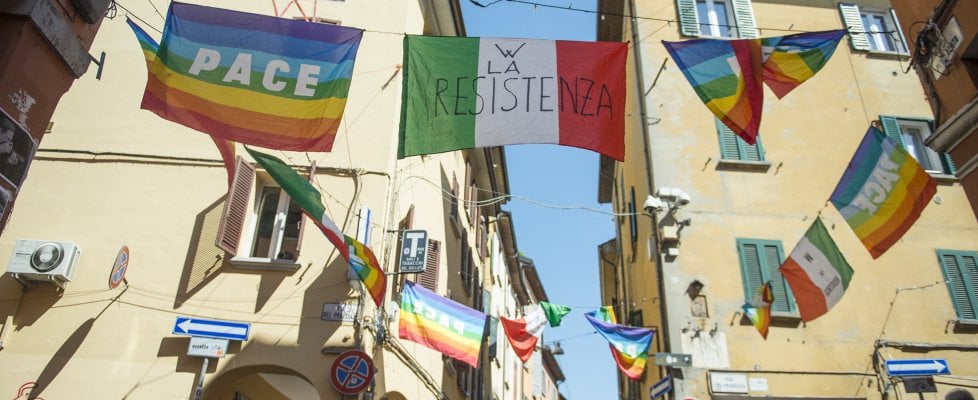
His address to the nation recalled the sacrifices and the courage of the resistance that brought about the nation’s rebirth in 1945, drawing clear parallels with the current battle against coronavirus and how similar sacrifices and courage today will just as surely as in 1945 bring about a further national rebirth. And while the spirit of the resistance could not be celebrated in the manner that the anniversary deserved, it was celebrated nonetheless with countless online gatherings, including a national start-studded virtual fundraiser for the Italian Red Cross. What truly captured the spirit of the resistance, however, were the tens of thousands of citizens up and down the country who hung flags from their windows and congregated on their balconies to unite in rousing renditions of the Inno di Mameli (the national anthem) and the much-loved battle-song of the resistance, ‘Bella Ciao’.

Paradoxically, the stripped-down, homemade celebrations of 2020 may well turn out to have been one of the most memorable and meaningful Liberation Days in the  festival’s seventy-five year history.

Image courtesy of La Repubblica: https://www.repubblica.it/dossier/politica/25-aprile-2020—75-anni-dalla-liberazione?ref=RHHD-T

Meanwhile…

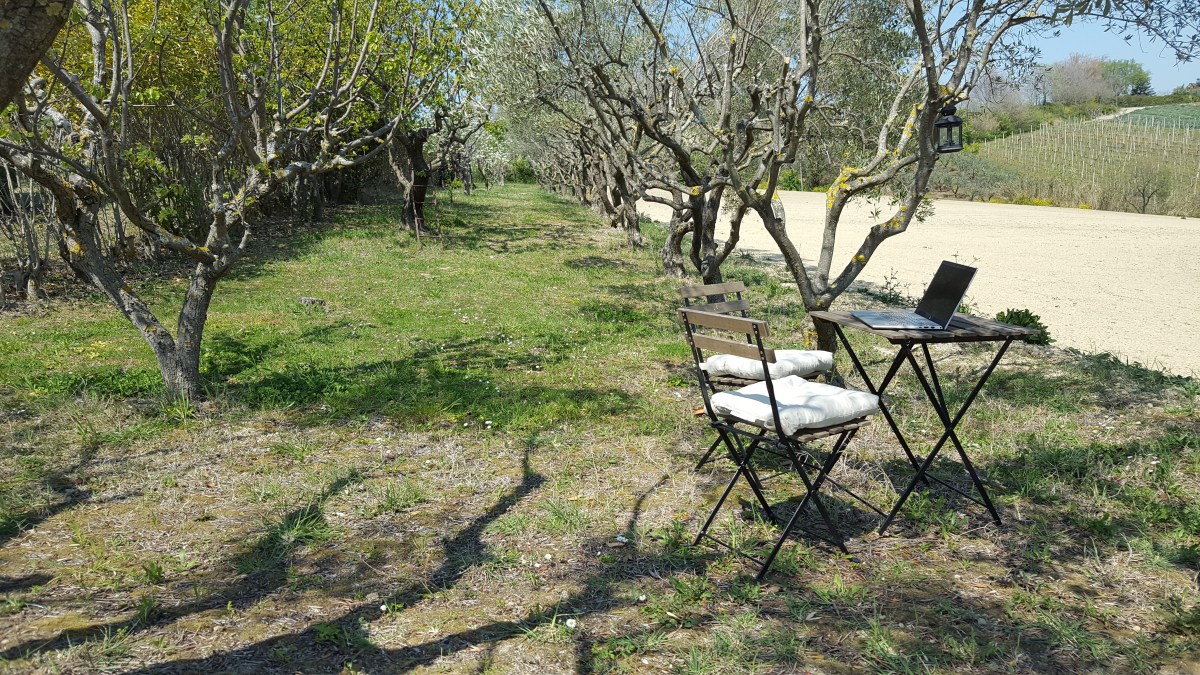
It was back in the pre-corona age of innocence just six weeks ago that I began the tale of Mr Blue-Shirt’s latest project – and probably his biggest to date. This has been the construction of the thirty-eight square metre terrace to the eastern side of the house that would link the sections to the northern and southern sides together and, more importantly, finally give us a proper, grown-up outdoor seating and dining area from which to enjoy the magnificent view over our olive trees up to the village and then down the broad, olive tree and vine filled valley to the tantalising triangle of turquoise sea in the distance.

It was in those weeks when Covid-19 was still a minor story in the foreign news columns that Mr Blue-Shirt progressed from scraping away the topsoil and digging out the foundations for the perimeter wall to lining the sides of the neat, narrow trench with plywood shuttering, then knitting together with twists of heavy wire the sections of thin steel bar that formed the long, thin cages that would reinforce the concrete he later poured into the trench. It was in those days filled with the promise of spring when our minds were still filled with three-year old images of long, languid lunches enjoyed beneath a rose covered pergola on a sunny terrace edged with terracotta pots from which tumbled a mass of scarlet geraniums and crimson petunias that Mr Blue-Shirt spread and flattened the 2.5 cubic metres  of stabilising hardcore that formed the base layer. And that apparently simple step in the process felt like a huge leap forward. In place of an uneven expanse of coarse clumpy grass and bare muddy patches we at last had a clearly defined, mud- and grass-free, flat, solid area outside the garden doors. Those long, languid lunches suddenly seemed a lot closer. To me, at least; for Mr Blue-Shirt, there was still a long way to go.

As the news from Lombardy grew more alarming by the day and the spread of coronavirus became headline news, Mr Blue-Shirt cracked on with the next phase of the build: constructing the low brick walls that would support the whole structure. I’ve mentioned before, I think, that Mr Blue-Shirt loves bricklaying, and he takes great pride in achieving kink-free lines and exact right-angles. And just as with every job he tackles, preparation is paramount, so long before he could set the trusty old cement mixer in motion again, he spent ages – usually at dusk so he could use his prized laser measuring gadget – precisely positioning, checking and re-positioning lengths of yellow nylon string to ensure perfectly straight edges, and a perfectly horizontal surface. Only once he was satisfied he had got everything just so did he start wheeling round the first few loads of bricks carefully selected from the pallets of reusable building materials he had salvaged from the (happily now ‘former’) pigsty.  It was only then, with a neat row of Jenga-like stacks of bricks in place, that he tipped the first batch of freshly mixed cement into his barrow, took the first brick from the nearest stack, spread it with a generous dollop of grey goo, and carefully set it in place, tapped it level with the handle of his trowel and, of course, checked with the spirit level that it was completely straight. One down; two hundred and forty-nine to go.

Over the course of the next week or so as the country gradually began to shut down, the skeleton of the terrace rose from the concrete foundations brick by brick. Neat slices of pinkish-beige laid in arrow-straight rows alternating with stripes of icing-smooth, pale grey cement. It really was a thing of beauty. I was intrigued, too, by how high the wall along the terrace’s furthest-most edge actually needed to be to ensure the whole area would be at the same level. It turned out that the uneven expanse of coarse, clumpy grass that had been our main seating area had sloped away much more than I’d realised, so when it was finished, our smart, new seating area would give us a distinctly more elevated view of the valley. It would feel a bit like being on the prow of a boat, I couldn’t help thinking.

Before Mr Blue-Shirt could crack on with creating that more elevated view, however, he had the incredibly time-consuming and fiddly task of installing all the cabling and conduits for the twelve lights that would be set into the terrace floor, extending and connecting up the irrigation system that is fed from the well, and carefully positioning the steel support brackets for the uprights of the timber pergola that will eventually provide some protection from the fierce midday sun.

Finally, with the giant spider’s web of wire and tubing neatly bunched together with cable ties, all connected up and fully tested, it was on to the infinitely more satisfying business of filling the entire space with rubble. Fortunately, we still had a plentiful supply of the stuff. As well as all the bricks, Mr Blue-Shirt’s methodical demolition of the pigsty had also yielded an enormous heap of broken bricks, tiles and chunks of concrete that he had kept for this very purpose: it had made little sense to send all this building detritus to landfill only to have to  go and buy several cubic metres of hardcore that would simply be made up of someone else’s discarded broken bricks and tiles. And this was quite apart from the symbolic value we continued to place on ‘re-habilitating’ the materials from the building where the chain of events that had culminated in the burglary the previous spring had all started.

As it turned out, the day Mr Blue-Shirt had earmarked for this task was the same day all schools finally closed in an effort to slow the advance of the virus and my teaching timetable was instantly slashed to just a handful of classes. So with some unforeseen free time suddenly on my hands, I could at least help him with the shoulder-wrenching, arm-stretching task of wheeling barrow after barrow of rubble –  three cubic metres of the stuff, in the end – from up behind the well on our western boundary, down past the house and round to its eastern side, heaving the contents into the thirty-eight square metre space, and then levelling it out into a relatively even layer with a heavy-duty rake, but mostly by hand. All the shovelling and shifting and raking threw up great clouds of throat-clogging dust from the ancient cement (and, we suspected, desiccated pigeon poo).  So having just heard news of the first case of the virus in our village, we fervently hoped that no one would hear the incessant coughing and choking that accompanied every barrow load.

Next came the broad, unwieldy sections of steel mesh that had to be snipped exactly to size, and then shuffled into position on top of the layer of chunky rubble. Then, after Mr Blue-Shirt had precisely positioned a series of parallel galvanised steel bars to ensure the desired level across the whole of terrace, everything was at last ready for what would finally turn this large rectangle of rubble into a recognisable terrace: the concrete.

Naturally, Mr Blue-Shirt’s first instinct was to mix and spread the required six cubic metres of concrete himself.  But then he did a little arithmetic: using just our battered old cement mixer, this would take about eighty separate loads. Each of these would weigh about one hundred and eighty kilos, and each would need to be transferred from the mixer to its final destination by hand, barrow and shovel. And even if he managed to mix, shift and spread as many as eight loads per day, it would still take a good ten days to finish the job – if the job didn’t finish him first. So he phoned the quarry to arrange for the six cubic metres to be delivered by truck and pumped straight into the space.

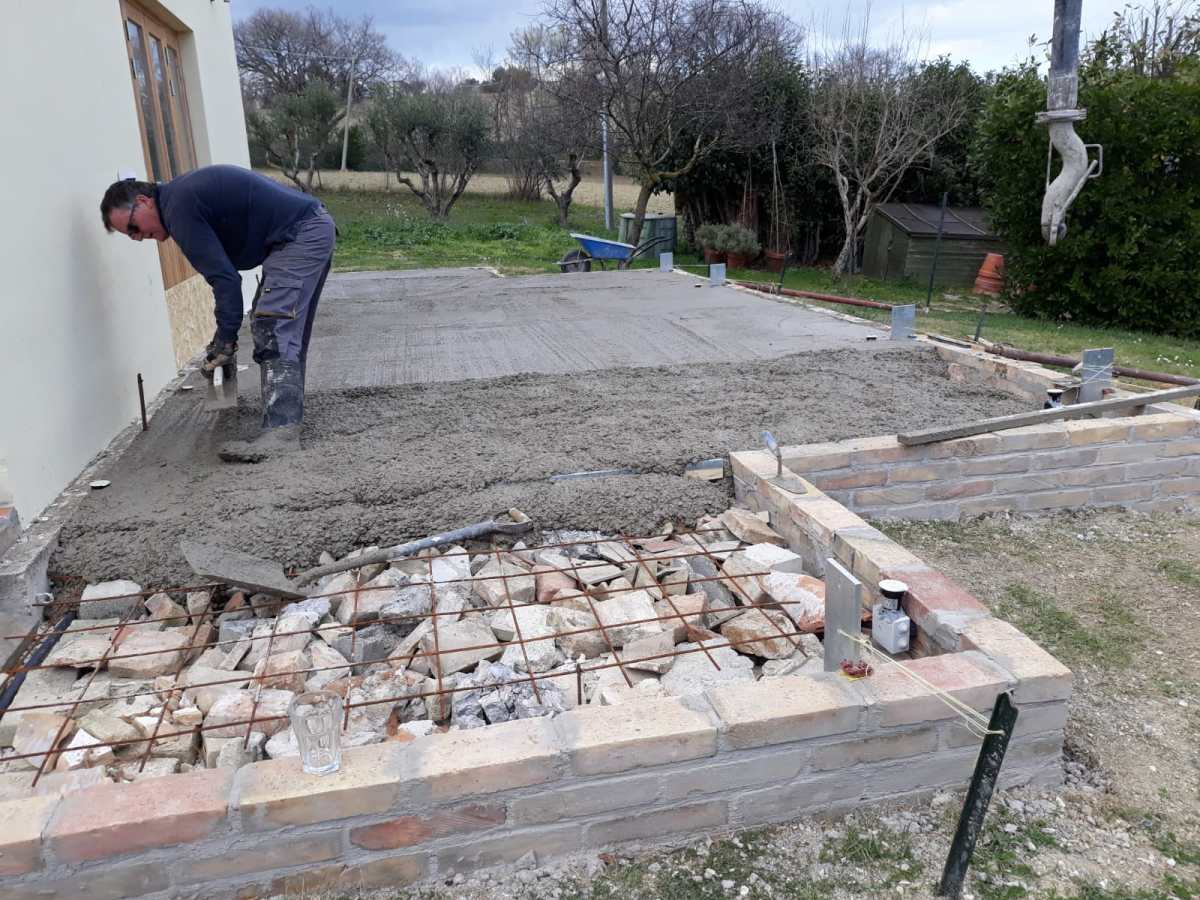
On that Friday in early March, I don’t know who was more tense, Mr Blue-Shirt or me. Mr Blue-Shirt alternated between checking his calculations and peering out of the window every time he heard a vehicle approaching, while I was doing some whistle-stop training on the online teaching platform that we were going to start using the following Monday. But when I eventually emerged from my work room, slightly boggled but more or less ready to run a virtual classroom, the cement truck had been and gone. While I had spent the afternoon getting to grips with screen sharing, breakout rooms and interactive whiteboards, it had disgorged its load over the waiting rubble and mesh as Mr Blue-Shirt plodded about in the viscous grey sludge, hurrying to keep up with the spreading and levelling, as the liquid cement gushed from the pump’s broad nozzle. By the end of the day, though, I was an online English teacher and we had a terrace.

And we had achieved both in the nick of time: at the start of the following week the whole country went into complete lockdown.
This is the time to be slow – Easter in the time of Coronavirus

Uncertainty, fear and anxiety; learning, teaching, and sometimes simply keeping going. Together they have left me drained and weary of mind and spirit, so with this brief pause at last upon us, I am taking the time to relax and recharge, to regroup and reflect. And I am heeding the advice of the Irish poet, author, philosopher and one-time priest John O’Donoghue, whose soothing words I leave you with today.

This is the time to be slow,
Lie low to the wall
Until the bitter weather passes. 

Try, as best you can, not to let
The wire brush of doubt
Scrape from your heart
All sense of yourself
And your hesitant light.

If you remain generous,
Time will come good;
And you will find your feet
Again on fresh pastures of promise,
Where the air will be kind
And blushed with beginning.

May those ‘fresh pastures of promise’ soon be within our sight…


Life under lockdown: politics not quite as usual

Now here’s a word I never expected to use in relation to Italy’s famously turbulent politics: heartening. But that is exactly how they seem at the moment. For the preceding two or three years, mind, Italian politics have been both fractured and fractious. Like many other countries there has been an alarming rise in support for populist right-wing parties resulting in a highly polarised political environment. So it would have been easy to imagine that the ongoing coronavirus crisis would provide fertile territory for opposition parties of all persuasions in which to sow the seeds of further discord and discontent and seek to de-stabilise or even bring down the government.

This is, by the way, a fragile coalition between the anti-establishment Five Star Movement (Movimento Cinque Stelle, aka M5S) and their previously bitterest rivals, the Democratic Party (Partito Democratico – PD). It was hastily cobbled together last autumn after right-wing fire brand Matteo Salvini walked away from the previous, even more fragile coalition between his hard-right La Lega party and the M5S in a bid to capitalise on his popularity in the polls and force the President of the Republic to call a general election which would enable Salvini and the other parties of the hard right to storm to victory. The President, however, chose to obey the constitution rather than give in to Salvini’s political ambitions and invited the two largest parties in parliament, M5S and the left-leaning PD, to try and form a new coalition first. It didn’t take as long as might have been expected for these two sworn enemies to come together, presumably on the basis that ‘my enemy’s enemy is my friend’, but their uneasy coalition was never likely to be much more than a marriage of convenience, and there was little hope that, under the premiership of M5S’s politically inexperienced leader Giuseppe Conte, it would last the course, especially with Salvini on the side-lines still doing his noisy damnedest to undermine it at every turn.

And yet…

Under the measured, spin-free leadership of this sober and statesmanlike former professor of law at the University of Florence, the government’s approach to the current public health emergency and the stringent quarantine measures it put in place in response to the crisis have enjoyed unparalleled support that appears to have transcended party allegiances and ideological differences. In excess of 95% of the population approve of the comprehensive programme of restrictions that have effectively brought social, economic, cultural and spiritual life to a near total halt. And this despite the fact that the government is not simply ‘advising’ or ‘encouraging’ citizens to observe social distancing rules: it’s the law. The government is not just ‘requesting’ or even ‘imploring’ everyone to stay at home: it’s the law. And if people break it, they are subject to an automatic fine of €280 for being outside without sufficient justification, rising to €3000 (or €5000 in the worst hit areas in the north) for those having tested positive for the virus leaving the house. Of course there are rule-breakers, and the number of fines being issued is rising, but in percentage terms, they remain tiny. Some infractions will doubtless have been committed in honest error, too; a good-faith misinterpretation of the rules rather than wilful or intentional breach (not that this makes any difference to the transmission of the virus, I know) especially since local law enforcement agencies have been granted a degree of discretion in terms of what is or is not ‘necessary’ when it comes to leaving the house, or exactly what ‘close to home’ means when it comes to taking exercise.

Throughout all this, however, the opposition parties have remained remarkably quiet. Yes, one party or another claims it would have been more stringent in respect of one regulation, or more relaxed in respect of another; that it would have taken certain steps sooner or taken others later. But that really is the extent of it. Partly, I’m sure, because there really was little else Conte could realistically have done, but also – I would like to think, at least – because there is an unspoken acknowledgement that this is a national crisis of such seriousness that only unity of purpose and unity of resolve will see the country safely through the emergency that is still unfolding.

It will be interesting to see how long this political ceasefire will hold, though. For after nearly a month under lockdown, and despite the €25bn of assistance that has already been made available to families and businesses (as well as €340bn in loan guarantees, with pledges of more to come) the economic impact of the restrictions is really beginning to hurt, especially in deprived areas in the south. Here there are the first stirrings of discontent with the level of financial support being made available to assist those who have been furloughed or laid off, and how difficult and time-consuming it is proving to access it. There are reports – still mercifully rare – of looting, and in a handful of places, armed police have been called in to prevent increasingly desperate people stealing from supermarkets – which remain well-stocked here, incidentally.

So with the curve both for new cases and for fatalities at last beginning to flatten, if not yet actually to fall, Conte’s hardest test may still be to come. He needs to ensure that the country’s resolve does not falter and that it doesn’t lower its guard prematurely, while simultaneously ensuring that the economic burden of maintaining that resolve does not become so weighty that he loses the people’s goodwill – and their self-discipline – and risks undoing the progress that has been made towards overcoming the virus and mitigating its effects on the economy.

The law professor has already learnt to be a statesman in record time. Now he must learn to be a tightrope walker, and probably a juggler, too.


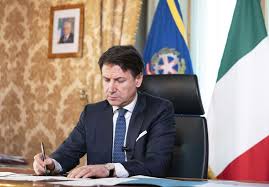
Image of Prime Minister Conte signing the lockdown decree of 11th March 2020 courtesy of http://www.governo.it

Counting our Blessings

Let me be quite clear: we know how very fortunate we are, Mr Blue-Shirt and I. While life is not much fun just now, it isn’t awful either. We have space aplenty inside the house and could even self-isolate separately if the worst happened. That said, our chances of contracting Covid-19 seem vanishingly small since neither of us has been within two metres of another person (and certainly not without mask and gloves) for very nearly three weeks now, and we are otherwise fit and well with no underlying health conditions. Many are not so fortunate.

We are not short of space outside either: we can stroll or sit, stride out or simply ‘be’, enjoy sun or shade, and views in three directions. We know that for all too many even a balcony to sit out on, never mind a garden, would be a blessing. And even with the extremely limited radius within which we are now permitted exercise, we are at least still able to stretch our legs a little and briefly enjoy a change of scene. Many are not so fortunate.

That said, life feels far from relaxing, despite the absence of all the daily dashing about. But then again, we don’t have the added pressure of bored and restless children to feed and clothe, educate and entertain, and simply to tire out; or harder still, a sick or disabled child to look after. Nor do we have the extra worry of care responsibilities for elderly and vulnerable relatives. Many are not so fortunate.

Then there are the countless thousands, if not millions, who cannot meet up with their nearest and dearest just when then they most need the sustenance of the powerful familial networks that are at the very heart of Italian society and form the basis of every family’s social life. But there are also those trapped in abusive relationships who now find themselves imprisoned with their abusers.

And there are those who can no longer work, not even from home, and cannot be sure if they will even have a job to return to once the crisis begins to recede and restrictions gradually loosen. For despite the comprehensive programme of economic rescue measures the government has been racing to put in place, it is taking time for financial help to find its way to those who need it most. And so concerns about paying the mortgage, making the rent or covering the car loan and more will be mounting by the day, and for some relief will simply come too late.

Then there are those who have contracted the virus and who will be fearful of how badly it might affect them, and concerned by how many more they might have transmitted it to. And of course there are those – more than 10,000 families now – who have lost someone to the virus, but who were not able hold their loved one’s hand or say their goodbyes in those final precious hours, and who then were not even permitted to grieve their loved one’s passing in accordance with their faith or to draw comfort and solace from time-honoured funeral rites and rituals.

So when our mood darkens, frustrations bubble up, and we start to feel hard done by, our thoughts turn to those for whom lockdown is a much weightier burden; we take a look around at all we’ve got, give ourselves a sharp talking to, and remind ourselves just how very fortunate we are.

Today, though, it seems that there could be the first tiny glimmer of light at the end of this very long dark tunnel, the first signs that the quarantine measures might just be beginning to gain traction. At last the rate of increase in infections looks as if it could be starting to slow, with the number of new cases falling for four consecutive days; the number of deaths, though still horrifically high, is eighty lower than the day before, and the number of patients who have officially recovered has almost trebled.  And so with these very early signs of hope, it will be just that little bit easier to adopt Churchill’s wartime mantra and simply ‘keep buggering on’.

Data courtesy of http://www.larepubblica.it 20.03.20

Life under Lockdown (contd.)

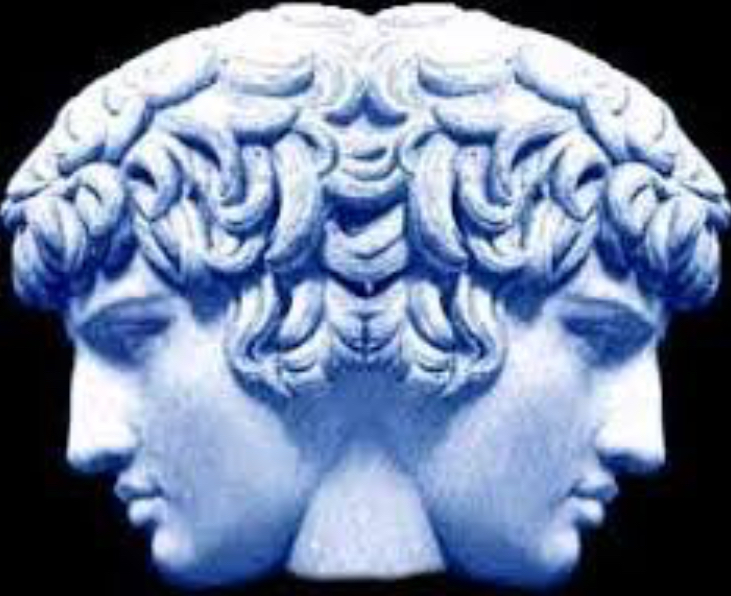
This week – our second in almost total lockdown – I have felt a little like Janus, the Roman god of duality and transitions, of the past and of the future, and who is usually depicted looking both ways at once.

By far the greater part of my week has been spent enclosed in a very twenty-first century online world. My only direct human contact has been with Mr Blue-Shirt and the brief exchanges I have had with a handful of shop assistants at the supermarket, the latter conducted from behind surgical masks. The rest of the time it has been by screen and keyboard, webcam and microphone, both for keeping up to date colleagues and teaching online lessons. Conversations have been dominated by uploads and backups, downloads and workarounds, screen sharing and embedding; by Facebook and WhatsApp, by Zoom and by Skype; by IWBs and VLEs, by 121s and F2Fs – along with quite a lot of FFSs and WTFs.

It has been by turns uplifting and frustrating, satisfying and confusing, entertaining and infuriating, comforting and overwhelming. It is not yet a world where I feel entirely at home, where I feel comfortable in my virtual skin. So when that niggling sense of disorientation and overload has become impossible to ignore, I’ve signed off, logged out and re-grounded myself in the comfort and familiarity of the physical, of the timeless and the permanent. I’ve tugged on my leggings and laced up my trainers and headed out into the fresh air to reconnect with the reality and timelessness of the natural world.

By the way, I know we are in quarantine, but along our quiet lanes, even should I catch sight of another person – invariably one of our neighbours working in their garden – there is no difficulty maintaining the obligatory one-metre’s social distancing. In fact, never mind a metre: it is seldom any less than just waving distance and barely close enough to call out a quick neighbourly greeting. So I remain content that in maintaining and protecting my own well-being, I am acting within the rules and putting no one else at risk.

Sooner or later almost every day I’ve found myself craving the sensation of the sun on my skin, the breeze in my hair; longing to drink in the sound of birdsong and the scent of new flowers, the sight of buds bursting and leaves unfurling. The significance of these unfailing, irrefutable, almost clichéd symbols of rebirth, regrowth, and recovery has seldom seemed greater in these fear-filled times of disease and death. As ever, when the world weighs heavily on my shoulders, it is going for a run that allows me to recalibrate, to restore balance and perspective. And running in the soothing Marchigian landscape brings an additional breadth to that perspective. For it is such a timeless landscape whose features have altered little for generations. These gentle hills and valleys, vineyards, fields and olive groves, the mighty mountains and even the glittering sea have all borne witness to drought and deluge, fire and famine, earthquake, war and occupation – and have withstood the lot. It is a landscape that has endured and recovered, that has provided food and sustained communities for centuries, that has continued to shift from past to present to future in an infinite cycle of renewal – and so that never fails to remind me that ‘this too shall pass’.

And it is this above all that eases my spirit and calms my mood and enables me to return to my other, virtual world, refreshed and restored and ready to confront the next wave of daily challenges that quarantine will bring.

It was the best of times, it was the worst of times (part 2)

Whereas yesterday it was all about ‘the worst of times’ in coronavirus-stricken Italy, today it is all about ‘the best of times’, for even under lockdown there have been many positives to hang onto amid the fear and gloom.

First of all, in a country where family and community mean everything, there is an almost palpable sense of solidarity and selflessness. While many Italians tend to regard the state with some degree of scepticism if not suspicion, there has been little opposition to or defiance of the government’s stringent quarantine measures. Indeed, a poll earlier this week indicated an 89% approval rating, and, more importantly, people are observing them with good grace.

In our local supermarket, for instance, customers diligently observe the required one-metre gap between people with sombre courtesy and patient stoicism, waiting until one shopper has finished at a particular shelf before approaching to make their choice, then beckoning the next shopper forward when they are done. There is no sense of panic, no over-filled trolleys, no empty shelves. Instead of the ‘every man for themselves’, ‘I’m all right, Jack’ attitude on display elsewhere, here the overriding sense is that ‘we are all in this together’, that ‘together we can crack this’.

That same spirit of togetherness and solidarity has characterised my working week as well. All my colleagues and I – an international team of some fifteen teachers – have been working remotely from home, going the extra mile to provide online lessons to our students. Learning to use unfamiliar software at breakneck speed has been a massive challenge for us all, but we have managed it – largely thanks to the entire team’s generosity, patience, support, friendship and good humour, which have truly been a shining light in these dark days.  And I am certain that we are just one of tens of thousands of companies across the country where this same spirit of cooperation is in evidence, with everyone pulling together to keep their respective ships afloat.

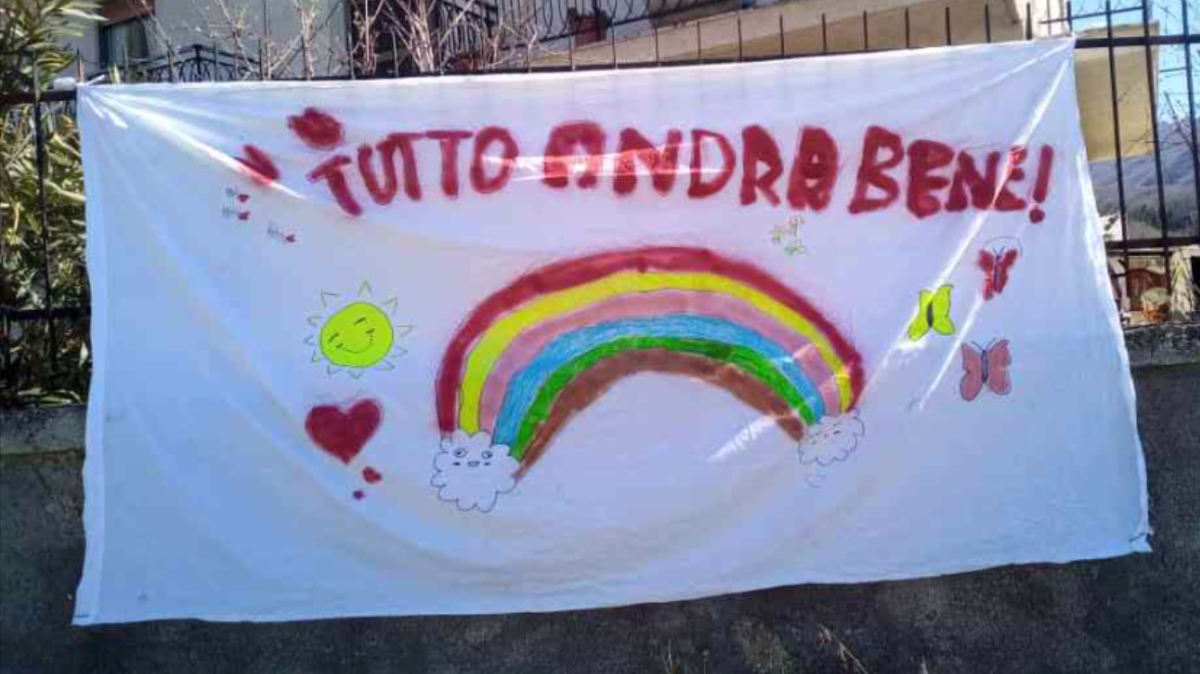
In fact, that spirit of solidarity, coupled with a kind of defiant optimism, is spreading throughout the country faster than the coronavirus itself. From Turin to Palermo, people have been combatting the isolation and boredom of quarantine by taking to their balconies and conducting spontaneous bursts of community singing. Folks songs, pop songs, patriotic songs – anything to lift the spirits that that everyone can join in with, even if that means using saucepan lids as cymbals or cooking pots as drums. Amateur DJs have set up their equipment on their balconies and blasted music across the rooftops for their neighbours to dance to in their sitting rooms. Elsewhere a lone trumpeter played the national anthem from his tiny balcony and ended up with his neighbours producing a rendition of the rousing Inno di Mameli as rowdy and impassioned as anything you are likely to hear on the terraces at San Siro or the Stadio Olimpico. And having realised the power of the flash mob, people are now harnessing it to raise funds for their embattled and under-resourced local hospitals, with sums of €50,000 being donated in a matter of hours in several locations in the south. But spreading more quickly than anything else, though, is the slogan “tutto andrà bene” – everything will be all right. Children from one end of the country are leaving it on sticky notes in windows, accompanying it with paintings of rainbows on posters taped to front doors, and decorated with love hearts and smileys on homemade banners hung from balconies.

And so in these fear-filled ‘worst of times,’ with all these simple yet powerful expressions of unity and hope, you can’t help feeling that it is somehow also ‘the best of times’.


Image courtesy of confinelive.it

It was the best of times, it was the worst of times (part 1)

It is the opening line of Charles Dickens’ historical epic, The Tale of Two Cities. He was describing pre-revolutionary France, but it also perfectly sums up life in coronavirus-stricken Italy at the moment.

So let’s deal with the worst part first: after four days’ total quarantine, the statistics remain grim. Here in Le Marche, the number of fatalities now stands at 36, and the number of confirmed cases has risen to 899 (two-thirds of which are confined to the northernmost province of Pesaro Urbino), while in our province of Macerata, there are currently 58 confirmed cases, but mercifully few fatalities. Nationwide, meanwhile, confirmed cases stand at just shy of 15,000 (including about 1,100 people who have recovered) and slightly over 1,200 fatalities in total – with things widely expected to get worse before they get better. And of course, the hope of the entire nation is that the stringent quarantine measures brought in on Tuesday will enable things to get better; that the hardships we are currently enduring will be worth it.

With practically everything that is not essential for daily existence now closed, and everyone instructed to stay at home as far as humanly possible, this gregarious, noisy, exuberant and sociable country has fallen almost silent, which in itself is quite unnerving. Streets are deserted, roads empty, and shops stand shuttered and lifeless. The only pockets of relative busy-ness are around supermarkets, but it still feels rather like a scene from a dystopian survivalist drama. A line of customers snakes across the car park, each one obediently standing one metre behind the next, the officially decreed spacing marked out on the tarmac in yellow and black striped tape. They are all waiting for their turn to enter, for there is a strict ‘one in, one out’ policy in place to make sure that the obligatory one-metre gap can be maintained while people shop. Once inside, many customers and all of the staff are in gloves and masks. The checkout cashiers stand behind Perspex screens, while a couple of their colleagues wipe down trolley handles with disinfectant. The place is strangely quiet, partly because the masks impede conversation, but also because only one person per household is now permitted to go shopping. So there are no couples noisily debating which type of bread to buy, no small children scampering up and down the aisles while their parents queue for meat or fish, no clusters of chatty pensioners turning their weekly shop into a social outing. Just near-silent acceptance – and a hint of fear.

There is fear not only for the virus, though. Now that so many businesses are closed and staff laid off, people are also starting to fear for their jobs and their livelihoods, despite a wide-ranging programme of tax holidays and state-backed loan guarantees as well as financial support for the hardest hit sectors. But for any business teetering on the edge in Italy’s already fragile economy, these closures could well push them over the edge and a two-week lay-off could easily turn into redundancy. And with schools and universities already closed for fortnight, students are becoming concerned about their exams (which are in turmoil) and the likely effects on their future studies and career prospects. So this is very far from just an enforced holiday; this is not a time of idle pleasure, nor of unexpected relaxation.

And yet, it also has been ‘the season of Light’, as Dickens put it, not only ‘the season of Darkness’; there have still been positives to hang onto…


Image: http://www.ilriformista.it