Finally!

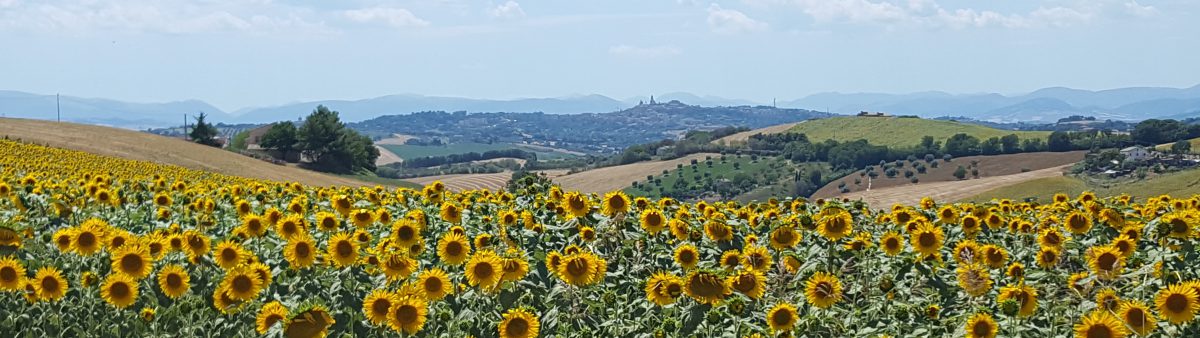
From the ruby-red sofa on which I am curled I peer through the rain-streaked windows of the garden doors, up towards where Montelupone stands wrapped in a grimy shawl of thick cloud. One of the September storms that mark the start of the shift from summer to autumn is raging outside, angry gusts of wind rattling the shutters and curtains of rain billowing across the terrace. It is almost the first time since May that we have really used the sitting room, which over summer became little more than a corridor between the kitchen and the terrace where we have spent most of the last five months.

In late April we pressure-washed, sanded and oiled all our outdoor furniture, and since it can accommodate around a dozen people, perhaps this was an early manifestation of the growing optimism we felt as we emerged from our third period of lockdown and the vaccination programme started to gain traction. Then once we had re-positioned the dining table and chairs and the L-shaped sofa to their respective positions on each side of the main terrace and re-erected the parasol over the former and the sail shade over the latter, we effectively moved outside for the summer. When we haven’t been busy at home or out and about, we have been outside on one part of the terrace or another: cooking and eating, writing and reading, Zooming and snoozing, making conversation, or just drinking in the picture-postcard view up the hill to the village and down to the tantalising triangle of turquoise sea at the bottom, and in the scented warmth of the evening, simply watching the lights twinkling across the valley and listening to the chirruping of the crickets.

The only thing is, Mr Blue-Shirt built this fantastically sociable space over the course of the first lockdown. So even though it had always been conceived as a place to while away lazy summer days with friends and family, for over a year while further lockdowns came and went and rules on visitors and travel restrictions persisted, it had to remain just the two of us on our own on the terrace. But a couple of weeks ago, and almost two years – two years! – since we had had people to stay, we were finally able to welcome friends here once more and to share our space at last.

It was quite ridiculous really, as before the pandemic we’d been used to having people to stay every six or eight weeks, but we found ourselves feeling almost nervous before Bill and Melanie arrived. All the things that had previously come so naturally now felt unfamiliar and out-of-practice: had I remembered to put fresh towels in the bathroom? had I checked that the hairdryer was still in the drawer in the guest room? did we have enough milk – and wine! – in the fridge? could we still remember how to cook for four rather than just two? But the instant they pulled onto the drive, the nerves dissolved beneath the huge wave of joy that washed over us. This. This was what we had been missing. This was how it was supposed to be. And it really was the simple fact of Bill and Melanie being here, with us, in our space that caused us such delight. For we had already done the whole outpouring of emotion thing when we met up again for the first time in over two years at the international blacksmithing event in Tuscany from where we had just returned. The tangle of hugs as they climbed out of the car, the babble of chat about routes and traffic, the unloading of suitcases, the ‘make yourselves at home’ and ‘what can I get you to drink?’This was what was normal and real and as it should be; not the separation, solitude and relentless monochrome of the last eighteen months. This was us. We were back – because people were back. Full colour had been restored.

Being able to hear other people’s laughter from upstairs, to catch the hum of conversation in another room, or even see two different pairs of legs walking down the stairs as I prepared breakfast in the kitchen were all somehow both alien yet ordinary, surprising yet comforting. The sound drifting in through the garden doors of chairs shifting and plates and glasses clinking, the sight about the place of books and tablets, bags and shoes that were not our own all came as such a delicious familiarity-tinged novelty.

I snuggle deeper into the sofa’s cosy embrace, recalling the late lunches and long suppers the four of us enjoyed together around the table on which the rain now beats down and gurgles in the gutters like an echo of our laughter. I watch the lavender and plumbago that edge the terrace trembling in the strengthening wind that tugs insistently at the sail shade beneath whose shelter we had lounged on the sofa, spinning yarns, sharing jokes and swapping tales, and I am cheered by the renewed sense of connection that this simple togetherness has given me.

Another flash of lightning briefly splits the grey and I reluctantly conclude that it is probably time to pack up the barbecue, take the parasol and sail shade down and put the covers on the furniture for winter. But even though it may be time to close the doors on summer and return to life indoors, my sadness at the fading of the season is tempered by the knowledge that the doors on normal life, on our life, have at last re-opened. And with our next set of visitors due within the month and still more already in the diary, the prospect of more, long-awaited reunions, togetherness and reconnection fill me with more warmth and delight than even the most perfect summer’s day spent out on the terrace.
“And so we emerge to see the stars once more”

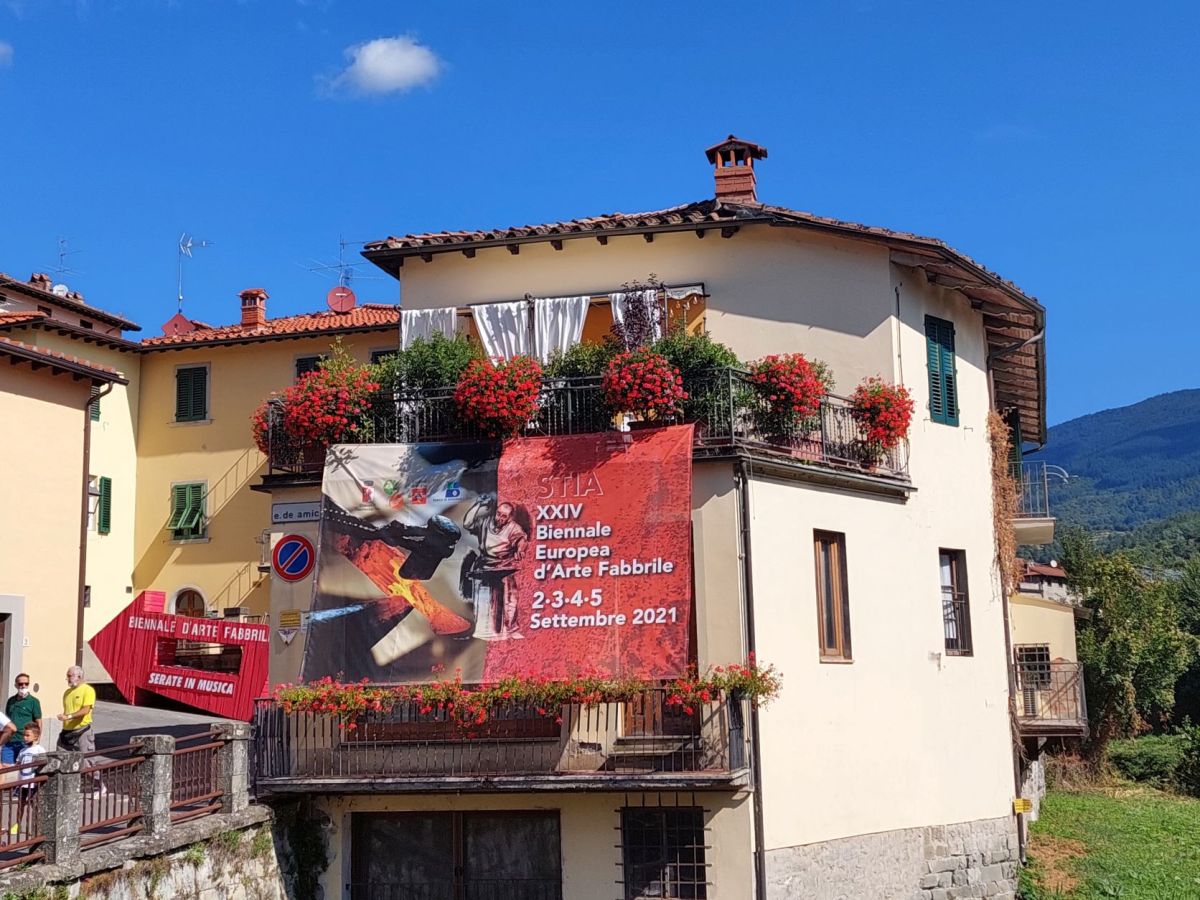
Our principal reason for choosing Tuscany as the destination for our brief summer break is that it is the home of the Biennale Europea d’Arte Fabbrile (European Blacksmithing Biennial) which for over forty years has been held in Stia, a small and dignified medieval town nestling in the forest-clad hills of the Casentino area of Tuscany about 60km east of Florence and 50km north of Arezzo. We first started going in 2007, and while we were running our blacksmith’s forge, it provided the ideal opportunity for an extra trip to Italy. Since we relocated to Italy in 2017, though, things have done a complete volte-face and this four-day international festival of forging now provides the ideal opportunity to catch up with the blacksmithing scene. And even though we appreciated that essential anti-Covid measures were likely to compromise some aspects of this large and complex event, we were just delighted it was able to go ahead at all, and were even more excited about meeting up with a few of our blacksmithing friends whom we had not seen since well before the pandemic.

After checking in at our usual hotel in the historical centre, we wandered up to the main square to register our attendance, have our Covid Passes scanned and be given the fluorescent green wristbands that would then give us access to every element of the event without further checks being necessary, then it was straight across to the forging area that takes over most of the rest of Piazza Mazzini. We were pleased to see that along the customary row of glowing hearths, grubby-faced blacksmiths were already hammering furiously at their anvils to produce their entry for the competition that is the raison d’être of the event. Using just the material provided, participants have three hours in which to produce a piece of work in response to a set theme that is announced a month in advance. In the circumstances, few had been surprised to find that it was a famous quote from Dante’s Divina Commedia – E quindi uscimmo a riveder le stelle” – that refers to the return to normality after a period of anxiety, danger or difficulty.

Apart from the fact that we now had to show our wristbands to enter the viewing area, and could only stand in the space opposite the forges where normally there was a bank of seating to watch from, it was all very much business as usual, with plenty of spectators avidly following what was going on. Meanwhile, the customary unlikely mix of tattoo-ed and dreadlocked smiths, stiff-hipped grannies, smart couples and self-conscious teenagers milled about in the remainder of the shady square, simply taking in all the sights and sounds and comings and goings, and it was good to see that even in these difficult times, the event had, as ever, attracted almost as many ‘lay’ visitors as blacksmiths.

Mr Blue-Shirt was planning to forge a piece he had designed with our pal Bill who was driving down through France from the UK. So we found ourselves looking out for his familiar lanky form and floppy hat as we wandered down the hill for a quick coffee at the quirky bar by the bridge over the Arno that provides the best people-watching spot in town. And as we drained the last of our cappuccini, I caught sight of him, wheeling a suitcase across the road.
“There he is!” I yelped excitedly, suddenly all too aware that this was the first time in two years we had seen any of our UK friends in the flesh.
“And there’s Melanie, too,” said Mr Blue-Shirt, pointing to the equally familiar figure of Bill’s wife in one of her trademark colourful kaftans walking up from the car park. “They look a bit frazzled – Bill said they were setting off at dawn from down by Grenoble.”
“Yes, let’s leave them to get settled in and arrange to meet up later.” I said, trying to be calm and sensible – and to loosen the knot that had formed in my throat.

With Bill and Melanie’s arrival giving us an extra spring in our step, we continued on to Piazza Tanucci in the heart of the old town. This year, there were fewer of the dramatically lit large sculptural pieces normally displayed along one side of this narrow square lined with tall palazzi, and the casual seating made from pallets, scaffolding planks and re-purposed oil drums was very obviously much more spread out than usual. But the stage with full sound and lighting rig was still there: a good sign as it meant that live music was still set to form part of the evening programme. Then from the far end of the square, we headed down the narrow alleyway that leads to the lanificio, the semi-restored woollen mill whose huge contemporary gallery space houses one of the event’s other key elements, a professionally curated exhibition of forged ironwork.  

“I think that’s Luc!” exclaimed Mr Blue-Shirt as we approached the forging demonstration area outside the mill. And sure enough, there was our Belgian friend whom we had worked with at various international events over the years, his distinctive shock of thick silver hair standing out among his team of black-clad smiths hammering away at what we later learnt was sculptural piece for the local children’s playground. We waited at the guard-rail for a few minutes, not wanting to interrupt Luc while he was working. Eventually he glanced up, looked back down at his anvil – then did the biggest double take ever, all but dropped his hammer and ducked under the rail to envelop us both in a massive bear-hug that soon also included Luc’s wife Christine who had suddenly appeared from nowhere. Gradually we let go of one another, our eyes glistening with barely held back tears, and hastily exchanged news, assured each other that we had got through the pandemic OK and promised to meet up for a drink . Then, amid much back-slapping and kiss-blowing, we let Luc and Christine get back to work while we carried on up to the exhibition, babbling excitedly about how fantastic it had been to see them both.

We made a quick tour the exhibition, noting that while there were some fabulous pieces, there were far fewer exhibits than normal – although whether it was simply a sign of the times or a deliberate tactic to keep numbers in the gallery down, we couldn’t decide. But we didn’t really take much in after bumping into Luc and Christine. For this had made us keener than ever to see Bill and Melanie, so after a rapid exchange of messages we agreed where and when to meet for dinner.

They were already sitting at one of the long trestle tables outside when we arrived at the bar by the Arno and leapt to their feet the instant they saw us, their arms flung wide in greeting. And only after a prolonged frenzy of hugging and handshakes (and discreetly dabbed eyes) did we manage to curb our childlike excitement and sit down and talk like proper grown-ups. Without interrupting our conversation, we soon slipped from drinks to dinner, and continued talking and laughing, eating and drinking and then talking and laughing some more until we were the only people left in the restaurant and the charming staff politely made it plain that it was closing time.

The next couple of days were spent drifting from café to gelateria and from bar to restaurant together, catching up properly with Luc and Christine, and simply enjoying being part of this incredibly sociable gathering once more. We did also manage to check out the drawing and design competition and the children’s forging station, attend a couple of lectures and take a proper look at the exhibition, none of which turned out to be as compromised by the anti-Covid measures as we had feared. Best of all, though, while overall participation was definitely lower than usual, a good 70 or so competition pieces ended up on display along one side of Piazza Mazzini, forged by around 85 smiths from over a dozen countries including Russia, the USA and Japan, while the UK sadly had just two representatives this year, namely Bill and Mr Blue-Shirt. Over the course of their three hours, they produced, with a little added muscle power from a kindly American smith, a piece that showed the virus being crushed into submission by a large hammer – one of a number of entries that made direct reference to Covid.

We agreed on our way home to get ready for Bill and Melanie to come and stay for a few days that our trip had been all that we had hoped it would be. We had managed a few days away, we had found the event that we remain so fond of in surprisingly rude health, Mr Blue-Shirt had been able to swing a hammer for the first time in four years, and – best of all by miles – we had had the chance to spend proper face-to-face time with some very dear friends. All of which left us feeling more energised and connected than we had done in months, and that we truly had in some ways ‘emerge[d] to see the stars once more’.

Note: ‘And so we emerge to see the stars once more’ is a rough translation of “E quindi uscimmo a riveder le stelle”, the quote from Dante’s Divine Comedy that provided the theme for the forging competition.

Refamiliarising Ourselves With The Unfamiliar

In the heady days of last summer when we naively imagined the Covid nightmare might be coming to an end, we managed to escape for twelve magical days in Croatia. This year, although the acute phase of the pandemic and its shocking novelty may have slackened into the weary familiarity of its chronic phase, the cumulative burden of a further year’s anxiety, uncertainty, separation and solitude had left us even more stale and depleted, but also with an even greater need to do something different, be somewhere different and see the world through a different lens in order to shake us out of our post-lockdown lassitude. However, another year of unpredictability and ever-changing rules had also made us wiser and more wary, so in late spring, with our vaccines lined up and the promised land of the white zone in which only the most basic restrictions remained drawing ever closer, we booked ourselves just six days in Tuscany (still taking care to ensure that last-minute cancellation would be possible). But despite the comparative modesty of our ambitions, those six days in late August turned out to be just as special and just as restorative as the previous year’s more adventurous trip across the Adriatic.

We started off with three nights in Arezzo, little more than a couple of hours away from us in Tuscany’s south-eastern corner, close to the border with Umbria and about 40km north of Lago Trasimeno. The opening line of Arezzo’s entry in our aged Lonely Planet guide, “heavily bombed in World War II”, had nearly put us off, but an acquaintance had warmly recommended it some years earlier, and now that we actually live here, we are in any event always keen to pay a brief visit those lesser-known places that stand in the shadows of their showier, more popular neighbours – Florence and Siena in Arezzo’s case – safe in the knowledge that should such a place prove disappointing, it won’t have spoilt a whole holiday. And despite its general sniffiness about the city, our Lonely Planet did concede that its ‘medieval centre packs some inspiring highlights’.

These highlights, not surprisingly, are all located within the ancient fortified walls that still almost completely encircle the city. And at last being able to enjoy once more the simple pleasure of ambling, map in hand, through an unfamiliar city’s ancient streets and discovering all these new and different sights was exactly what we had been longing for. They included a medieval fort, a cathedral and sundry other vast and tiny churches, all dripping with Renaissance artwork, an assortment of grand palazzi, several galleries and museums, and a Roman amphitheatre that is still in use as a performance space. The beating heart of the city, however, is the magnificent Piazza Grande. This broad, sloping square was originally a market place, with the tall, narrow merchants’ palaces built along the eastern and southern sides in the 14th century still standing as testament to its commercial roots. During the Renaissance, however, the square became the civic centre and the imposing Palazetto della Fraternità dei Laici and the elegant Logge Vasari were built alongside the church of Santa Maria della Pieve with its distinctive bell tower and the sombre episcopal palace on the northern and western sides.

As if this glorious jumble of architectural periods and styles were not arresting enough, as we entered the square via a narrow alley in the north-west corner we were also greeted with the sight of large, brightly-coloured flags fluttering from practically every window in every building, while around the edges, tiered banks of temporary seating were being erected, and across the middle ran a banked-up track made from tightly packed earth and sand – and a crackle of anticipation hung in the late summer air among the clusters of dawdling tourists and busy workmen. The waiter at the café where, over a mid-morning cappuccino, we indulged in a little people-watching in an unsuccessful effort to work out what was going on eventually told us all this activity was in preparation for the Giostra del Saracino – the city’s biannual Saracen Joust. In response to our blank expressions, he directed us to the grand Palazzo dei Priori, which, as well as being the current town hall, also houses a museum of the joust that explains the history and traditions of this hugely popular, hugely spectacular event – to which our Lonely Planet guide, quite inexplicably, devoted not one single word.

We are not big museum-goers, but the colourful bustle in the Piazza Grande had piqued our curiosity and, coupled with an unaccountable keenness to test out our freshly downloaded Covid Passes, soon had us striding back across the square and up the hill to the town hall. Having successfully scanned our passes, the young and enthusiastic curator theatrically swung open the huge double doors that gave access to the exhibition and indicated the route we should take through the various rooms. Over the next hour or so, we learnt by means of the first-class immersive audio-visual displays in each of them that the joust, which takes place in late June and in early September, dates back to the Middle Ages when it was used for military training purposes. While it flourished throughout the 16th and 17th centuries, it fell into decline during the 18th and 19th centuries, but was resurrected in the early 20th century, since when it has grown into the day-long extravaganza of today (Covid restrictions notwithstanding), with its cast of some 350 costumed characters. These include a long procession of buglers, drummers, flag-wavers, jugglers, valets, crossbowmen and foot soldiers, as well as the Herald, the Registrar, the Field Steward, the Jury of score-keepers and the Judicature who make sure the byzantine rules are complied with. The real stars of the show, though, are the eight mounted Knights of the Joust. Organised into four pairs, each representing a different quarter of the town, they take it in turns to gallop at full speed across the square and, with the inked tips of their 3.5-metre-long lances, try to strike the highest scoring portion of the target fixed to the shield of the Saracen, a wooden effigy of “Buratto, Kind of the Indies”. After three nail-biting rounds, and frequently a tense tie-breaker too, the quarter represented by the two highest scoring knights is awarded the coveted Golden Lance by the Mayor. There follows a cannon salute and a Mass of thanksgiving held by the Bishop in the cathedral, and proceedings are rounded off with rowdy, night-long celebrations throughout the city.

Here’s the thing, though: the very fact that this September’s joust was happening the day after we left Arezzo did not disappoint us in the slightest. In fact, it came as a much-needed reminder that we could come back in subsequent years at the drop of a hat as such events are practically on our doorstep. The relative novelty of this for us had not so much worn off over lockdown as been shut away and completely forgotten about. And, slightly paradoxically, the simple fact that we felt able to say ‘never mind, we can always come another time’ did almost as much to lift our spirits as being there in the first place.

So we spent the rest of our time in the city contentedly wandering around the enticing maze of narrow, cobbled streets surrounding the Piazza Grande, poking around in their many antique shops and quirky boutiques, and deciding which of the dozens of long-established, family-run ristoranti, trattorie and osterie serving local specialities we would dine in.  And each evening we still got a taste of the joust anyway, as horses were trotted in and out and around the square to familiarise them with the layout of the course, while bands of drummers from one quarter and teams of flag-wavers from another, all incongruously dressed in T-shirts and shorts, carried out their rehearsals in the evening cool of the near-empty streets.

There was another reason why we were not that bothered by missing the joust, though. It was the second half of our trip, and really why we had picked Tuscany as our destination in the first place: the Biennale Nazionale di Arte Fabbrile (National Blacksmithing Biennial) – held in Stia, barely 50km north of Arezzo. Yes, it would give Mr Blue-Shirt his first chance to swing a hammer in nearly four years, but so much more precious than that, it would give us the chance actually to meet up with a few of our blacksmithing friends whom we had not seen for over two years. So: joust-schmoust. We had proper, actual hugs to look forward to…

For more information on the Saracen Joust, go to https://giostradelsaracinoarezzo.it/la-storia/

‘…. As The Romans Do’

Ferragosto is the national public holiday on 15th August that marks the height of summer. Like many traditions in Italy, the origins of this festival are Roman. The name is a corruption of ‘feriae augusti’, which translates as ‘the holidays of Augustus’, the Emperor who in the 18BC designated August as a period of rest following the strenuous labour of bringing in the harvest over the preceding weeks. During this period, working animals were also relieved of their loads and horse races were held as part of the celebrations.  Indeed, this is the origin of the world-famous palio that is still held in the Tuscan town of Siena on 16th August in much the same form as in Roman times, although it had to be cancelled again this year as its traditional rituals (and the crowds it attracts) did not conform with anti-Covid regulations.

August was already punctuated with festivals such as the three-day Nemoralia dedicated to Diana the Huntress, the Consualia to honour Consus, the god of the harvest, and the Vinalia Rustica to celebrate the forthcoming grape harvest. By unifying all these pre-existing jollities into one continuous holiday period, the Emperor’s gesture of largesse was consequently tempered with an element of practicality, not to mention a dash of politics by currying favour with the masses, who on wishing their masters ‘buon ferragosto’ would receive a small gift of money or food with which to enjoy the holidays. This tradition became so entrenched that during the Renaissance, the Papal States (of which Le Marche then formed part) made it obligatory.

Along with many other festivals of Roman origin, the Catholic Church soon muscled in on things and sought to Christianise these pagan festivities as early as the 5th century AD when it established The Feast of the Assumption of the Virgin Mary bang in the middle of the feriae augusti.  Since then, 15th August has marked the day on which the Virgin is claimed to have ascended to Heaven at the end of her life on earth and is technically the reason why it is a public holiday in Italy.

In the first part of the twentieth century, the festival took on a more political flavour when Mussolini’s fascist regime began organising discounted trips for workers through its Opera Nazionale Dopolavoro (National Recreational Club), which was conceived as a means of competing with the Socialists in terms of looking after workers’ welfare. The initiative, known as ‘the People’s Trains of Ferragosto’, ran from 1931 to 1939 and gave the working classes the opportunity to take short trips to the seaside, the mountains or cultural sites – which is why present-day tourists are still able to visit museums, monuments and galleries on 15th August even though many other amenities will be shut. As it was aimed chiefly at city dwellers and workers, it turned Ferragosto from an almost exclusively rural affair into a festival for all the labouring classes and as such was effectively a fore-runner of modern mass tourism.

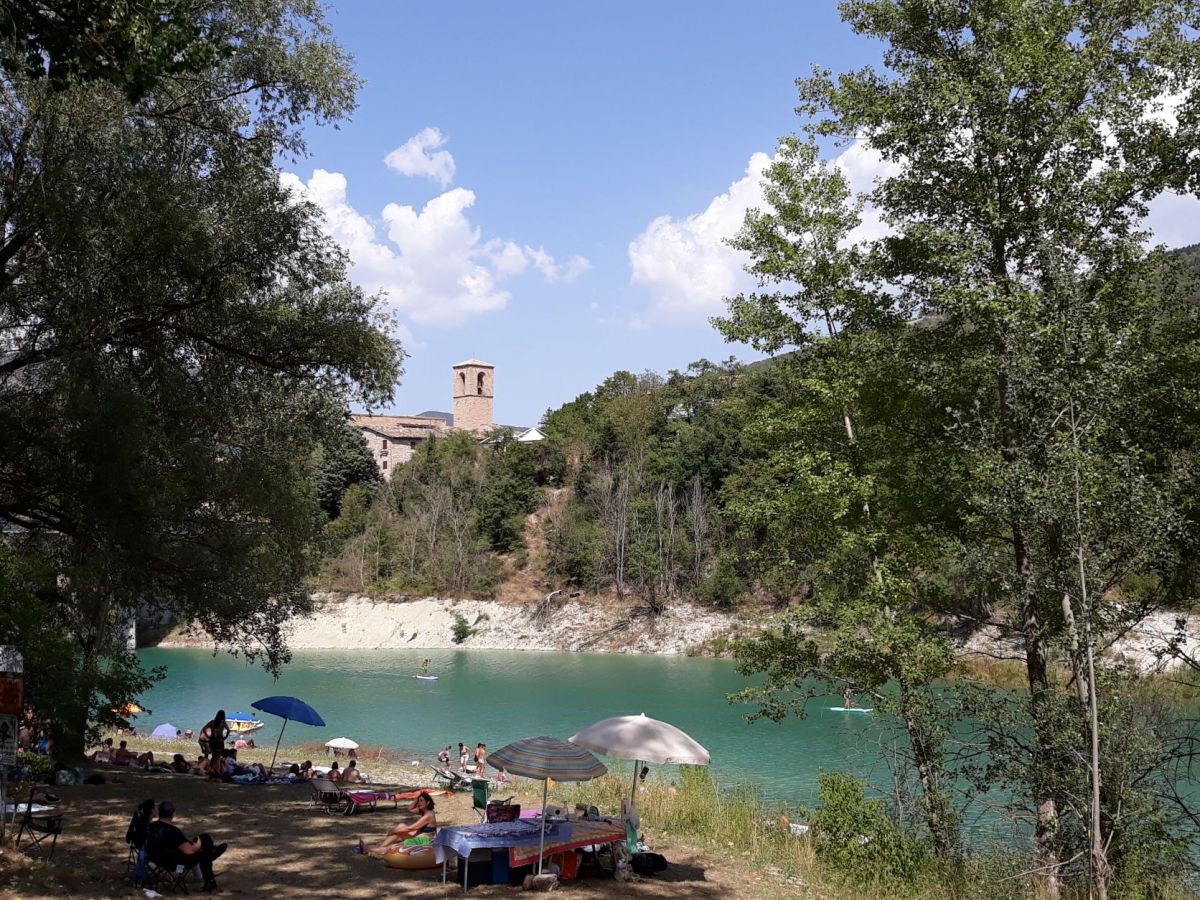
Another feature of the fascist era Ferragosto that has persisted is the picnic. As the People’s Train trips did not include meals, travellers had to bring their own food with them and this tradition has stuck. A protracted lunch all’aperto (in the open) with family and friends, preferably somewhere that offers some respite from the mid-summer heat, still forms an integral part of celebrations. And this is exactly how we spent the day, especially since Ferragosto this year coincided with the peak of the pitiless heatwave that has held us in its searing grip since mid-June. So with temperatures set to reach 38°C locally we headed up into the relative cool of the Sibillini Mountains for a picnic on the shores of the cobalt-blue Lago di Fiastra. By the time we had reached Sarnano, the self-styled ‘gateway to the Sibillini’, it was already well into the mid-30s. But within minutes of turning off onto the long, winding climb up towards Sassotetto (literally ‘rock roof’) the temperature began to fall. About half the way up we raised a cheer as the display on the dashboard finally dropped below 30°C, and continued to drop by another degree with every additional 100m or so of altitude. By the time we reached the summit (c.1100m), it showed just 24°C – cooler than most nights for the preceding fortnight – but as soon as the road started to take us down the other side towards the lake, the temperature began to climb again and was back to 30°C by the time we reached the normally sleepy lakeside village of San Lorenzo al Lago. Today, however, its narrow, winding streets were crammed with visitors to its Ferragosto farmers’ market selling an array of local pecorino cheese, lentils, sausage, ham and all sorts of truffle-based delicacies, and traffic was reduced to walking pace despite the frantic arm-waving and whistle-blowing efforts of the local police to keep things moving. Within a few minutes, though, the mayhem was behind us and we caught our first enticing glimpse of glittering turquoise further down the hill.

Most people remain on the through-road that runs parallel to the lake and provides easy access to the steep shale beaches along the eastern shore. But we headed left, over the bridge towards the small town of Fiastra and immediately turned off to our preferred spot at the southernmost end of the lake. Down a narrow, easily missed lane, clumps of mature trees cast dappled shade over a broad grassy bank that slopes gently down to the inviting water. Usually it is very quiet and, well hidden from the road, feels almost private. Today, though, it was teeming with people, for not only is it the ideal spot to spend the hottest day of summer, there is also a simple chalet-bar serving drinks, snacks and ice-creams and, more importantly on this particular day, a flat, shaded area equipped with several brick-built barbecues, a small food preparation corner and a collection of long trestle tables and benches. And even though it was only mid-morning, all of them were already crammed with large multi-generational groups setting out bowls of salad, cutting up slabs of bread, slicing cheese, threading meat onto skewers, lighting barbecues and generally just enjoying being together.

Somehow we managed to squeeze the car into the last remaining parking space and even to find a suitably socially-distanced spot to spread out our beach towels on the grassy bank where it was very much the same story: more groups of friends, families and couples, all of whom were setting out folding tables, chairs and parasols and unpacking elaborate picnics, their laughter, chatter and excitement making whole thing feel almost as festive as a Christmas dinner.  And even though it was just the two of us, as we laid out our own modest picnic, we still relished the feeling of being part of the festivities – all the more so in year when such celebrations have been in short supply – and of being part of a tradition stretching back over two thousand years. Not to mention spending a few hours in the deliciously cool mountain air and having a dip in a deliciously cool mountain lake.

More on last week’s story – Ice Cold in Ancona

Much as I had expected, it had been a very long nine days since my doctor had diagnosed the brown, now thumbnail-sized bump on my right temple as keratosis. A long nine days since she had assured me it was nothing serious, but recommended I have it removed anyway and referred me to a dermatologist. And the day of my appointment with that dermatologist had finally arrived.

The thing is, I am a seasoned worrier with a life-long tendency to seek out the worst-case scenario in every situation. Consequently, instead of dispelling any fears as to the nature of the growth, Dr. Rinaldi’s diagnosis and proposed treatment had simply set my internal alarm bells ringing more loudly than ever. So for nine days solid my cool-headed, rational self had been engaged in a bitter war of attrition with my fretful, emotional self, the former doing its level best to quell the mounting anxieties and darkest imaginings of the latter which had raced through the full gamut of nightmarish ‘what-ifs’ starting from mis-diagnosis and going downhill from there.

Mr Blue-Shirt kindly offered to drive me to the large, modern university hospital on the north side of Ancona and by the time we set off, the battle-weary combatants in my head had reached an impasse, though, leaving me exhausted in a vaguely fatalistic no-man’s land of ‘what will be will be’ – but with the firm conviction that this would still mean bad news (my fretful self always has to have the last word). We arrived well in advance of my 3pm appointment to allow time for the inevitable Covid-19 checks and then find the relevant clinic among the hospital’s sprawling collection of inter-connecting buildings, walkways and levels. Fortunately, both of these proved much more straightforward than anticipated: an automated temperature-check-cum-turnstile followed by a simple “over there” from the ‘meet and greet’ volunteer we asked for directions to the dermatology clinic. 

‘Over there’ was in fact the general outpatient clinic, and from reception we were directed down a short corridor to the dermatology unit. We took a seat in the deserted waiting area and completed the obligatory anti-Covid-19 health questionnaires. Then at just after 3pm a young doctor in green scrubs and black mask and holding a clipboard in his hand strolled down the corridor and called out my surname. I got to my feet and Mr Blue-Shirt gave me an encouraging thumbs-up as I followed him into his consulting room. I showed the dermatologist the growth on my temple and repeated what Dr. Rinaldi had told me. Exactly as she had done nine days earlier, he slowly and carefully examined the growth with an instrument that looked like an elongated jeweller’s magnifying glass and finally declared “She was right, it’s definitely keratosis – and nothing at all to worry about.” I exhaled deeply, unaware I had been holding my breath.
“We can remove it for you if you want, though…”
“Yes, please.”
“… But it will only be for aesthetic reasons; the growth is completely harmless.”
“I’m not worried about aesthetics, but I’d still like it removed – just for peace of mind.”
“I know what you mean. But before we make the appointment, which will probably be in September or October, I’d like my professor to take a look. I’ll just go and get her.”
He left the room and my fretful self barged in. Was he unsure of his diagnosis? Was it actually something more serious?

After what felt like an eternity, he reappeared with a reassuringly mature woman in owlish glasses who introduced herself as Professor Cellini. She examined the growth in the now familiar fashion and within seconds confirmed what her colleague had said and my fretful self retreated a little. I reiterated that I did definitely want it removed, so please could I make an appointment for September or October as her colleague had indicated?
She scanned the appointment list on the desk, glanced at her watch and then casually said “We’re not very busy this afternoon. I can remove it now if you want. We use liquid nitrogen to freeze it off so it will only take a few minutes.”
“Now-now?”
“Yes, right now. You can wait until autumn if you’d prefer, though…”
“No! I’d much rather have it done straight away.”
My rational self had finally taken charge.
“OK, just lie down on the on the couch and I’ll go and get my equipment.”

“Is that your husband out there?” asked Prof. Cellini as she re-entered the room, carrying a stainless-steel canister about the size of a thermos flask, a bundle of what looked like wooden barbecue skewers and a large wad of cotton wool. “He can come in if you want.”
I nodded and she waved Mr Blue-Shirt in. He sat down in my line of sight as I twisted my head to the left ready for the procedure, and gave me a broad wink of support. The professor and her colleague took up their positions on each side of the couch, she to my right and next to the trolley where she had placed the canister of nitrogen, he to my left with the skewers, around each of which he wound a blob of cotton wool before handing them to his boss who placed them tip down into the canister from which escaped occasional wisps of vapour. I held Mr Blue-Shirt’s gaze and swallowed hard. There was a faint hiss and out of the corner of my eye I glimpsed a sinuous plume of dry ice as the professor removed the first skewer from the canister and turned to press its now frozen cotton wool tip firmly into my temple. My heart started to race and my body tensed. The disconcertingly loud sizzling sound and accompanying cloud of vapour made Mr Blue-Shirt wince, but it was in fact almost entirely painless. Once the sizzling had stopped and the nitrogen dispersed, she handed the spent skewer to her colleague, took a fresh one from the canister and repeated the process.

And so they continued for a good twenty minutes, with the prof and her junior chatting amiably over me about placements and exams as they swapped spent skewers for fresh ones, only occasionally thinking to ask if I was all right. For the most part I was, although the longer the procedure went on the more the frozen patch on my temple began to sting, accompanied by the kind of jabbing pain you get at the bridge of your nose if you bite into a super-cold ice cream. But just as it was getting really uncomfortable, Prof. Cellini tossed her last skewer onto the trolley and declared “A posto! – All done!”
I slowly relaxed and sat up gingerly, the movement causing a surge of pain.
“I’ll prescribe you some antibiotic cream to make sure it doesn’t get infected, but it’ll be a bit sore for a couple of days in any event,” she said, pulling off her blue latex gloves.
“Should I avoid washing my hair or going swimming?” I asked as I slid down off the couch.
“No, it doesn’t matter if you get it wet. Just make sure you put some cream on afterwards,” she said. “And if you go out in the sun, use plenty of sun cream,” she added as her colleague sat down at the computer.
“We just need to book a check-up for next month,” he said, opening the calendar on his screen. “And then you’re good to go.”

By the time we got back to the car barely five minutes later, the side of my head had begun to throb as if I’d been hit with a rock wrapped in wire wool and I started to feel distinctly wobbly as my adrenaline levels crashed and relief washed through my body.
“Can we go and have an ice-cream, please? I think I need some sugar,” I said weakly, stuffing my appointment confirmation in my bag and reaching for the seatbelt.
“I bet you do! That can’t have been pleasant, but you were really brave.”
“I’m just glad it’s done and that the growth has gone. I’d got really worked up about it.”
“Yes, I know. But you got through it; I’m proud of you.”
“Thanks. I’m feeling pretty wrung out now that it’s over, though.”
“I can imagine. So let’s go and get that ice-cream, then. Mind you, I’m surprised you want anything frozen…”

Meanwhile, in other news…

I found the bump one morning in June as I ran my fingers through my hair. That’s new, I thought, twisting my hair up into a chunky tortoiseshell clip. I peered into my magnifying mirror to examine what I quickly discovered was a slightly raised and discoloured circle of dry skin on my right temple. No pain or redness, no itching or signs of an insect bite. Just a small, brownish patch about the size of my little fingernail. Hmmm, I thought. I’ll keep an eye on that. Having spent three years in the scorching equatorial sun of Borneo, much of it outside either on or in the water, I’ve long kept a watchful eye on any new marks appearing on my naturally pasty, northern European skin, regardless of how insignificant they appear. But for the next few weeks there was no change so I decided it was just the latest addition to the sprinkling of freckles and moles I’ve had for years.

On a Monday morning in late July, though, I realised the bump had suddenly doubled to the size of my thumbnail and darkened in colour. Still no pain, redness or itching, but I reached for my phone anyway. I scrolled through to my GP’s number and, following the protocol that the practice put in place at the start of the pandemic, sent her a brief text message, detailing my symptoms and requesting an appointment as soon as possible – but suspected that this would probably mean the end of the week at the earliest. She responded within twenty minutes, though, offering me an appointment at the surgery in village for later that morning.

Avanti, avanti!” called Dr. Rinaldi cheerily and beckoned me into her bright and airy consulting room as a young mother came out, carrying a rather wan looking toddler on her hip.
“So you’ve found a new mole,” she began as she picked up a bottle of anti-bac spray and swiftly wiped down the top of her desk and the wooden chair placed in front of it.
“Yes, it doesn’t hurt or itch at all, but because it’s recently doubled in size, I wanted to get it checked out.”
“Very sensible,” she replied, tossing the paper towel in the bin and tugging on a fresh pair of blue latex gloves. “Take a seat and let’s have a look.”
I sat down on the freshly sanitised chair and tipped my head to the left as she picked up an instrument that looked like an elongated jeweller’s magnifying glass, pressed the cool metal tube to my right temple and peered in through the eye-hole. Saying nothing, she slowly and carefully slid the lens back and forth over the growth to examine every last bit of it. The only thing to break the silence was the sound of my heart pounding in my chest.
“I’m certain it’s a keratosis, so nothing dangerous,” said the doctor after what felt like an eternity. “But for peace of mind it’s probably still a good idea to have it removed, so you’ll need to see a dermatologist.”
I exhaled deeply, suddenly aware I’d been holding my breath. She snapped off her gloves, pushed her thick chestnut hair behind her ears and sat down at her keyboard.
“I’ll give you a prescription, one that will ensure you’re seen within ten days. This will just be an initial consultation, though; you’ll need to make another appointment actually to have the keratosis removed.” She handed me the prescription that had just rolled off the printer as I tried to slow my still pounding heart. “So, just take this along to the pharmacy and they’ll be able to make the first appointment for you. Let me know how you get on.”
I put the prescription in my bag and gave her a slightly shaky smile as I bade her farewell and left her consulting room.

“Well, I can offer you a slot in …… Osimo ….. and …. Urbino this week, although that’s probably a bit far to go….” said the white-coated assistant as she scrolled through the schedules on her screen. I was sitting in the fancy new pharmacy that has recently opened on top of the supermarket just outside the village centre and barely five minutes’ walk from Dr. Rinaldi’s surgery.  “….or Ancona…..and…… Cupramontana next week, but still within ten days.”
Savouring the delicious cool of my almost spa-like surroundings, I weighed up the options. Osimo and Urbino are both fairly small places with correspondingly small hospitals, so they weren’t wildly attractive. But I did want the growth removed as soon as possible – for peace of mind, as Dr. Rinaldi had rightly said – so they were certainly tempting. Cupramontana was definitely out, though: as well as being much smaller than either of those two places, it also meant a longer wait. Then again, if I did wait until the following week – and since the keratosis was apparently harmless, a few more days surely wouldn’t make any difference – I could go to the big, modern, university hospital in Ancona…
“I’ll take the appointment in Ancona, please.”
“No problem. So that’ll be next Wednesday. Is 3pm OK for you?”
“Yes, that’s absolutely fine,” I said gratefully.
The pharmacy assistant tapped at her keyboard. “Right, that’s all confirmed. I’ll just print off all the details for you,” she said and hit the return key with a flourish.

“That was quick!” said Mr Blue-Shirt as I pulled onto the drive a few minutes later and little over half an hour since I’d gone out. “What did the doctor say?”
“She says it’s a keratosis,” I said. “Which is nothing serious…” I swallowed hard. “… But she recommends getting it removed anyway.”
“So how that’s going to work?”
“Well, I’ve already got an initial consultation with a dermatologist in Ancona, but not until next week,” I said and ran through my reasoning for my choice of hospital.
“Makes perfect sense to me. A bit of a backwater this week or the region’s main hospital next week: a total no-brainer,” declared Mr Blue-Shirting skimming through the A4 sheet on which the pharmacy assistant had helpfully circled the key details of the appointment with a pink magic marker.
“Fantastic result!” he exclaimed.
Part of me felt just as impressed: from my initial enquiry to an appointment just over a week later with a specialist at a major teaching hospital had taken under three hours. Which was indeed a fantastic result, except…

I am a seasoned worrier with an over-developed tendency to seek out the worst-case scenario in every situation, so the combined effect of “I’m certain…but…”, “… a good idea to have it removed…” and “… ensure you’re seen within ten days…”, far from reassuring me that I had nothing to be concerned about, had simply set my internal alarm bells ringing more loudly than ever. It was going to be a very long nine days…

Getting Back on the Bike

Get this! We went to a concert at the end of last week! It was nothing grand; no big names, no hot venue. It was free, in fact, and was held in the village square. But it was real, live music performed by real, live musicians in front of a real, live audience. And it was delightful.

We could have gone to a similar event a week earlier, but the Swing Band concert that kicked off the village’s modest Musica in Piazza programme this summer simply slipped our minds. Only it didn’t really slip our minds in the sense that we forgot the date or were just too busy to go. No, over the days that followed, it dawned on me that it was more as if we had somehow almost forgotten how going to an event worked. After so many months in lockdown during which, even when it became possible to move around freely, there was still nothing to do and nowhere to go, the staying in habit had become so ingrained and so familiar that we were out of practice with proactively going out, being sociable and having fun.

This dispiriting realisation jolted us into action, though. So in bright red capitals I immediately scrawled details of the following week’s concert – a soul quartet – on a large, fluorescent orange Post-it note that I stuck at eye level on the door of the fridge to make sure we both saw it every time we prepared a meal or poured a drink. And it worked. In fact, so firmly planted in our brains was this low-key outing that, come Friday, our anticipation was such that anyone would have thought we had got tickets to the opening night of the opera season at La Scala. But even that was part of it, really, as it had been so long since we had had something like this in the diary to look forward to.

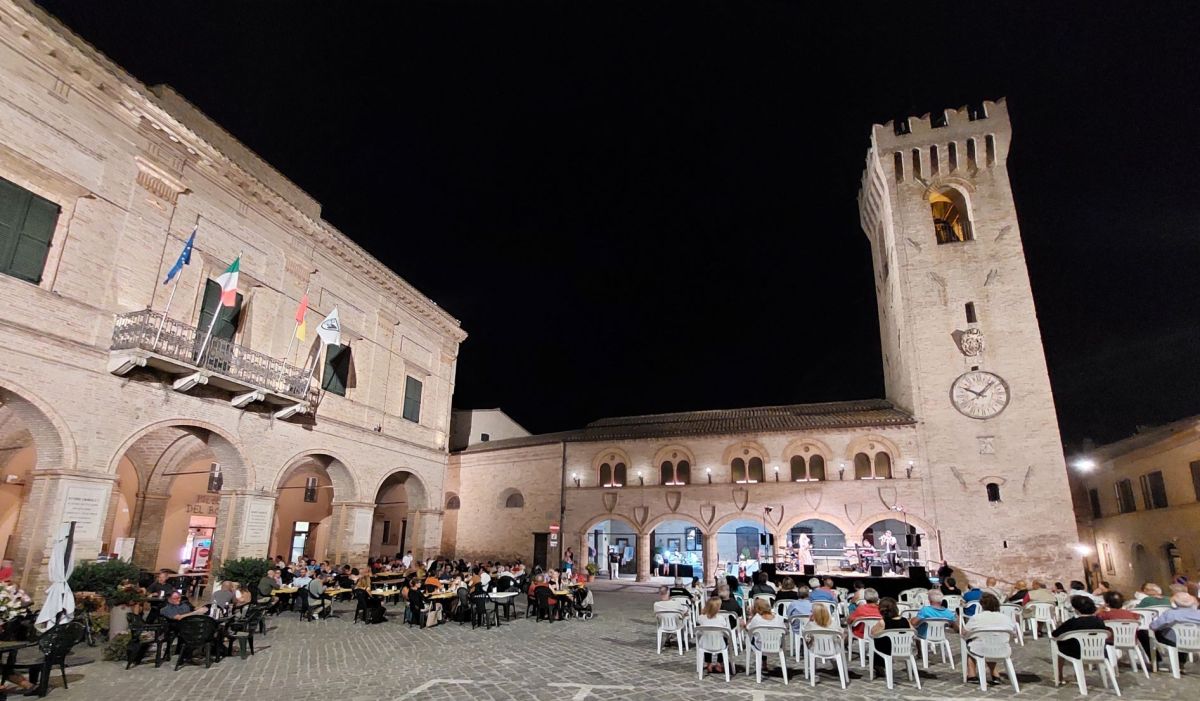
To be honest, we came over all a bit too Anglo-Saxon about it – which showed just how out of practice we were. According to the poster we had seen outside the town hall, the concert was billed to start at 9.00pm. So, knowing that the most of the village centre would be closed to traffic, we pulled into the parking area just outside the ancient fortified walls that encircle the centro storico at about ten to nine, leaving us plenty of time to walk through the formidable Porta Ulpiana and up the cobbled hill lined with tall, elegant townhouses with their dark green shutters and geranium-filled window boxes, then down through the shady Piazzale Cesare Peruzzi dominated by the imposing Church of the Crucifix and its even more imposing neighbour, the Church of St Peter and St Paul, before arriving in the corner of the Piazza del Comune. On the far side, in front of the grand 14th century Palazzetto del Podestà with its sturdy bell tower stood a brightly lit stage with drum kit, keyboards and mike stands already set up for the performance, and to the left, in front of the graceful Palazzo Comunale (town hall), groups of people sat at tables that spilled out onto the square from the Pizzeria del Borgo and the neighbouring Caffé del Teatro, the sound of laughter and the clinking of crockery drifting across the square on the soft, pizza-scented breeze.

We ambled across the square and sat down at a table with a clear view of the stage, gave Cecilia our order and settled down ready for things to get going. As Simeone the café owner set our customary beer and Aperol spritz combo down in front of us, however, we noticed that even though the town clock was about to strike nine, the organisers hadn’t yet started setting out in rows the dozens of white plastic chairs that were stacked next to the stage, no one was champing at the bit to get seated, and there was no sign of any roadies, never mind any band members. And it was at this point we realised that over the previous eighteen months we had also forgotten that few events, especially informal local ones such as this, start anywhere near on time. We briefly cursed our lapse into our old, overly-punctual ways, but then, with the sky darkening from lavender to indigo, sat back to enjoy some long overdue people-watching as we sipped our drinks and picked at the selection of tasty morsels that are invariably served with drinks. It was such a pleasure to see the square teeming with life on a deliciously warm summer’s evening – and, despite a scattering of masks, all looking so wonderfully normal. Parents dishing out slices of freshly-baked, oozy pizza to their families, dumpy grandmas rocking babies to sleep, groups of leathery old men shooting the breeze, teenage couples staring dreamily into each other’s eyes over glasses of cola, children playing tag across the square, and toddlers happily dripping ice-cream down their fronts.

At about 9.30pm, a handful of men in black ‘crew’ T-shirts started setting out chairs in front of the stage and people began to take their seats. Shortly afterwards, another crew member checked the microphones and adjusted a couple of lights, then at just before 10pm, the band, comprising vocals, trumpet, keyboard and drums, finally took to the stage and without preamble launched into Ben E. King’s ‘Stand By Me’.  In the context of the ongoing pandemic, starting their set with this track seemed a very apt choice, and as the words ‘When the night has come, and the way is dark / And that moon is the only light you see / No I won’t be afraid, no I won’t be afraid / Just as long as the people come and stand by me.’ rang out across the square, I found myself with a lump in my throat.

The band were really very good; they performed a selection of Soul and Motown hits, interspersed with Italian classics that got people clapping along and a couple of folk up on their feet. After a solid ninety minutes on stage, they brought their show to an end with a well-crafted medley of Soul/Disco crowd-pleasers that concluded with ‘I Will Survive’. And with its defiant chorus of No, not I, I will survive / Long as I know how to love / I know I’ll stay alive / I’ve got my life to live / And all my love to give and / I will survive’, it was another choice that surely can’t have been a coincidence…

In the end, though, the evening was ultimately less about the music than the sheer pleasure of reconnecting with the community and being among people united in the enjoyment of a shared experience.

And as for the whole going out thing, it seems it’s like riding a bike after all.

The Greening of Casa Girasole – Part 2

The first time we went out for a meal with Giovanni was last October in a brief ‘yellow’ phase between lockdowns. He took us for lunch at his favourite fish restaurant towards the northern end of the seafront at Civitanova Marche after we had signed the contract with him for the supply of our solar energy installation following a lengthy period of to-ing and fro-ing that had begun back in summer. We’re going out for another meal with him next weekend, this time to celebrate a much bigger landmark: the completion – at last – of the project, the management of which has been Mr Blue-Shirt’s main pre-occupation for much of the last year.

Even though it was carried out in the depths of winter, the easy part was the mounting on our south-facing roof of the set of eighteen slimline photo-voltaic panels that form the heart of the system, together with the installation of the electronic brains of the system and the stack of batteries that hunch in the hall cupboard like a softly humming dalek. These were all wired in, connected up and actually producing solar energy by the end of January. But they were only the start of the all-singing-all-dancing system that the government’s programme of fifty to sixty percent discounts on domestic renewable energy installations had enabled us to include in the specification.

In order to minimise our use of gas as well as fossil-fuel-based electricity, this also consisted of an air-source heat pump (ASHP) to provide hot water and heating, along with a new, super-efficient boiler as a back-up-cum-top-up, a clever gizmo that allows the system to switch between the two, and three new combined heating/cooling (fan coil) units for our bedroom, the guest bedroom and the sitting room, as well as several hundred metres of tubing, ducting, cables and conduits to knit the whole lot together. Oh, and for good measure we also threw in a bit of future-proofing in the form of an electric car charging point in the carport, ‘just in case’.

The much more complicated and protracted part was getting this huge, hi-tech box of tricks up and running in a converted 19th century farmhouse; a task that tested the skills and patience of Giovanni’s team of tradesmen to the full. Giacly the cheery plumber, his shaven head and thick beard combo giving him the curious appearance (to me, at least) of someone with his head on upside down, Gianni the Rolling Stones-loving, drama queen electrician and Paul the totally unflappable, softly-spoken technology wizard spent much of the spring either crouched in the upstairs porch with the ASHP, or squidged in between the boiler and the switching system in the tiny, cramped boiler room, or with their heads buried in the hall cupboard making adjustments to the software that runs everything, or going from room to room to check whether this, that or the other bit of kit was working properly or not.  Needless to say, very often it was not – mostly thanks to the idiosyncrasies of the house, its 60cm-thick walls and the way it had been plumbed and wired by our predecessors, but also because in some instances Giovanni hadn’t got the spec. quite right (like ordering fan coil units that looked as if they belonged in a factory and which we insisted he replace with something more suitable for a domestic setting), and all-too frequently, just because, well that’s just how tech is, all of which slowed progress considerably.

Things were slowed down even further by ENEL, which as well as being the mains electricity supplier also manages the distribution infrastructure. It took Giovanni weeks of nudging and nagging to get their engineer to come and upgrade our meter so it could cope with the increase of our supply from 3kw to 6kw in line with the system requirements for a house the size of ours. It took even longer, however, and even more nudging and nagging, as well as a flurry of form-filling, actually to achieve that increase in supply – even though this, as far as I could see, surely amounted to little more than the equivalent of turning a knob or opening a tap. This delay caused a real bottleneck, though, as until someone bothered to flick the relevant switch, we only had half a system as it meant that the ASHP couldn’t be commissioned and so we had to continue to rely on gas for hot water and heating.

Mind you, it was while we were waiting for ENEL to get its act together that, after extensive research and several test-drives, we also took the plunge and used some more of Mr Blue-Shirt’s inheritance to replace our aged diesel Renault with a brand new fully electric Nissan Leaf. In the end, it wasn’t that difficult a decision, largely because of the government subsidies, the manufacturer’s discounts and the dealer’s special offers, which brought the price down by more than a third. But our purchase quickly revealed a glitch in the system set-up, which meant that Paul the gizmologist had to come and configure the car charging point (wallbox) so that it appeared on the system app, thus giving us the means to maximise the use of our own solar energy when charging the car depending on how much power we are actually generating, how full the house batteries are and how fast we need to charge the car; all very clever. And no sooner had we got this glitch resolved than another became apparent when ENEL were doing some maintenance work nearby and knocked the power out. This revealed that the back-up that is supposed to allow us to use energy stored in the battery to maintain certain key functions in the case of a power cut was not connected, so this time Gianni the drama queen had to come back to do some additional wiring work, cursing as long and loud as ever as he flounced back and forth between boiler room, battery cupboard and fuse box until he was satisfied he’d got it working correctly.

ENEL eventually got round to upgrading our mains supply in late May, which was fortuitous as it meant that the ASHP came on stream just in time for the sudden and early arrival of summer and so allowed us to take advantage of the fan coils’ cooling function; cooling that is as deliciously ironic as it is guilt-free, incidentally, as it effectively runs on pure sunshine. And with the upgraded supply, the final piece of the jigsaw dropped into place: the switching of our mains supplier from ENEL to SENEC, the company that supplied the batteries but that is also a power distributor, and one which uses exclusively renewable energy, meaning that even on the rare occasion that we require top-up from the mains, it will still be completely fossil-fuel-free. Better still, this switch also enables us to feed back into the grid any surplus power that we generate, which we have already found easily compensates for any we take out, thus meaning that the latter is almost free.

So after a year in which Giovanni has spent so much time with us explaining this, chasing up that and sorting out the other that we’ve become quite good pals, we’re finally there. Not only is the whole system now properly connected and configured and we are at last officially driving, heating, cooling, lighting and bathing on sunshine, we are also now saving several hundred kilos of CO2 emissions every week. All of which sounds like a pretty good cause for celebration to me.

Image shows:
Solar panels generating 5kw
House battery at 100% so not charging
House consuming 0.6kw
Wallbox not in use as car fully charged
4.4kw (ie 5kw-0.6kw) going to the grid


What a time it was..

I’m feeling a bit nostalgic. This is normally the weekend of Montelupone’s  annual Festa della Pizza. Mind you, even though this is our fourth July in the village, we’ve only been the once, the first year we were here – and it was terrific: a glorious celebration of practically everything we love about life in Italy concentrated into one fantastic evening. The following year, though, it was only a few weeks after our second burglary and we were still wary of leaving the house unattended, while last year Covid-19 restrictions meant that all such summer events were banned. And this year, although festivals and fairs are permitted now we are in the white zone’ (subject to an array of public health measures, of course), there was, presumably, insufficient time available to put together an event of this scale. But how I wished we might have had the opportunity to repeat the experience this year. Sitting on the terrace after dinner and holding the glass of grappa Mr Blue-Shirt had just poured me, I looked up towards the village, its crown of lights making its honeyed walls and stand out against the inky sky, and, as I leant my head on Mr Blue-Shirt’s shoulder and took a sip of grappa, my thoughts drifted back to that very special evening …

We plodded the final few metres up the hill into Montelupone’s main square, the Piazza del Comune, more than ready for a cool drink after our 4km walk from home. We had come into town for the Festa della Pizza and had assumed that the four-day event would be held here in the centre of the village, as this is where all village festivals tend to take place. But although the square was buzzing with life, it was just the Caffé del Teatro and the Pizzeria del Borgo doing their normal roaring trade on a warm summer’s evening. Slightly puzzled, we looked around for some evidence of the festa and soon noticed a series of hand-written signs bearing the words ‘stands gastronomici’ with large arrows drawn below them. These guided us out of the square and up the narrow street behind the town hall and eventually led us to the imposing pair of forged metal gates at the end of the high moss-clad wall that runs along the back of a small quiet square where the village war memorial is located. They look as if they are the gates to the courtyard of one of the tall slim houses facing onto the square, and for most of the year, it seems, they remain chained shut. But now they were flung wide in welcome, and stepping through them we discovered that they are in fact the entrance to what looked like a secret little park: a large grassy area about the size of half a football pitch surrounded on three sides by high stone walls with the fourth looking straight down over the sea, and a magnificent cedar tree bang in the middle, its ancient limbs fanned out in a giant parasol of gracefully arching green.

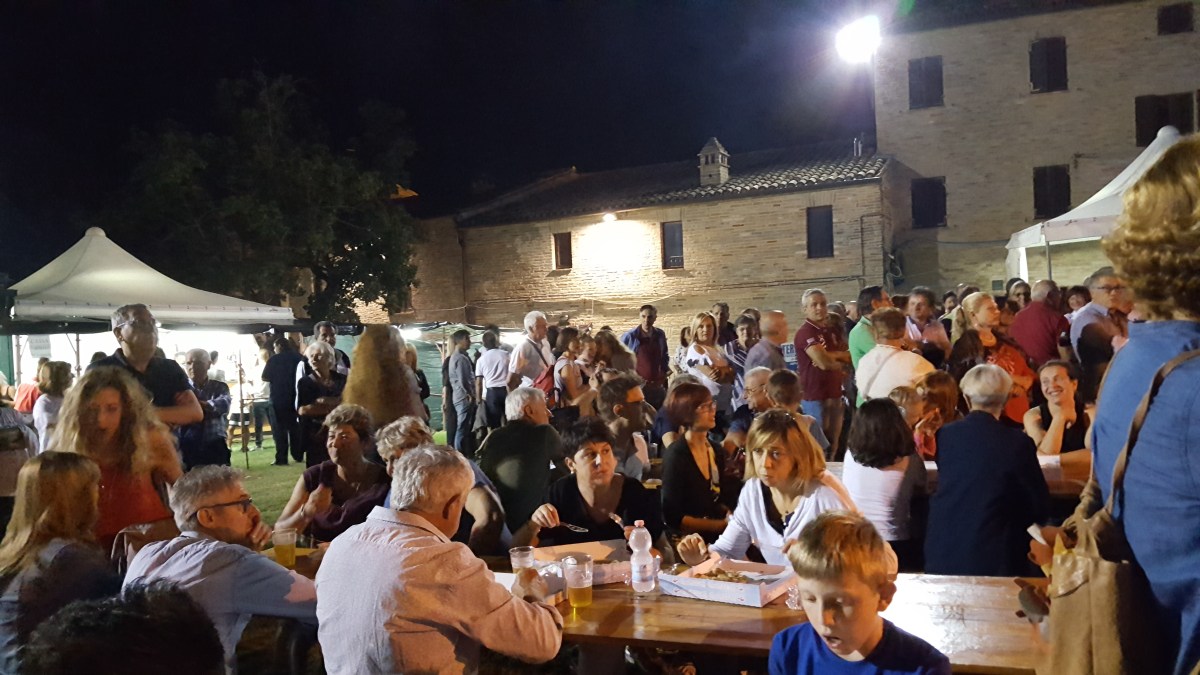
The little park wasn’t much of a secret tonight, however, for it was thronged with easily half the village’s 3000 population, music blaring and strings of lights dancing on the breeze and the evening air rich with the aroma of freshly baked pizza. To our left along the front wall was a stage with microphone stands and drum kit set up ready for that evening’s live band, and in front of this was a raised dance floor across which small children were charging and sliding, squealing with excitement. Around the right-hand edge of the space stood a couple of small open-fronted marquees housing banks of cash desks, in front of which queued groups of people chatting animatedly. Along the far wall stood another much larger open-fronted marquee from which spilled rows of trestle tables and benches already crammed with diners munching their pizzas. These were appearing in a steady stream from a bigger marquee still that, together with the bar, ran along the fourth side.

Once we had got our bearings, we worked out that we needed to order and pay for our food and drinks at the cash desks first before collecting our order from the relevant marquee.  “Una pizza diavola e una pizza verdure,…” Mr. Blue-Shirt bellowed above the Euro-pop pounding away in the background when we finally reached the front of the queue, “…una birra grande e un vino bianco”. Having handed over our €20, we received two receipts, one for our drinks order, the other for our pizza order, which crucially also included our order number: F180. We eased ourselves away from the crush around the tills and while Mr. Blue-Shirt joined the queue for the bar, I headed for the pizza marquee. In front of the entrance stood a long bench behind which stood a chap in shorts and a bright blue ‘crew’ T-shirt and clutching a microphone. “Effe cento quaranta cinque!”  he called over the crackly PA system, as he plucked a ticket from where it was tucked under the flap of the uppermost pizza box in the stack that had just been deposited on the bench. Someone in the gaggle of people gathered in front of the table yelled “Si, io! – Yes, me!” and waved their receipt at the caller who then checked the number before finally handing over the stack of pizza boxes to the hungry customer. If order number F145 had only just been served, we were in for quite a bit more pizza bingo until they got to F180, then. Fortunately, Mr. Blue-Shirt re-appeared beside me at that point, clutching a large plastic beaker of beer, a smaller plastic beaker of white wine and, balanced between the two, a portion of deep-fried artichoke slices, so at least we would have something to keep us going until our order was called.

As we enjoyed our aperitivi, we watched the incredibly slick pizza-making operation in full swing in the marquee. This was swarming with a huge team of volunteers in their bright blue ‘crew’ T-shirts and white aprons, and was furnished with a long row of trestle tables, each of which formed a different pizza-making station. “Effe cento cinquanta cinque!” blasted over the PA.  At one stood a team of people forming dough into soft plump balls, at the next, amid clouds of flour, stood the dough-rolling, -spinning and -tossing team, and at a third a team of volunteers was ladling rich, chunky tomato sauce, fragrant with herbs and garlic, onto the paper-thin bases. “Effe cento sessanta quattro!” Then came the topping-adding team, with their battery of plastic tubs overflowing with different ingredients, and finally the mozzarella-scattering crew. “Effe cento settanta due!” Here, the finished pizzas were lined up, ready for the pizza chefs, their faces glowing red in the blazing heat, to slide them onto long-handled paddles and feed them into the roaring maw of the one of the two huge wood burning pizza ovens that dominated the marquee. “Effe cento settanta otto!” After just three or four minutes, the bubbling, sizzling discs were slid back out of the fiery caverns and passed to the pizza-boxing, -slicing and -stacking crew who finally dispatched each completed order to the front of the marquee. “Effe cento ottanta!” “Si, io!” I cried, waving my receipt in the approved manner.

Mr. Blue-Shirt dabbed the final smears of garlicky tomato sauce from his lips. “That was top-notch”, he shouted over the band who were now in full swing just across from the trestle table where we had managed to squidge ourselves into a couple of spare seats. With my mouth still full of the final delicious oozy, smoky forkful, I could only nod vigorously in agreement. “The sausage on mine was properly spicy”, he continued. “As good as anything we’ve had from a proper pizzeria.” “Absolutely!” I was able to say at last. “My vegetable topping was really generous and the crispy base was yummy”.  Replete, we swivelled on our bench to watch the band. They were clearly going down well as the dance floor was now full of couples of all ages performing the practised steps and twirls of traditional dances taught by one generation to the next.

We could still hear the band as we headed back down the hill, but as we descended into the cool night air, the rhythmic thump of the bass finally gave way to the gentle rasping of the crickets. Walking hand in hand beneath the velvety sky we reflected on a wonderful evening that had effectively been some kind of vindication of our decision to move to Italy.

I lifted my head from Mr Blue-Shirt’s shoulder, drained my glass and sighed deeply. It had been wonderful not only in its own right, but also as a powerful affirmation of community and the bonds that maintain it. And as I remarked here a couple of weeks ago, it was such a cruel irony, therefore, that just when those bonds and the need to celebrate them seem more important than ever, we have had to be denied a much-missed means of doing so.

Mind you, I’m betting that next year’s pizza festival will be an absolute corker…

Title taken from ‘Bookends’ – Simon & Garfunkel

Into the Lions’ Den

Antonio’s mask may have concealed the grin spreading across his round, suntanned face, but it did nothing to hide the playful twinkle in his large brown eyes.
“All very simple and relaxed again” he assured Mr Blue-Shirt. “A bite to eat and a couple of drinks down at the bike club while we watch the match…”

Mr Blue-Shirt has become quite good pals with Antonio, proud owner of a classic Triumph motor cycle and leading light in the Porto Potenza Picena bike club. His day job is running the shipping company, together with his Canadian-born wife Lori, that transported Mr Blue-Shirt’s storage container over from UK. He has kindly let us store it in his yard free of charge ever since in return for Mr Blue-Shirt doing a series of maintenance and repair jobs around the place.

A couple of weeks earlier he’d invited us to a similar get-together at their ‘clubhouse’ just along the coast from Porto Potenza Picena. This turned out to be a huge customised classic caravan permanently pitched in the corner of a generous patch of grassy land enclosed within a tall hedge of crimson oleander trees. I imagine the club rents the plot from the huge pizzeria next door which throughout the evening supplied us with a steady procession of dustbin-lid-sized pizzas straight from their enormous wood-burning oven. Coming shortly after Le Marche went into the white zone when nearly all restrictions on eating, drinking and making merry were lifted, it was a very welcome evening of conviviality enjoyed around picnic tables assembled at the base of a magnificent sycamore tree strung with lights and filled with cicadas and crickets whose noisy rasping accompanied our conversation.

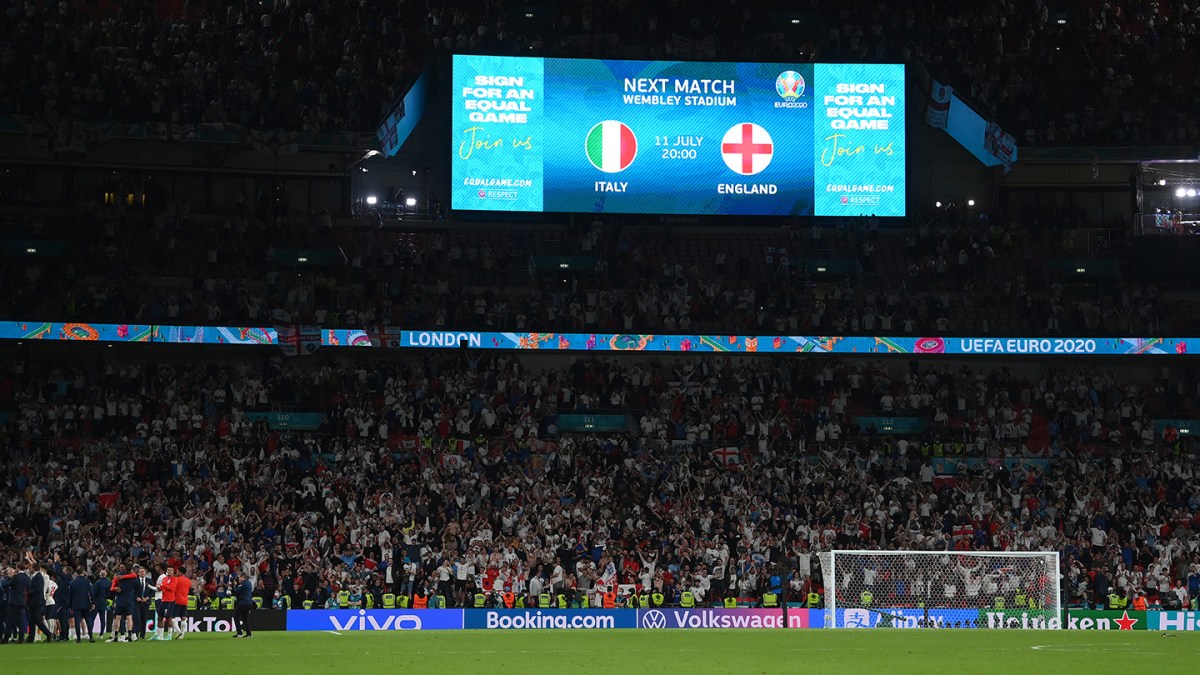
Consequently, we happily accepted this latest invitation – albeit with just a smidgen of apprehension. For the match Antonio had mentioned was the final of the Euros 2020* between Italy and England. Now, if there is one thing that anyone knows about Italians it is that football is practically the country’s second religion. And if we add to the mix that Gli Azzuri  -The Blues, as the national team is affectionately known – were still smarting from having failed even to qualify for the last World Cup in 2018 (practically a national disaster) it is no exaggeration to say that, with a good chance of laying that particular demon to rest at last, excitement in the run-up to the match was at fever pitch. The ever-affable Antonio convinced us, however, that he had no hidden agenda in inviting a pair of English people to come and watch a match in which everyone else present would be desperate to see Italy triumph. They were a bike club, after all; the football was just a good reason for a get together…

Ragazzi e ragazze – Guys and girls,” boomed Antonio almost as soon as we walked through the gate. Twenty or so people looked up from setting out tables and chairs, filling paper plates with portions of cheese, cured meats and porchetta, or rigging up the large-screen television, amplifier and aerial.
“Some of you met them a couple of weeks ago,” he continued with his arm draped across Mr Blue-Shirt’s shoulders. “But for those who didn’t, I’d like you all to meet these two friends of ours, an ENGLISH couple who I think you will agree are being very BRAVE in joining us this evening to watch THE BLUES WIN tonight’s final!!”
Bastardo!” muttered Mr Blue-Shirt under his breath as Antonio winked mischievously at him and the assembled company broke into whoops, catcalls and applause.
“Let me introduce everyone,” he said, thrusting a cold beer into Mr-Blue-Shirt’s hand and a glass of chilled local white wine into mine.
“Are you here on holiday from England, then?” asked someone called Laura who good-naturedly looked us up and down as if searching for signs of union flags or ‘three lions’ emblems.
“No, we live in Montelupone; we’re officially Monteluponesi.”
“See? We’re all practically neighbours!” exclaimed Lori supportively.
That we were ‘locals’ certainly helped prove our pro-Italian credentials, but it was Laura’s husband Marco who asked the question that was still on everyone’s lips:
“Ah, but who are you supporting this evening?”

We knew we were bound to be asked, but also knew that as an answer, ‘it’s complicated’ wouldn’t quite cut it. For a start, neither of us actually likes football and only knew how the England team had been progressing as a result of the blanket coverage the UK media had given all their matches. In addition, we had been absolutely appalled by the way that sundry racists, xenophobes and jingoists (in government as well as on the terraces and on social media) appeared to have hijacked the tournament to further their own dubious political agendas. However, despite our love of Italy, we still couldn’t quite bring ourselves to abandon completely what is still ultimately our home nation. But then again, we didn’t want to antagonise our friendly hosts either. Like I said: it’s complicated.
“What do you think?” I responded evasively. “Look what colour we’re both wearing!”
“Blue! So it’s blue for The Blues!”
“Well, there you are then!” I declared, hoping this would be sufficiently ambiguous to let us off the hook. There was a brief pause, and then our interrogators raised their glasses in an impromptu toast to “Gli Azzuri!”
“Well done!” hissed Mr Blue-Shirt in my ear. “That was genius.”

So with everyone at least reasonably satisfied (if not totally convinced) of our loyalties, we sat down with Lori and Antonio to enjoy our apericena and watch the match.  But we were soon lost in conversation about the relative merits of Nortons versus Triumphs so only realised that England had scored two minutes into the game when twenty pairs of Italian eyes turned towards us, eager to see how we would react to this apparent catastrophe. Thankfully, as this implausibly good start for England had passed us by, our slight bafflement at the sudden excitement was, happily, interpreted as indifference and any remaining doubts as to our allegiance were assuaged.

Throughout the rest of the match, we paid as much attention to the reactions of our fellow diners as we did to what was happening on the pitch. When Italy were in the ascendant, it was all shouts of “Forza Italia!” and “Bravissimi!”, while it switched to wails of “Madonna!”, and “Porca miseria!” whenever England looked dangerous. But when Italy drew level early in the second half, had there been any roof on the place, it would have been blown off by the deafening collective roar of “G-o-o-a-a-l-l!!!” Then as the clock ticked down and the more likely extra time became, the further the volume fell, leaving just the cicadas cheering the players on by the time the final whistle blew.  Those around us quickly concluded that a penalty shoot-out would inevitably provide the climax to the tournament, so used the ensuing ‘phoney war’ to settle their nerves, clear the tables and refill their glasses in preparation for the final few minutes of exquisite agony. Then as the fuchsia-pink-clad referee signalled the start of the shoot-out and both teams went into their respective huddles on the pitch, so we all rose from our tables and huddled around the television screen.

With each penalty kick, our mini-crowd burst into a succession of whoops of joy, howls of dismay or cheers of glee depending on whose shot had gone in, been saved or had missed completely. But with one kick remaining, and the last chance for England to level the score at three-all, silence fell. Then as that final young Englishman, with the weight of his nation’s hopes on his shoulders, had his shot saved by the Italian goalkeeper, the warm night air was rent with roars of delight and a mass of fireworks – in red, white and green – exploded across the inky sky to chants of “Abbiamo vintooooo!! – We’ve wooon!!”

Even as our hearts went out to those poor young Englishmen whose penalties had not gone in, it was easy for us to be magnanimous in defeat. And not so much because of our relative lack of investment in the outcome as for our companions’ graciousness in victory. We exchanged congratulations and commiserations, fist-bumps and back-slaps with our euphoric companions, whose delight at winning contained not a single taunt or shred of Schadenfreude. While the podium was erected on the pitch for the presentation ceremony, Antonio distributed glasses of sparkling wine (which he had clearly put on ice ’just in case’) and as the huge trophy draped in green, white and red ribbons was presented to the Italian captain, we all as one raised our glasses of fizz and toasted the new UEFA Champions, ‘Gli Azzurri’.

If the evening had been a test, I think we had passed it.

* The UEFA European Football Championship postponed from the previous year.

Image courtesy of http://www.englandfootball.com