Found in Ancona…

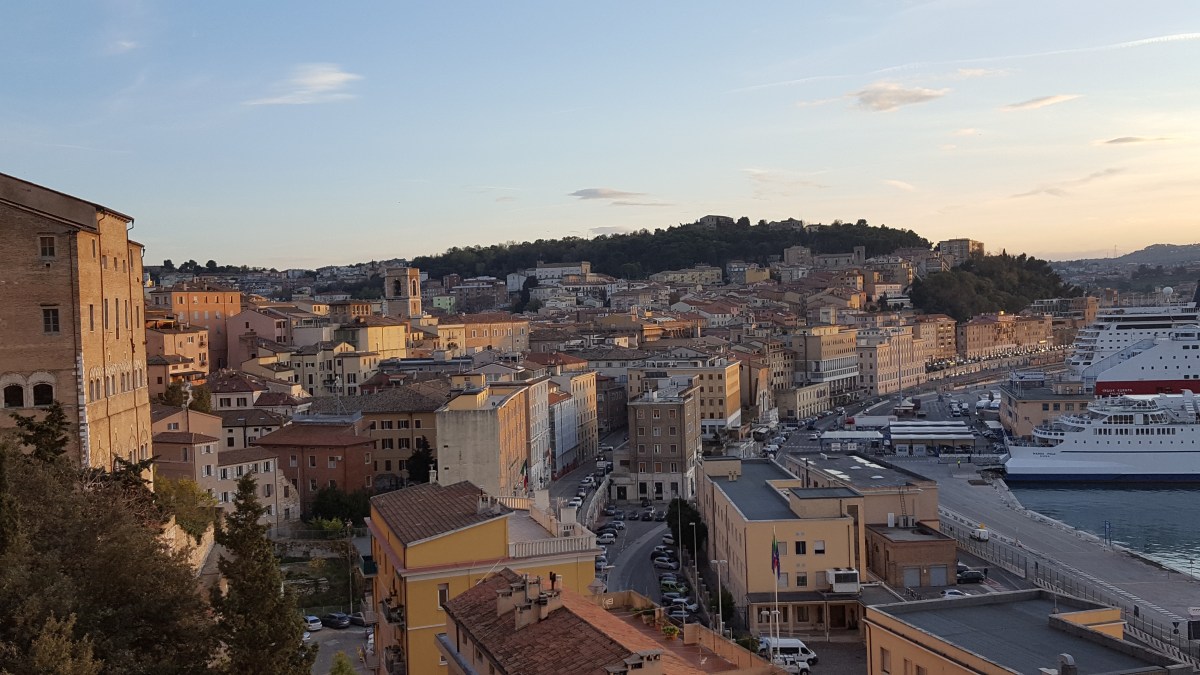
So, if the likes of Rome and Florence, awash with jaw-dropping architectural and artistic treasures, are akin to a swanky antiques shop, then I would say that Ancona is probably more akin to a collectables emporium. The antiques shop is filled with artfully displayed period furniture, glass-fronted cabinets full of delicate porcelain and crystal, and artworks with ostentatious gilt frames hang from the tastefully painted walls. Every which way you look, your eye falls upon one period gem after another, but after a while your eyes glaze over and you succumb to antiquity overload. The collectables emporium, by contrast, is probably crammed to the roof with every conceivable variety of knick-knack and bric-a-brac with little thought for logic or aesthetics. Stacks of second-hand books lean lazily on dusty shelves, floral table lamps with wonky shades prop up one-eyed dolls, and you have to negotiate a forest of mis-matched dining chairs to reach that interesting-looking glassware in the corner. And yet, for all its clutter, the place somehow draws you in; there is a warmth to all the jumble, a human story behind every battered piece, and you soon find yourself happily poking around among the chaos. Then suddenly you stumble across a real treasure, and it stops you in your tracks. And in that instant, as you turn your precious find in your dusty hands, you just know there must be more. And you are hooked…

So here, then, are our best finds so far in Ancona’s Emporium of Collectables:

  • The Romanesque Cathedral of San Ciriaco is built from white stone quarried from nearby Monte Conero and named after Ancona’s patron saint. With sweeping views over the bay, it stands on the site of the city’s ancient Greek acropolis atop Monte Guasco, and dates back to the 10th century, although it was changed and added to numerous times throughout the Middle Ages. In more recent times, it was bombed in World War I, then rebuilt and rededicated, only to be bombed again in World War II. It was rebuilt and rededicated again in the 1950s, but the earthquakes of 1972 caused yet more damage. And even today, huge timber buttresses support one transept that was damaged in the earthquakes of 2016.
  • Across the bay on the summit of Monte Astagno stands The Citadel. This mighty fortress was commissioned by Pope Clement VII as a display of papal wealth and power. Designed by Antonio da Sangallo younger, who Clement VII commissioned to build similar fortresses in Perugia and Florence, it was completed in 1538 and includes five imposing bastions. It played a crucial role in the defence of the city in succeeding centuries, but fell into disrepair following the earthquake of 1972. It has since undergone substantial restoration work and is once again one of the city’s most significant monuments.
  • Down in the harbour, meanwhile, nestles another papal commission – Clement XII this time. Here you find the striking, pentagonal Lazzaretto, which is also known as the Mole Vanvitelliana. Built in the 18th century on an artificial island, it was originally a quarantine station and leprosarium for the city and as such had no physical link to the quay, but was later connected by three bridges. In the 19th century it became a military fort, and is now home to the ground-breaking Tactile Museum that seeks to promote a multi-sensory enjoyment of art.
  • Further round the harbour, stands in splendid isolation on the edge of the north quay one of the city’s oldest and most iconic monuments. The Roman Senate ordered the construction of the triumphal in AD115 Trajan Arch, which is built from Turkish marble and stands over eighteen metres high. It was conceived as a gesture of gratitude to Emperor Trajan who substantially expanded both the city and the port at his own expense. These improvements subsequently assisted him in his defeat of the Dacians across the Adriatic, thereby expanding the Roman Empire to its furthest extent.
  • At the base of the steep, pine-clad cliffs on the eastern flank of the promontory of Monte Guasco lies Ancona’s only town beach, Il Passetto. Although seemingly well-hidden and accessed via several flights of narrow stone steps, this narrow strip of shingle that plunges straight into the sparkling sapphire sea is hugely popular with the Anconetani. Apart from its restaurants serving the local speciality, brodetto all’anconetana (a mixed fish stew) it is best known for the small grottoes carved into the cliff-face in which previous generations of fishermen stored their boats. Now used as beach huts, they are jealously guarded by their owners who hand them down from one generation to the next.
  • Away from the waterfront in the heart of what remains of medieval Ancona is the Piazza del Plebiscito, complete with its 13th century city gate, the Arco di Garola. Made up of a pleasing mix of different 15th century palazzi, this grand square is dominated by the baroque church of San Domenico, and is filled with cafés and restaurants whose terraces spill across its cobbled pavements. In the maze of narrow streets that surround the piazza are lots of tiny artisan jewellery workshops, each with just a couple of craftsmen or women hunched over their work-worn benches.
  • Running inland from the waterfront are Ancona’s main shopping streets, the elegant Corso Giuseppe Mazzini and parallel to it, the equally elegant Corso Giuseppe Garibaldi. Just off the former, hiding down an unpromising-looking side street is the once-lovely fin de siècle covered market, the paint now peeling from its delicate cast and wrought iron, but the stone fronted stalls down one side, still filled with today’s catch and those down the other filled with today’s crop from the family orto (market garden). Towards the waterfront end of the latter you will find one of the city’s most famous bars, the tiny Bar Torino. Barely any bigger than the average sitting room, it retains its stylish 1960s décor and has been in the same family for several generations. It is famous for its vast range of cocktails and down the years it has attracted many a celebrity whose signed photos now proudly hang behind the bar.

And we can’t help thinking we are still just scratching the surface…
Ancona: books and covers

“OK, you’re familiar with the ‘boot’ of Italy, yes? With its toe looking as if it’s kicking Sicily? So, now think of the slight bulge of the calf of the boot. Well, it’s at the outermost point of that bulge.” It’s my tried and tested means of locating Ancona for first-time visitors who will in all likelihood being flying into its modest airport that lies at the north-western edge of the city.
“Our place is about forty minutes to the south-west,” I typically continue, and round off my brief orientation with “Don’t bother about detouring via Ancona itself; it’s really not much to write home about.” Well, until recently I did, anyway. For over the last few months I have discovered that I had been doing the city a great disservice and owe it an apology: it is a surprisingly beguiling place that Mr Blue-Shirt and I are becoming really rather fond of.

Admittedly, the messy sprawl of post-war concrete that forms an arc around the city is not immediately encouraging: faceless trading estates, criss-crossed by a tangle of flyovers and underpasses, mingle with clumps of low-rise cream and ochre apartment blocks. It is this undeniably ugly first impression that for years put us off visiting the place properly, and consequently, discovering its long history that turns out to be as fascinating as it is turbulent. And that helps put the ugliness in context.  I now realise, for instance, that in World War I the Navy of the Austro-Hungarian Empire, on whom Italy had declared war only the day before, subjected the city to sustained naval bombardment that inflicted heavy damage on the port and surrounding areas. Then in World War II, it endured extensive bombing during its liberation from Nazi occupation by Allied Forces (in the form of the Polish 2nd Corps) who, as part of their advance north, needed a seaport closer to the front line. And fewer than thirty years later, it suffered a series of earthquakes in 1972 and then a landslide in 1982. All of which makes it much easier to forgive the apparent disregard for conservation principles and the seemingly insensitive urban development: the city’s beleaguered and exhausted residents needed housing and jobs – and fast.

And once you look beyond its concrete exterior, you will be warmly greeted by a vibrant, gritty, and proud maritime city with two thousand years of tempestuous history as a strategically important seaport on the Adriatic coast. It was founded by the Greeks in the 4th century BC to facilitate the expansion of trade from the Greek peninsular. Indeed, it was the Greeks who gave the city its name. Ancona derives from the Greek word ‘ankon’ which means ‘elbow’ and refers to the way the harbour is cradled in the crook of the protective arm formed by Monte Astagno to the north and Monte Guasco to the south. These are the twin extremities of the distinctive Conero Promontory whose forested bulk rears up behind the city.

Three centuries later came the Romans, and shortly after he crossed the Rubicon, Julius Caesar took possession of the city because of its harbour’s proximity to the Roman province of Dalmatia on the other side of the Adriatic. Emperor Trajan subsequently enlarged the harbour, in gratitude for which the Senate erected a triumphal arch in his honour in AD115 – and the Arch of Trajan still stands in splendid isolation on the north quay today.

In succeeding centuries, it was attacked by Goths, Lombards and Saracens, who sacked and burned the city in the 7th and 8th centuries. A couple of hundred years later it became a semi-autonomous maritime republic, during which time it built its cathedral on the summit of Monte Guasco, sent ships to the crusades, and was devastated by fire and by the black death. Two centuries after that, it became part of the Papal States, and the main architectural  legacy of this period is the imposing citadel that still keeps watch over the city from its position high on Monte Astagno.

By virtue of its position as the gateway to the eastern Mediterranean, the city has long been a melting pot of creeds and cultures: towards the end of the Renaissance it was home to a large community of important Greek merchants, and also to a substantial Jewish community that had been established in Roman times. In fact, Ancona was the only city within the Papal States that tolerated Jews, thanks to the wealth they brought to the city via their banking and trading activities, and even welcomed Jews escaping persecution elsewhere in Europe. The city still has two synagogues, and the 16th century Monte Cardeto cemetery, one of two in the city, is one of the largest Jewish cemeteries in Europe.

During the Napoleonic era, the city briefly fell to the French, became the Anconine Republic, and was incorporated into the short-lived Roman Republic following Rome’s invasion by one of Napoleon’s generals. After a couple years’ to-ing and fro-ing, however, Ancona returned to the Papal States which were restored in 1799. But only sixty years later, the Papal States were defeated once and for all in the Battle of Castelfidardo (which lies just 20km to the south of Ancona), this time by the forces of the Risorgimento that brought about the unified Kingdom of Italy in 1861.

There followed a brief period of peace and prosperity, during which the railway came to the city, linking it to Bologna to the north and Pescara to the south, a tram service started operating, the southern quay was built, and the population grew to just shy of sixty thousand. But within barely fifty years, the continent was at war again and those Austro-Hungarian battleships out in the bay had the city in their sights…


Tallying up

Old habits die hard. Having managed all the finances of the business Mr Blue-Shirt and I ran for fifteen years, I still find myself doing an annual profit and loss account at the year’s end. Only these days, the debits and credits are no longer measured in pounds and pence, but in terms of quality rather than quantity, of the intangible rather than tangible.

So how does our triumphs and tragedies account for 2019 shape up? Well, the debit column is, understandably, dominated by three devastating and genuinely life-changing events: the burglary in spring, the death of Mr Blue-Shirt’s mother in autumn, and just seven weeks later, the death of his father. All three cast long, deep shadows across the year, plunging us into months of fear, anger, pain and loss; shadows whose sorrowful darkness has yet to recede. And all three rendered every other frustration and niggle, glitch and hiccup mere small change; just a handful of coins lost down the back of the sofa of life. Indeed, I am struggling to itemise other debits that any sensible accountant wouldn’t write off for being within an acceptable margin of error. The bureaucratic annoyances of importing first the car and later the van? Well, that’s just par for the course, so neither debit nor credit. The repeated wild goose chases involved in hiring construction equipment, then? Same thing: zero impact on the final balance. OK, so what about a horribly and uncharacteristically cold and wet May? Pfft! Not even worth a line on the spreadsheet. The frighteningly vicious storms that tore through the region in July and ended a blistering heatwave, then?  No damage suffered, so no entry necessary.  In fact, the only other debit that has affected the final balance to any degree was the sudden and desperately premature death of Stanley, one of the two lovable young cats we had acquired in January and who immediately captured our hearts.

The credit column at first glance appears much more mundane, with no obvious show-stopping gains to cancel out those huge losses. Our application for planning permission was granted, we successfully got ourselves as Brexit-proof as possible, Mr Blue-Shirt razed the despised pigsty to the ground, constructed new terraces and built a pergola. We enjoyed mini-breaks in Matera, Gibraltar and Tuscany, and welcomed six sets of visitors to Casa Girasole. My job remained stimulating and satisfying, I met my new great-nephew and I maintained my running and writing habits. We spent summer Sundays at the beach, dined outside from June to September, made new friends, had a good olive harvest, and continue to enjoy the affectionate presence of Stanley’s sister, Tilly. And the  most valuable assets of all: we have survived everything that life has thrown at us this year in the home that comforts and sustains us; the place that is our refuge, our place of healing; the place that  fits our needs more precisely, and where we have felt more truly ‘at home’ than anywhere else we have ever lived. A home that is located in the most magical spot whose ravishing beauty makes our hearts sing and whose reassuring constancy nourishes and grounds us each and every day.

So where does that leave us? What is the final tally when multiple small triumphs and pleasures are weighed against a few enormous losses? Was it, in crude terms, a good year or a bad year? Well, I am gratified – and not a little surprised – to find that the credits do amount to much more than I first anticipated.  The sheer scale of those losses, however, has cost us dear and our reserves are undeniably at low ebb. So the result, on balance, is a deficit – albeit a far smaller one than I had first feared, and one that we can surely be hopeful of reversing in 2020.

Maybe I should carry on doing the accounts after all.

In Praise of ‘Stuff’

Decluttering has been ‘a thing’ for well over a decade now. The process of getting rid of accumulations of unnecessary objects from one’s home with a view to achieving a soothing, minimalist environment and a calm, stress-free state of mind has spawned countless books, created online ‘influencers’ and turned decluttering gurus such as Marie Kondo into multi-millionaires. I have to confess, however, that I’ve never much subscribed to the tenets of this very millennial cult, partly because we are not prone even to collecting, never mind hoarding – fifteen years moving from place to place with the armed forces saw to that. But having lost so many members of first my family and now Mr Blue-Shirt’s, I am more certain than ever that there is a place for, and even a value in ‘stuff’.

With Christmas coming only weeks after the funerals of both Mr Blue-Shirt’s mother and then his father, there were two yawning voids at our table this year. Metaphorically speaking, you understand: we didn’t religiously spend every Christmas together – and couldn’t always have done so, even if we had wanted to. The thing is, though, whether physically present or not, because his folks were always part of our lives, they were always involved, always part of our celebrations. There are the family traditions we adopted from childhood. For years now Mr Blue-Shirt has relied – tongue firmly in cheek – on his beloved dad’s all-purpose get-out clause “I’m doing the stuffing!” to try and avoid other less interesting Christmas chores. Just as we have long adhered to my parents’ tradition of opening presents only after the Queen’s Speech, and having bubble and squeak for Boxing Day lunch. And then there would be the swapping of recipes, the advice on wine, the calls and messages on Christmas morning, and the exchange of carefully selected gifts and cards. Until this year, of course.

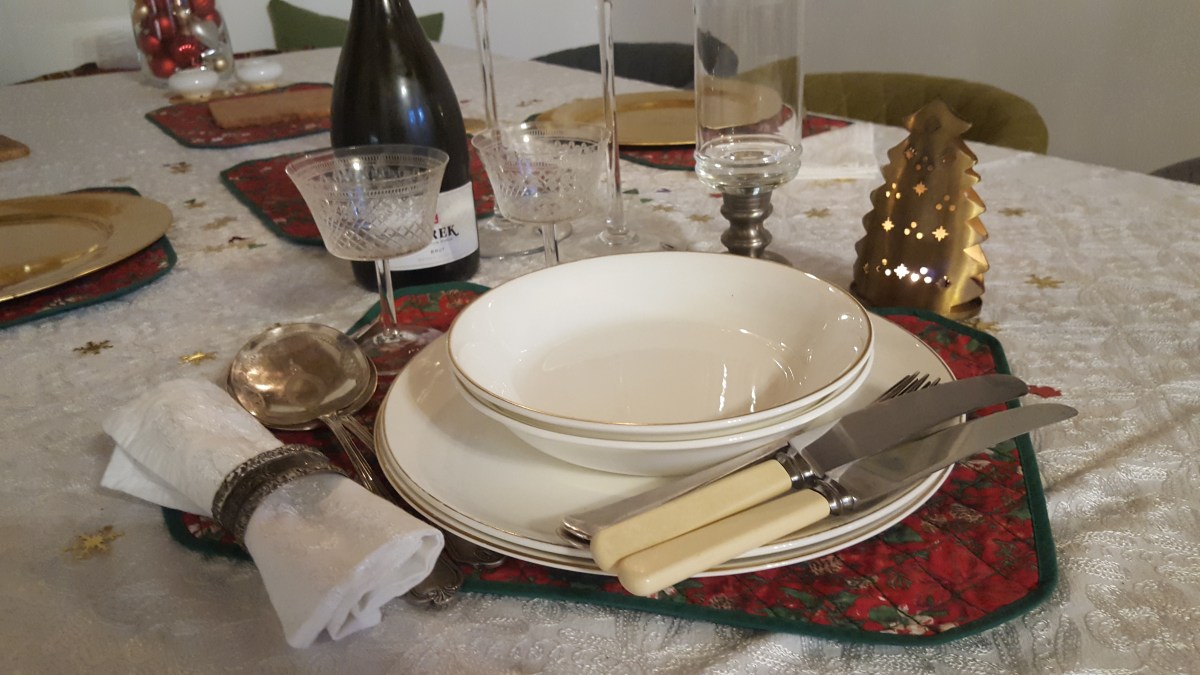
What did much to ease the almost overwhelming sense of absence and loss, though, was in fact ‘stuff’. Our Wedgwood Christmas crockery, we realised over our roast turkey, had been his parents’, the engraved EPNS serving spoons his grandma’s, Mr Blue-Shirt’s beer glass his father’s, my silver napkin ring his mother’s. Among the jumble of battered, mis-matched utensils we had used to cook our lunch had been his mother’s – or mine. Indeed, it occurred to us that our bone-handled cutlery had been my parents’ Sunday-best, and that we had sipped our Christmas fizz from my grandparents’ 1930s, paper-thin champagne coupes.

What we ate and drank from, they had too; what we had touched and held, they had too. It comforted us, it connected us. It brought the past into the present; it made what we had lost feel less distant.

I have always been a fan of William Morris’s golden rule of style: “have nothing in your house that you do not know to be useful or believe to be beautiful”, to which I would now add a third category: …or nothing that you do not recognise to have meaning. For what the likes of Marie Kondo would doubtless condemn as mere ‘stuff’ means the world to us, and we wouldn’t part with it for anything.

Merry Christmas and Happy New Year to one and all.

Pressing Business

So the burning question was: how much oil would we get from this year’s olive harvest? Mr Blue-Shirt had arrived at the oleificio with our freshly picked crop as the purple dusk fell and too late for it to be pressed that day, but in time to find that we had harvested a very satisfying 196kg of olives: just enough for a proper single pressing. Better still, Rodolfo the owner had invited him back to watch the whole pressing process the following morning.

The oleificio we use to get our olives pressed is a small yet impressive set-up in the corner of a sprawling and immaculately kept olive farm down a lane on the way to Macerata. We had found it the previous year by following the recommendation of our neighbour Enrico and the signs off the main road to Morrovalle, the next village from us. Despite the wave of storms that had dragged nearly all the fruit from everyone’s trees in the final critical weeks before the harvest, we had managed to garner just shy of 100kg. Batches under about 200kgs are usually pooled and you end up with a pro-rata share of the resulting oil, but Rodolfo was willing to reward our efforts and run our meagre pickings through the press before he shut up shop for the year. We ended up with an impressive twenty-five litres of oil that Rodolfo had approvingly described as ‘buono’ – good. He had even said that some of our fruit was good enough to cure for table olives. So hopes were high for this year.

“Did you go to Rodolfo’s, then?” I asked the next evening when I got home from work. Mr Blue-Shirt looked at me as if I had lost my mind.
“Was I likely to miss the opportunity to poke around someone else’s workshop? Of course I went!”
“Yes, daft question, I suppose. All that shiny gadgetry: I bet you were in seventh heaven!”
Ever the engineer, Mr Blue-Shirt has never lost his fascination for all things mechanical and is still drawn to practically any kind of machinery like a moth to a flame.
“Tell me all about it then,” I said, lowering my bag of books to the bottom stair and easing off my shoes.
“It was brilliant! He’s actually got a much more complicated set-up than I realised – and all squeezed into a space only about the size of a double garage.”
“Really? When we went there last year, I got the impression he just had the basics so he could do a bit of pressing on the side. He’s mainly an olive farmer, isn’t he?”
“Yes, but with the amount of money that lot must have cost, he’s definitely not doing it just on the side!”
“Do you want a cup of tea? I’m gagging.”
“Yes, please. There were a few old codgers there too – you know the type: all flat hats and leathery faces. They were really friendly, though, and kept explaining to me what was happening in each machine.”

I finished making tea, carried the steaming mugs into the sitting room and settled onto the sofa: this could take some time, for I knew that not the tiniest step in the process will have passed Mr Blue-Shirt by.
“Well, go on then: what did it all involve?”
“Right, so first of all a chap emptied all our crates into one big one that then tipped the whole lot through a stream of air that blew away all the twigs and leaves and so on.”
“I thought you got rid of all the leaves and twigs, though.”
“I picked out what I could, but there was still loads of debris in there that you don’t want to end up in the oil.”
“So where did they go next then?” I asked, sipping my tea.
“Well, the hopper they landed in fed them onto a large round tray. This bit was amazing.”
“What was?”
Mr Blue-Shirt put his mug down and rummaged around in his pocket for his phone.
“I took a video. Look! They still use huge rotating stone wheels to crush the whole olives into a sludgey paste. All that hi-tech everywhere, but it’s effectively the same technique they’ve used for centuries. I love it!”
“If it ain’t broke, don’t fix it, I suppose.”
“Exactly. And then there’s another bit that’s just a modern take on ancient technology: it’s actually an Archimedes screw that feeds the goo into the next machine. A stainless steel one, but look: an actual Archimedes screw!”
I peered at the shaky video that showed the black paste winding through the screw and into the slot-shaped nozzle of the next machine. This spread a generous layer of paste onto a circular mat made of stainless-steel mesh. Mr Blue-Shirt stuffed his phone back into his pocket and took a swig of tea.

“Then the bloke from the start re-appeared: when the mat was fully covered, he lifted it off, replaced it with a fresh one, and threaded the full one over a thick pole mounted on a round plate that sat on a low trolley. By this time, the next mat was ready, so off it came and onto the pole. He went on like that until he had a stack about 1.5 metres high.”
“I’m pretty sure the mats date back centuries too. Carol Drinkwater mentions them in her books about the history of olives. Only they were made of straw or something originally, I think. Anyway, what happened to the stack?”
“Right, then came the pressing itself. The chap wheeled the trolley into a huge press which slowly pushed down on top of the stack of mats.”
“Was the press one of those old things with a great big comedy wing nut on top you sometimes see in farmyards?”
“No, proper hi-tech this time: hydraulic. Four hundred kilos of pressure per centimetre squared,” he declared in full nerd-mode.
“Only you would know something like that!”
“One of the old codgers pointed out the pressure gauge to me,” he grinned. “He told me it would take a good half hour to press all the oil out, too. It just trickles down the sides into a big steel tank in the floor.”
“You surely didn’t stand there watching it all that time, did you?”
“No, not even I’m that much of a nerd! I went to the cashpoint in Morrovalle: Rodolfo doesn’t take cards. It’s strictly cash only.”
“Something else that hasn’t changed for centuries, then!” I observed wrily as I leant over to put my empty mug on the coffee table.

“So what was happening when you got back?”
“Well, the oil is a horrid opaque khaki colour when it drains into the tank – look…” I squinted at a photograph of what looked like a vat of used motor oil.
“Yuk!”
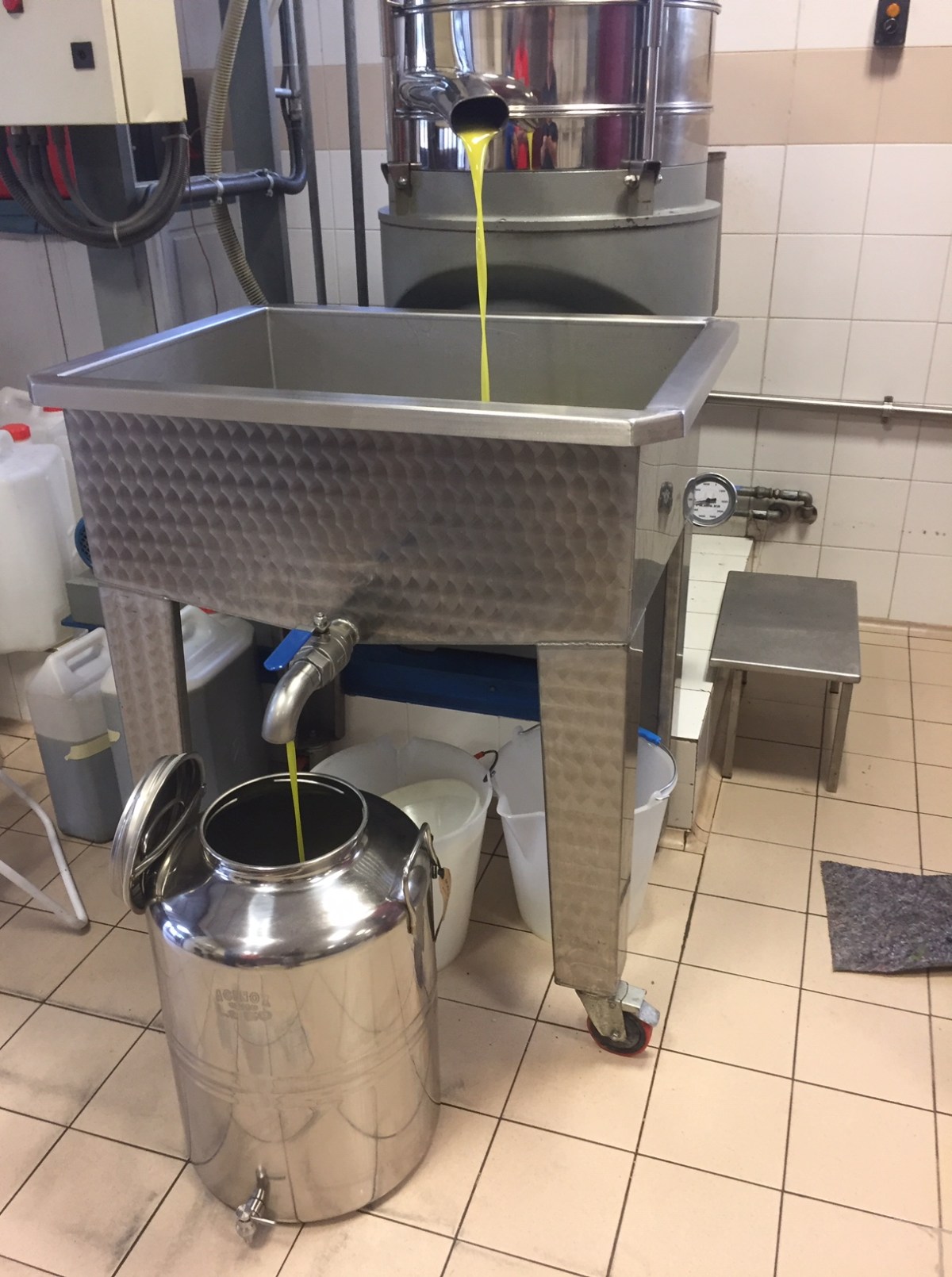
“Yes, there were still quite a lot of solids in there at that point – pulp, skin, bits of pip and so on. So to get rid of them the oil is pumped into a centrifuge that separates the sediment from the oil. It spins at 7000 revolutions per minute, and so when it poured into our flagon that Rodolfo had already positioned below the spout, it had finally started to look like olive oil.”
Mr Blue-Shirt thrust his phone back into his pocket.
“And that was it, done!”
“Wow! It must have been so satisfying to see our oil pouring into our flagon!”
“It was! I can’t wait to taste it, but Rodolfo said we need to let it settle for a couple of days. It still looks a bit cloudy.”
“So go on, tell me: how much have we got, then?” I asked.
“Thirty-one litres!” said Mr Blue-Shirt smiling broadly.
“Oh…”
“What?”
“Well, that’s not much more than last year – from double the amount of fruit. That’s a pretty rubbish yield, isn’t it?”
“That’s what I thought, but Rodolfo says it’s not all about quantity. Apparently, the long, hot, dry summer affected everyone’s yield, and ours was still pretty good.”
“Well, that’s something, I suppose.”
“Yes, but the thing is, all that heat and sun has actually improved the quality of the oil, according to Rodolfo. He reckons it will have a richer and more intense flavour.”
“Really?! Well, that makes me feel loads better! Can we go and take a look?”

Down in the musty gloom of the cellar Mr Blue-Shirt unscrewed the lid of the flagon and shone a torch in through its wide neck. The beam illuminated the fragrant greeny-gold oil that nearly filled the flagon and I inhaled deeply, savouring the distinctive grassy and peppery aroma. I swear I could practically feel the sunshine and hear the crickets. It was not just oil; not just Casa Girasole oil. It was liquid summer…

That time of year again…

We had been um-ing and ah-ing about when to start for some time, keeping an eye on what our neighbours were doing as a signal for when would be the right time. Over the preceding week or so one of us would come in and report that “Maurizio and Flavia have started.” Or “There were stacks of crates outside the place with the goats.” Or “They’ve got nets out next door to the bakery on the way into the village.” With each new sighting, Mr Blue-Shirt went and dusted down another piece of our harvesting equipment. First the bright green nylon floor nets to catch the falling fruit, then the orange plastic rakes about the size of a child’s toy that can be fitted onto poles of varying lengths and with which the fruit is simply combed from the trees, and finally the russet-coloured storage crates (ingeniously designed so that they can either stack on top of, or, if turned round the other way, slot inside each other) in which to take the gathered fruit to the oleificio, the oil press.

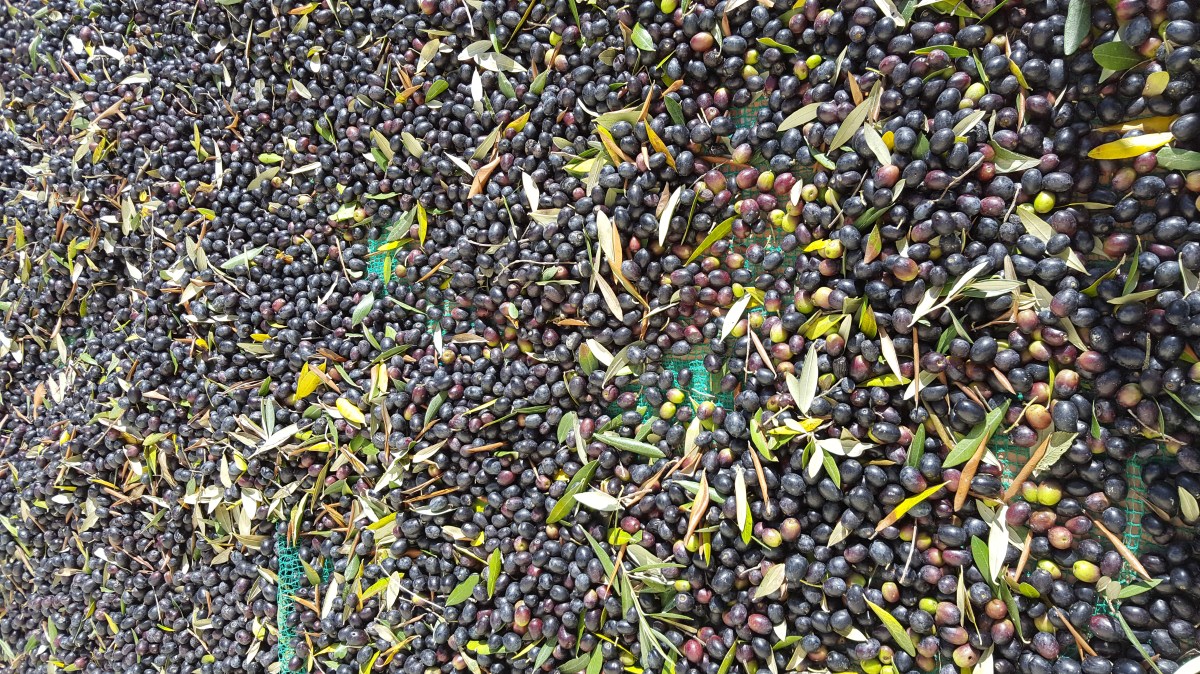
Our olive crop had been steadily ripening beneath the mellow sun of our prolonged Indian summer. The plump bright green fruit had gradually faded to a murky mauve, then darkened to purple, and now to glossy black: thousands of little black beads shining in the sun like fairy lights made of jet. The trees on the northern side that Mr Blue-Shirt had given a good pruning back in spring hadn’t fruited this year, of course, but there was so much fruit on the trees along the eastern side we could see it twinkling among the branches from our bedroom window. And a quick inspection of those along the southern boundary confirmed that they too carried a promising amount of fruit. But as ever it was a matter of judgement as to when was the best time to harvest these little black jewels, and as ever, we had decided to take our lead from what people locally were doing – hence the daily reports on what our neighbours we up to. Annoyingly, however, just when the harvest really seemed to be gearing up and we had decided we would spread our nets out beneath our own trees and get raking the coming weekend, the weather broke. After weeks of uninterrupted sunshine and temperatures consistently in the low twenties, thick grimy cloud suddenly bowled in from every direction, the temperature halved overnight, and rain fell in torrents from slate skies. Days of the stuff, heavy and relentless: harvesting in this was out of the question. Not only would it make a normally enjoyable task extremely unpleasant and mucky, but fruit harvested in the wet would quickly start to rot. And this would mean reduced yield or, if any rotting fruit was not extracted, tainted oil. So Mr Blue-Shirt returned the nets and rakes and crates to the shed and waited for the rain to stop and for the trees to dry out.

It was a good week later that the nets, rakes and crates finally reappeared from the shed, and Mr Blue-Shirt being Mr Blue-Shirt, this time accompanied by both chainsaws, the leaf-blower, the long-reach secateurs, the bolt-croppers, and the decorator’s ladder. Along with the harvest, he wanted to give the badly over-grown, unkempt trees along the eastern border a long overdue pruning and start the process of coaxing them back into their optimum fruit-bearing (and fruit-harvesting) shape. This means keeping them quite short, maintaining a good distance between the branches of one tree and its neighbours (to restrict the spread of pests and disease), removing any dead wood to avoid rot, and taking out most of the growth in the centre of the tree. This helps direct growth to the principal fruit bearing limbs, allows them to get more sun, and provides easier access when it comes to harvesting. The ideal shape to aim for, apparently, is that of a wine glass: a rounded, hollowed-out crown on a short, broad-based stem.

With his supporting cast of tools neatly laid out on the grass, Mr Blue-Shirt strode off to the boiler room for the star of the show, his beloved abbacchiatoro elettrico. This car-battery-powered device consists of a telescopic pole on the end of which is a pair of lightly interlocking rakes that jiggle back and forth like a pair of rapidly clapping hands and tease the olives from the tree as you pass them along the branches. The plastic rakes are all well and good for the lower branches and if the fruit is quite dense as just a vigorous tug will bring the black beads raining down. And there is something almost romantic about the simplicity of using a technology that has hardly changed for centuries. But to get right to the top of the trees, even the shorter ones, and comb through every branch to make sure you’ve got all the fruit, then one of these gadgets makes all the difference. And it’s not just the reach, it’s the speed as well: whatever quantity can be gathered using rakes and ladders will take a fraction of the time with the clappy hands – and with no need for ladders either.

Fortunately, however, we didn’t feel the same need this year to try and locate every last olive. The year before, waves of storms accompanied by raging gales in the weeks running up to the harvest had yanked most of our crop from the trees and hurled it onto the sodden grass below in a rotting carpet of slippery black. In the end, even with the assistance of the clappy hands, we had only managed to fill four-and-a-bit crates: little over a hundred kilos, whereas the year before that we’d got almost the same amount from just five or six of our thirty-eight trees using just our trusty orange plastic rakes.  This year, though, we were confident of achieving a much more substantial crop.

Our confidence had been justified: at the end of several days’ non-stop raking, combing, jiggling, snipping, sawing, sorting and gathering, nine crates brimming with shiny black fruit stood in neat rows on the floor of the van. Mr Blue-Shirt wiped his purple-stained hands on his muddy trousers and picked a few stray twigs from his fleece.

“Job’s a good-un,” he declared and stretched contentedly, rolling his work-stiffened neck and shoulders back and forth.
“Wow! I hadn’t realised you’d got that many! How many kilos do you reckon?”
“Well, we’ll soon find out. I’ll just these tools put away and then I’ll get straight down to the oleificio. I don’t want this fruit to sit around for any longer than necessary.”
And with the tools safely stowed for another year, he slammed the van doors shut, clambered into the cab and trundled off through the gathering dusk, down the hill to Rodolfo’s.

“196 kilos?!” I yelped when Mr Blue-Shirt got home and showed me the receipt Rodolfo have given him.
“Yes, I know! Incredible, eh?”
“But that’s almost double what we got last year! What on earth will we do with that much oil? We’re still getting through last year’s batch.” I gestured to the bottle of green-gold oil standing on the work-surface where I was preparing dinner.
“We don’t know what the yield will be like, though,” cautioned Mr Blue-Shirt. “At the end of the day, it’s how much oil we get from each kilo that counts. And we won’t know that until they’ve been pressed.”
“When’s he doing that, then? I thought you wanted to get them done today.”
“I was too late. He’s going to do it first thing tomorrow. And he’s asked if I’d like to go and watch, so time will tell…”

Perspective

“Let’s take a trip up into the mountains,” I said. “It’s a beautiful day, we’ve got nothing else planned, and we could probably do with getting our heads above the parapet.” For several days following Mr Blue-Shirt’s mum’s funeral we had been hunkered down in the house, sleeping lots and not sleeping lots, talking lots and not talking lots, and generally not feeling up to doing very much at all. I had taken leave of absence from work and all jobs on the house and garden were on hold; we just pottered about, slowly adjusting to this new kind of normal. But I had begun to sense that all this introspection and insularity was at risk of pulling us further down into the darkness, and that we need to start heading towards the light and to breathe the oxygen of purpose and people once more.

“What do you reckon?” I persisted. Mr Blue-Shirt had continued sipping his coffee while scrolling aimlessly on his phone. After a long pause, he looked up at the clock, took a final swig of coffee and nodded firmly. “Good idea,” he said. “Where were you thinking of?”
“I hadn’t got that far. Where do you fancy?”
“I don’t know. I thought you had somewhere specific in mind.”
“Not really.”…
This was typical of many exchanges lately when fatigue and mental fog conspired to make even the simplest of decisions just too much effort. I was determined not to let this one spark of enthusiasm fizzle out in another puddle of listlessness, though. The soft honey-gold sun was tracking across a sky of solid blue, beckoning us out into its mellow warmth.
“How about we just follow our noses and see where we end up? I’ll get the map.”
Mr Blue-Shirt squinted up at the sun through the kitchen window and nodded.
“OK. I’ll clear the breakfast things away and we’ll get on the road,” he said, easing himself from his stool at the breakfast bar.

We headed west and slightly south, directly towards the proud peaks of the grey-green Sibillini Mountains that looked magnificent against the perfect sky, and we could soon feel our mood begin to brighten. The main east-west dual carriageway guided us inland along the flat floor of the busy Chienti valley. But lost in thought once more, we missed our usual turn-off that skirts the eastern edge of the mountains and snakes along to Amandola and Sarnano, from where we normally begin our upward climb. By the time we were able to turn off, though, we were already well into the mountains and immediately found ourselves surrounded by steep wooded hills clad in shades of bronze and copper and gold as we zig-zagged up towards the craggy limestone peaks that jutted into the brilliant blue.

Without realising it, we had also ended up in an area that had been badly affected by the two violent earthquakes that had had struck central Le Marche exactly three years earlier. It was a sobering sight: village after village where dozens of houses, shops and churches still stood shored up by steel girders, or even still in ruins. Indeed, once debris clearance and stabilisation measures had been completed, most places seemed to have changed little since the quakes had occurred apart from the tight clusters of small, wooden chalets that had been rapidly erected on any piece of spare flat land. This was the emergency accommodation that had been provided by the state and whose residents had tried to make them as homely and attractive as they could, with white plastic table and chairs arranged on the narrow verandas and scarlet geraniums tumbling from modest window boxes. There are several thousand people across dozens of communities still living in these simple structures, and a similar number in rented accommodation or staying with relatives (although fewer now living in their campers), all still unable to return to their homes – if, indeed, they ever will be. In larger settlements, shops and businesses, even post offices, schools and police stations continue to operate from Portakabin-type structures in a humbling display of stoicism and determination to get back to normal and to get on with life. And while we both felt distinctly uncomfortable, as if we were indulging in some kind of voyeuristic ‘earthquake porn’, it was clear that these communities were desperate for people to come spend money and help them get back on their feet – and for people to know of their ongoing hardship.

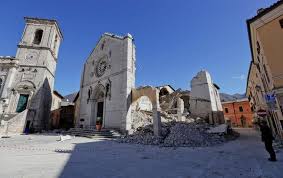
Nowhere was this more apparent than in Norcia, a small, picturesque town that lies on the western slopes of the Sibillini just over the border into Umbria. It had been close to the epicentre of the 5.9 magnitude quake that struck the area at the end of October 2016, bringing down many of the buildings in its historic centre that had already been damaged in the series of quakes and aftershocks that had rocked the same communities in late August. A foodie-heaven, it is famous for its sheep’s cheese and black truffles, and so great is the range and quality of its salamis and cured meats that the collective name for such products is ‘norcineria’. Its historic centre used to be packed with enticing delis and teeming restaurants, and a few are still battling on amid the ruins and abandoned buildings with their broken windows and flapping tarpaulins. Most, however, have long since de-camped to the temporary high street of cabins along one side of the town’s sports field where they are trying to eke out a living. But here in Norcia the stoicism and determination were accompanied by an all-too-evident anger at the lack of assistance from the government. From crumbling balconies and gaping doorways throughout the town hung homemade banners that complained of abandonment and indifference, of being betrayed and being forgotten. And we could see why, for as with other places we had passed through, we were taken aback by the almost total absence of any re-construction work in progress. Indeed, although the whole town bristled with buttresses and braces and scaffolding, the only place in Norcia where work actually seemed to be going on was the 14th century Basilica of St Benedict in the main square.

So apart from feeling the soft sun on our faces and enjoying the spectacular autumn colours, which had undoubtedly done us good, it was not quite the kind of spirit-lifting day out we had anticipated. It had nonetheless done us good in other ways, though, I’m sure. It had made us feel less ‘singled out’ by misfortune, it had turned our inward focus outwards, and it had given us some very valuable perspective. And, I think, might just have enabled us to turn a corner.

More importantly still, it had enabled us to make people beyond Le Marche aware of the wretched conditions in which so many people in the forgotten communities of this beautiful region are still struggling to live and work.

Photo of the Basilica of St Benedict, Norcia: http://www.nytimes.com

Taking stock

So  in normal circumstances I’d be sharing experiences from our life in Italy, or telling you about some little-known aspect of Italian culture. But circumstances remain far from normal, for it is still barely three weeks since Tim’s beloved mum died unexpectedly. And losing a parent remains surely one of life’s most challenging rites of passage; I know from my own experience that no matter how grown-up the child or how elderly or poorly the parent, the shock is immense and the loss immeasurable. So, with minds numbed by shock and spirits dulled by pain, it was a time for reflection and remembering and not for anecdotes or trivia.

A week later and there was still just a tangled mess of words and thoughts and feelings that refused to coalesce into orderly sentences and paragraphs, and that still lay trapped beneath the crushing blanket of sadness that continued to envelope us. Weighed down by sorrow, it felt as if our veins had been filled with lead. Every movement was an effort, every thought a struggle and performing even the simplest tasks became a challenge. The fatigue was overwhelming, but while brief interludes of dreamless, motionless sleep did provide some relief, all too often pain and loss prodded us into prolonged periods of restless wakefulness.

Another week on, and with the rituals and formalities of death now behind us, the long search for a new normality has begun. Sleep remains elusive, so fatigue and mental fog persist. But there is at least some sense that little by little we are starting to find our way out from beneath that dark blanket of sadness and to edge towards the light…

Tilly

And then it struck me: what about Tilly? We had just finished burying her brother Stanley, whose small, stiff body Mr Blue-Shirt had found on the road earlier that morning, his skull crushed by a passing car. By that time, Tilly had already disappeared through the cat flap for another day’s butterfly chasing, lizard hunting and tree climbing, presumably unaware of what had befallen her constant companion and partner in crime. While we were still kneeling in the car port stroking Stanley’s inert form, his thick brindled fur with its ginger-tinged highlights now strangely cold, I thought I glimpsed her dark tabby form among the olive trees a couple of times and I did fleetingly wonder whether she had somehow sensed that something terrible had happened. Poor Stanley and where to bury him had dominated our thoughts, though. Now, as we stood at the spot beneath a small pear tree in the far corner of the garden where Stanley now lay at rest within the crumbly dun-coloured soil, my own sadness at his loss shifted to concern for Tilly and the life-changing effect it would have on her.

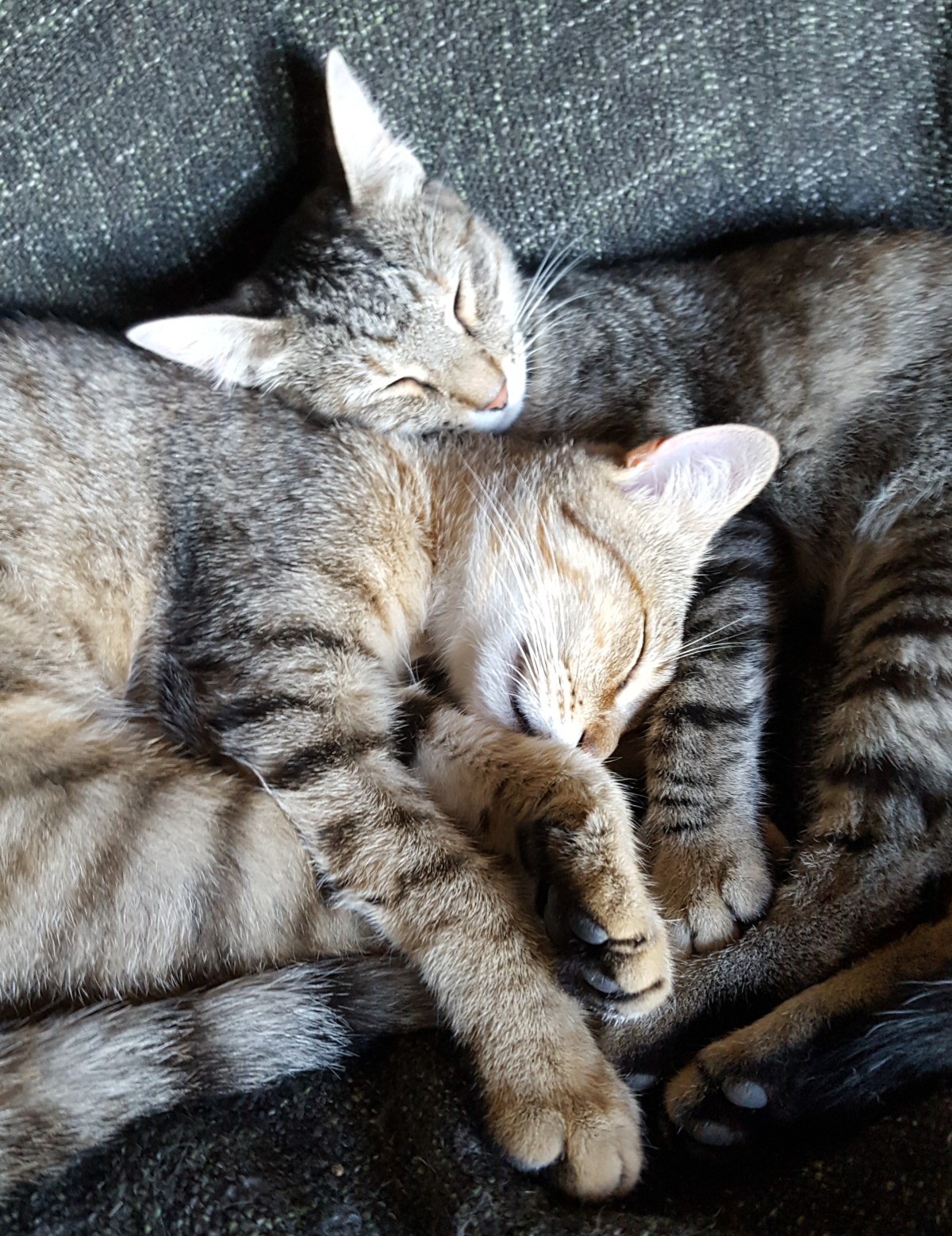
I reckoned that they couldn’t have spent any more than three or four hours apart since they had been born barely a year earlier. As tiny kittens they had suckled together from their mother and developed their cat-craft together as part of an extended family of siblings and cousins. When they first came to us as four- or five-month-old juveniles, they comforted their own and each other’s fears and anxieties at all the unfamiliarity by cuddling up side by side like a pair of tabby slippers in a succession of refuges, peering out at us from two pairs of golden, suspicion-filled eyes. First it was the dining chair in the far corner of the dining room where we spent long spells kneeling under the dining table trying to coax them out. When they had gained a little more confidence, they graduated to one of the armchairs in the snug or the leather-covered stool on the landing, although they mostly still shrank from our touch. As their confidence grew, they started to join us in the sitting room, Mr Blue-Shirt and I on one sofa and the two of them on the other to start with, and gradually allowed us to stroke and scritch them – although not yet to hold or cuddle them. And so it progressed over the tail-end of winter, testing boundaries, testing themselves and testing us – but always as a pair; each always the other’s wingman, back-up, watch-out and fall guy.

It was the same once they were settled in the house and confident in our company and we finally allowed them outside to discover a whole new world of adventure. Straight after breakfast, we would hear the distinctive double ‘ba-dap, ba-dap’ of the cat-flap, and that was them gone for the morning. From time to time we’d catch sight of them galloping across the grass, rolling around on the drive or chasing each other up olive trees. Wherever one was, the other was seldom further than a few metres away, and invariably in hot pursuit. Then once they’d lunched side by side, both munching contentedly from their respective bowls, they’d hop up onto the sofa, give each other a thorough wash, and then cuddle up together for an afternoon nap in an eight-pawed, two-tailed tangle of tabby fur. Having re-charged their batteries, they’d be off again as dusk settled. But by the time spring was turning to summer, they had become sociable, entertaining and affectionate house-mates who sought out our company, often coming to join us as we dined in the garden. While we ate, they would alternate between chasing moths or stalking various tiny rodents and lolling about at our feet, wanting to have their stripey (Stanley) and spotty (Tilly) tummies tickled. Then, as we headed in for the night, the two of them would head off to who knows where for a night’s important cat-business, only returning at dawn when we’d be woken by them calling for breakfast in a duet of urgent miaowing, and the daily cycle would begin all over again.

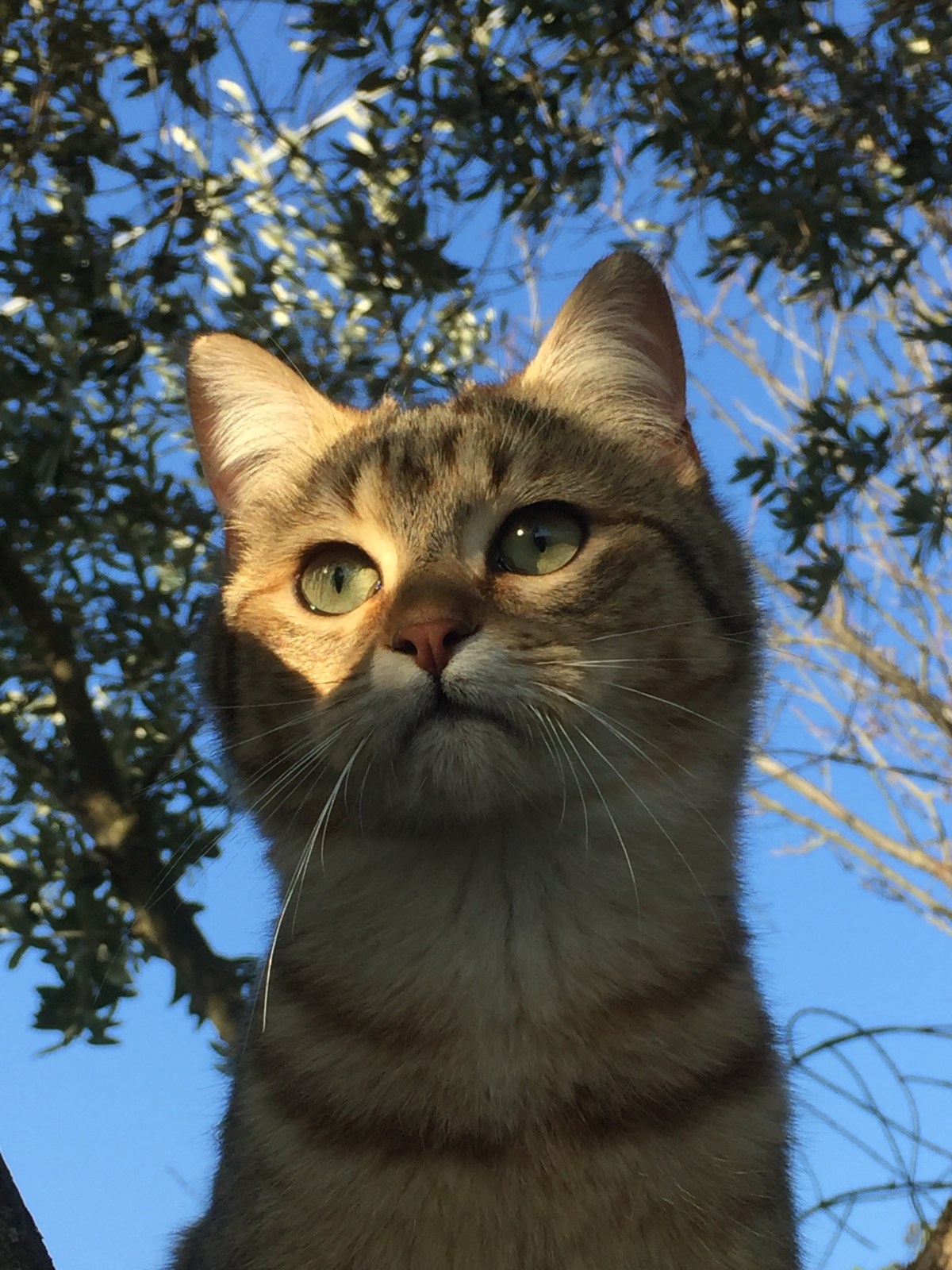
But now Tilly was on her own. She spent much of that first day without her brother outside, surely searching for him in all their usual haunts, and we were worried sick. But as night closed in, she finally re-appeared looking stricken and confused and utterly lost. Our hearts nearly broke for the poor wee creature and we smothered her in cuddles and comfort and did our human best to soothe her all-too-obvious pain. She wouldn’t rest, though. Once in, she roamed the house, systematically checking every room, every nook and every cranny. Into the small hours we could still hear her soft paws padding back and forth across the wooden floors, her mournful calls amplified by the stillness of the night. We lay there, racked with doubt: should we have shown Tilly her dead brother’s body? Should we have allowed her time with him to work out what had happened? But if we had, would she have thought we had taken him from her? By now we were undoubtedly both over-thinking everything and projecting our own sorrow onto her. But one look at her sweet little face with its long white whiskers and distinctive black ‘M’ between her huge golden eyes and her distress was plain to see.

And so it has gone on, night after night. We’ve been terrified that she might disappear altogether; just head off into the fields in a never-ending search for her brother and soul mate. To our huge relief, though, she has continued to come home and seems to find some comfort from all the extra attention we are giving her, inadequate though it seems.  She still patrols the house, however, and still calls for Stanley. And when she receives no answer, she once more seeks refuge on that dining chair in the far corner of the dining room, the same armchair in the snug or the leather-covered stool on the landing. She sniffs the last traces of Stanley’s scent, curls up, and continues the endless wait…

Stanley

“He’ll come bowling in any minute now,” said Mr-Blue-Shirt and bit into his toast. “… nearly bringing the cat flap off its hinges as usual”.
“Yes, with that wide-eyed look that shouts ‘have I missed breakfast?’” I said.
The cats nearly always eat together, Stanley on the left, Tilly on the right, one bowl each. Before they arrived with us, they were effectively semi-feral and had always had to compete with a dozen or more siblings and cousins for every scrap of food and meal times were initially a total feeding frenzy. After a few weeks, though, we managed to convince them that this was their food, no one was going to steal it from them and so they didn’t need to fight over it or eat it all at once. Mealtimes gradually became a lot less frantic and a lot less messy with each of them crunching contentedly at his and her own bowl of biscuits.
“Tilly will have told him she’s had hers so he needs to get a move on if he’s not going to be too late for his,” continued Mr Blue-Shirt, sipping his coffee. Anthropomorphise? Us?

It was Saturday morning so we were lingering over our own late breakfast before getting on with the weekend errands and chores. As usual Tilly had been at the bedroom door calling for breakfast as soon as she heard us stir. And as usual, Mr Blue-Shirt had fed her while making our morning tea. Then, still licking her lips, she had disappeared through the cat flap for another day’s butterfly chasing, lizard hunting and tree climbing. He hadn’t bothered to open the back door and call Stanley or rattle the biscuit jar as over summer he had taken to staying out longer than his sister. So we knew that before long we’d hear the distinctive ba-dap of the cat flap opening and closing and Stanley would appear, squawking loudly and looking slightly panic-stricken, for all the world like a hotel guest who thought he’d overslept and had come dashing down to breakfast before the restaurant closed.

We cleared away the coffee pot and jam jars, put some food down for Stanley and headed off in different directions to start on our respective job lists. Mr Blue-Shirt strode out to the shed that, with the pigsty gone,  now serves as a makeshift workshop, ready for a morning’s woodwork (the first section of the pergola for the southern section of terrace) while I trotted up to my study to catch up on some paperwork and prepare my lessons for the first part of the following week. With Radio 4 burbling gently in the background, a light breeze carrying the distant clatter of a tractor in through the open window and my desk covered in papers, I was soon absorbed in the daily task of completing my online class registers. So it was with a slight start that I became aware of Mr Blue-Shirt coming up stairs. Something was wrong, though. His tread was slow and heavy, as if he was carrying a great burden, and when he appeared on the landing outside my study, his face was grey and drawn.
“What’s up?” I asked. “Have you had an accident?”
He shook his head, swallowed hard and took a deep breath.
“Stanley’s dead.”

“What??” I’d heard what Mr Blue-Shirt clearly enough; I just couldn’t take it in. “Where? How?”
“A car got him. He was out on the road.”
It had been our abiding fear. Although the road is quiet, what little traffic there is is fast-moving and with their tabby stripes, both Tilly and Stanley are – were – is – extremely well-camouflaged.
“What? Just now? I didn’t hear anything.”
“No, it must have been during the night. He is quite cold.”
“I thought you were in the shed.”
“I was opening the gate. I need to go down to Civi to get some bits from OBI. I saw him straight away lying on the road.”
I winced. “Is he badly damaged?” My voice caught in my throat.
“No, thank goodness. It must have been a glancing blow. It will have been quick.”
“Where is he now? Another car might hit him.”
“It’s OK”. Mr Blue-Shirt had caught the anxious note in my voice. “I’ve brought him in and laid him in the shade in the car port. He’s quite safe. Do you want to come and see him?”
“I don’t know. I…” the words wouldn’t come. My throat tightened and tears sprang in my eyes. I stood up from my desk and wrapped my arms round Mr Blue-Shirt.
Another loss. Yet more taken from us. When will it stop?”
My tears flowing freely now, I sobbed into his saw-dust sprinkled chest while he stroked my back with one hand and wiped the tears from his own eyes with the other.
“I know, I know. It’s so bloody unfair. Poor little chap.”
After a few moments we released one another.
“What do you want to do, then? We can’t leave him in the car port.”
“No. But I do want to see him and say goodbye.”

Mr Blue-Shirt was right. There were no gaping wounds, no oddly-angled limbs. He was lying on his side, legs outstretched, mouth slightly open. From a distance you might think he was just snoozing in the shade. But close up, you could see that his head was slightly flattened and that he had already begun to stiffen. I knelt down beside him and stroked his thick brindled fur with its ginger-tinged highlights. It was strangely cold, and his small body was so utterly lifeless. No deep throaty purr, no languid yawn, no slow wriggle over onto his back to have his honey-coloured tummy tickled. Our dear, gentle, playful, loyal and oh-so-lovable Stanley had well and truly departed.

“Have we got an old pillow case I can put him in?” asked Mr Blue-Shirt, trying to be business-like. “I’ll get going on a grave. Where do you think we should put him?”
He sniffed and thrust his red spotty handkerchief back into his pocket.
“I thought maybe somewhere in the olive grove. He loved to play there and climb the trees.”
“With Mimi,” I said. “He loved to play everywhere out here. We can’t keep making little cairns all over the place either.”
My throat constricted once more. “And I know it’s silly, but I don’t want him to be alone.” Fresh tears spilled onto his tawny coat.
“No, it’s not silly. That makes perfect sense. With Mimi it is. I’ll get a spade.”
And with that, he was off to the far corner of the garden that catches the early morning sun and the spot where Mimi lies beneath the small pear tree that looks across to village and down to the sea.

We must have made a strange sight: Mr Blue-Shirt and I, together solemnly bearing a small, pale blue bundle across the drive and down past the legnaia to the freshly dug hole. We gently laid him on top of Mimi, still in her own pillowcase shroud, and neatly tucked him in – daft, I know, but… Then we bade him one last farewell and carefully re-filled the grave and rolled back into place the large stones that mark the spot and keep it safe from foxes and porcupines.

And then it struck me. “What about poor Tilly?”